

Table of Contents Show
The name Arkham carries a lot of weight in the modern Batman mythos. As home to many of Batman’s most notorious villains, Arkham Asylum has attracted the curiosity of fans and creators alike since its introduction in October of 1974,1 with many stories attempting to explore the infamous location — and its inmates.
Most notable of these stories is Arkham Asylum: A Serious House on Serious Earth (1989), written by Grant Morrison and illustrated by Dave McKean. Morrison’s story centers on Batman as he confronts an ensuing riot within Arkham, encountering many of his famous rogues, like The Joker and Two-Face. Meanwhile, A Serious House also delves into the backstory of the Asylum’s founder, Amadeus Arkham.

A Serious House on Serious Earth would serve as the biggest inspiration for 2009’s Batman: Arkham Asylum, the first of the successful Arkham video game franchise, developed by Rocksteady Studios. Like the novel, Batman: Arkham Asylum focuses on Batman being trapped in Arkham with his villains.
Amongst other things, Arkham Asylum has been lauded for its use of environmental storytelling. Details scattered around the game give hints not just to the asylum’s past, but to Batman foes not physically present in the game. Several of these villains find their origins in another Arkham-centered story: 2003’s Arkham Asylum: Living Hell, a six-issue mini-series by Dan Slott and Ryan Sook.
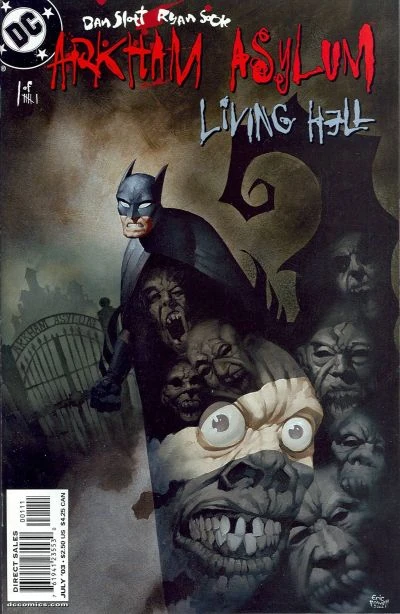
Shifting focus from Batman, Arkham Asylum: Living Hell explores the effects of life in Arkham through the perspective of its inmates and staff. While not as well-known as A Serious House, Living Hell’s influence can be felt in the world of Batman: Arkham Asylum, with several characters lifted from the pages of the comic. Their inclusion is more than an Easter Egg; it provides direct insight into the way Asylum portrays Arkham, painting it as a place which worsens its populace instead of heals. It is in the game’s environment — and Batman’s role in relation to it — that Arkham Asylum is able to achieve this.
“The Inmates Are Running The Asylum:” Staff, Patients, & The Revolving Door Of Arkham
Arkham Asylum: Living Hell shifts primarily between two main storylines. The first involves Warren White, a corrupt stockbroker sent to Arkham on a false insanity plea, where he is violently harassed by the inmates. The second deals with Jason Blood, vessel for the demon Etrigan, as he investigates a series of ritualistic killings in Gotham. It is the former rather than the latter which is most relevant to the story of Batman: Arkham Asylum, as White’s plotline examines what happens when an “ordinary man” is sent to Arkham.
White’s status as an outsider, or the new “fish,” as he’s referred, serves to make Arkham feel more dangerous. More than that, it emphasizes the transformation White undergoes as a result of his time in the asylum. Physically, he’s altered. He loses his ears, lips, and hair after being locked in Mr. Freeze’s cell. Mentally, he becomes a supervillain himself by the story’s end — “The Great White Shark,” to match his new appearance.

Through White, the reader is introduced to several notable staff members of Arkham: psychiatrist Dr. Anne Carver, security guard Aaron Cash, and Jeremiah Arkham, head of the asylum. Like White, Arkham has changed them in different ways. Carver struggles to maintain a social life outside of work, though her case differs in that it’s not actually the real Carver the reader is introduced to.
Two months prior to the events of Living Hell, Carver was murdered by the serial killer Jane Doe, who assumes her victims’ identities. This detail doesn’t change the fact, however, that Arkham had consequences for Carver — the asylum literally replacing her.

For Aaron Cash, he lost a hand during an incident with Killer Croc, leaving him terrified of the villain. Cash grieves for Carver, for whom he harbored feelings, and blames himself for her death. If the comic has a hero, it might be him. Cash’s role in the story, eventually facing the supernatural “B plot” of Living Hell, shows that even in the most absurd of situations, Arkham runs in a “business as usual” type fashion.
Jeremiah Arkham is a smaller character in the comic, but like Cash, he provides insight into the administrative side of Arkham. His communication to staff (told through “email” messages in the comic’s captions) is cold and impersonal, especially regarding Carver’s death. At one point, he laments that silence at the asylum is more concerning than the chaos, as there’s “always some idiot on the phone with some new problem.”2

Jeremiah Arkham’s comment suggests incidents aren’t just commonplace at Arkham, they’re expected, which reinforces the typical portrayal of the asylum, that being a “revolving door” where criminals come and go. What’s new, though, is seeing the impact of these incidents on staff, giving that “revolving door” some actual weight. In fleshing out its world, Batman: Arkham Asylum would paint a similar picture.
From Page To Game
“Our staff are here to help you,”3 says a cheery voice through the asylum intercom in Batman: Arkham Asylum, directing players to check out Arkhamcare.com for a breakdown of the asylum’s healthcare packages. It’s intentionally (and darkly) humorous, and a stark contrast to the dilapidated environment the Dark Knight traverses in the game. It’s also one of the first hints that Arkham’s corporate-like front doesn’t match its reality.

Like Living Hell, the Arkham Asylum of the game is no stranger to violent incidents. Despite “heavier security measures”, Joker is able to easily escape in Asylum’s opening, taking control of Arkham and setting the game’s story into motion.
As Batman works to stop Joker, the hero encounters much of Arkham’s staff — guards, doctors, and the asylum’s warden, Quincy Sharp. Being NPCs, the player is able to interact with these characters and hear their reactions to Joker’s takeover. As the night progresses, Batman saves many, while others are slain by Joker and his men.

Amongst the staff is Aaron Cash, sporting a hook for a hand. His inclusion is more than a nod for the fans; it gives players a name to latch onto. Tiny details such as this help Arkham staff avoid feeling like faceless victims.

In Arkham Asylum, the player can find “interview tapes,” which are recorded sessions between Arkham’s doctors and the villains of the game. While implied within the game, Killer Croc’s audio tape directly depicts the events after the villain consumes Cash’s hand. The event clearly spells out the dangers of working at Arkham.
In fact, in most of these interview tapes, the doctors in some way fall prey to the villains, such as becoming a test subject to Scarecrow, targeted by Victor Zsasz, or being seduced by Poison Ivy (whose design in the game bears some resemblance to her appearance in Living Hell). The whole narrative of Asylum hinges on the inmates taking advantage of the staff, with Joker tricking Dr. Young into supplying him with the TITAN formula. This manipulation is more than a little reminiscent of the way Jane Doe is able to replace Dr. Carver in Living Hell.
By drawing attention to Arkham’s staff, Living Hell and Arkham Asylum are able to flesh out characters like Cash as both victims of the asylum and cogs in its (very dysfunctional) machine. Details like the audio tapes create an Arkham which exists outside of Batman, as though everything functions even without the hero present. In this, Batman: Arkham Asylum tells a story in the background of its main narrative, but it’s one just as important for studying its titular location.
“Stories In The Walls” — How Arkham’s Unseen Villains Reveal Its Reality
Most of the villains encountered in Batman: Arkham Asylum are core members of Batman’s rogues gallery: Joker, Harley Quinn, Killer Croc, Scarecrow, Poison Ivy, Riddler, and Bane. Asylum capitalizes on the player’s familiarity with these villains to imply a past without directly showing it. This, coupled with voice actors which carry over from Batman: The Animated Series (1992-1994), such as Mark Hamill as The Joker and Arleen Sorkin as Harley Quinn, allow the game to fill in the blanks of their history with Batman.

Any villains who didn’t make the cut are made easter eggs. For instance, the player can find The Penguin’s umbrella or Catwoman’s goggles. Scanning these items results in the unlocking of a “character bio,” an illustration and a list of factoids about that character.
These bios serve to further expand Batman’s world, giving his villains a presence in the game even if they don’t physically appear. It’s also a chance for Rocksteady to feature more niche Batman villains, such as Killer Moth or Maxie Zeus. Two villains from Living Hell receive bios in Arkham Asylum: The Great White Shark and Humpty Dumpty.

To unlock The Great White Shark’s bio, the player must scan a jar of body parts — remnants of Warren White’s face. For Humpty Dumpty, it’s a pile of broken toy soldiers.

In Living Hell, Humpty Dumpty is an inmate named Humphry Dumpler, an obese man who takes an interest in Warren White. Per his namesake, Humpty Dumpty is obsessed with taking things apart in order to put them back together. This obsession leads to him killing his abusive grandmother, trying to “fix her.”

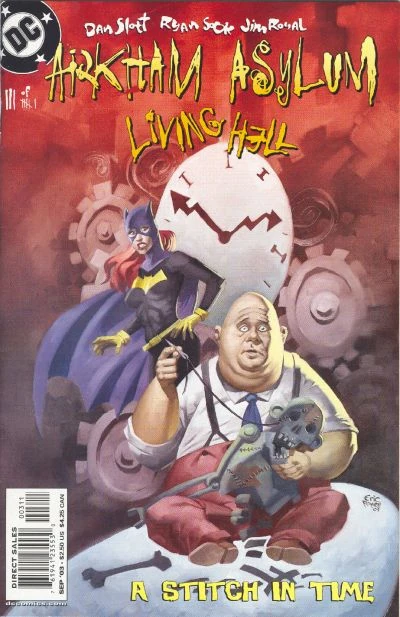
These details show more than just an awareness of obscure Batman villains. Arkham Asylum directly acknowledges their origins from Living Hell, and the psychology behind these characters. The result is an Arkham which feels bigger — and stranger — than the game itself, like Batman has a past with all these villains, even the strangest members.
Batman’s rogues gallery is in many ways purposefully absurd. Living Hell recognized this through both familiar foes and villains created specifically for the comic, such as Doodlebug, Death Rattle, and Junkyard Dog, an inmate obsessed with trash. On one level, it’s comedic. On another, it shows one can craft a narrative through implication. Here, that narrative could boil down to: only supervillains can thrive at Arkham.

Between a crumbling environment, a staff that’s either endangered or oppressive, and villains festering in every corner, Arkham Asylum and Living Hell tell the same story: Arkham makes people worse, not better. Written in direct contrast to this idea, however, is Batman himself.
The Sane Man, The Crazy Man, & The Batman
While lacking the fear Warren White shows in response to Arkham, Batman is nevertheless still the outsider character in Arkham Asylum. But where White ultimately succumbs to the asylum’s madness, Batman doesn’t.

But what does it mean to be Batman, especially in relation to Arkham? Living Hell makes an attempt at an answer. During his initial confrontation with Jane Doe, Batman asks if she’d enjoy taking his place, stating: “As Batman, you would fight [madness] every night of your life. It keeps coming back at you. And you can never stop.”4
If Arkham is indeed a “revolving door”, then Batman is continually on the receiving end of it, experiencing his own repetitive cycle. In Arkham Asylum, there’s an almost cynical edge to the character which contrasts from how the doctors treat the inmates, especially killers like Zsasz and Joker.

Batman has been through the motions before, clearly. However, he hasn’t let that worsen him. That’s the biggest difference between an Arkham story told from any other perspective and one told from Batman’s — the hero is meant to overcome.
Even if Arkham is a “living hell,” Batman emerges from it. In this way, the asylum emphasizes the divide between Batman and his villains. Maybe that’s why so many stories have thrown the hero into its walls.
The Legacy Of Living Hell
Arkham Asylum is made with an awareness for Arkham’s history — its origins, its inmates, and what it all means to Batman as a character. But for all their thematic similarities, Arkham Asylum is far from a 1:1 adaptation of Living Hell.
Instead, Asylum uses its source material, Living Hell included, as a foundation for its own world, filling the asylum walls with tiny details that make the location feel lived-in and operational.

Asylum’s worldbuilding ranges from exchanges between Batman and Arkham staff to references to various characters across the Dark Knight’s history. When it comes to the characters taken from Living Hell, their presence shows that the game has adopted from the comic a similar focus on the asylum’s effects.
Arkham Asylum victimizes staff and inmates alike. Those who enter, like Warren White, are only made worse by being there. The exception to the rule is Batman, who continually faces the products of Arkham.

Trading away Living Hell‘s supernatural horror, Arkham Asylum’s title location is more a metaphorical hell on Earth than a literal one, but thanks to the game’s strong environmental storytelling — and the history it implies between Batman and his villains — Batman: Arkham Asylum feels no less haunted.