
Table of Contents Show
One can glean surprising insights about a person based on their answer to the question, “What’s your favorite Barbie movie?”

For many, the response likely falls within the sixteen computer-animated films released between 2001 and 2009 — beginning with Barbie in the Nutcracker, directed by Owen Hurley in 2001, and concluding with Barbie and the Three Musketeers, directed by William Lau in 2009.
While these films were neither Barbie’s debut nor her final appearance on screen, they possess a distinct cultural resonance among many young adults today: nostalgia.

For many Barbie fans in their twenties, revisiting these films offers a gleeful — if fleeting — return to early 2000s childhood, complete with the era’s distinctive aesthetic quirks and stylized excess. Though undeniably dated, it is precisely these idiosyncrasies — enthusiastically embraced by the Barbie franchise — that lend the films much of their enduring charm.
At the same time, these decades-old animations, which oscillate between the whimsically enchanting and the unintentionally uncanny, may offer more than nostalgia alone; they invite reflection on how cultural memory, visual storytelling, and even the limits of early CGI have shaped contemporary media sensibilities.

Yet there is another dimension to the Barbie films’ animation style that sets them apart from much of children’s media: their deep engagement with dance — particularly ballet. This focus is perhaps not coincidental. In many ways, Barbie occupies in the world of toys the same symbolic space that ballet holds in the realm of dance: both are sites of tension between commercial appeal and artistic aspiration, rigid gender roles and the desire for autonomy, prescribed perfection and personal expression.
These dualities continue to shape the evolving legacies of both Barbie and ballet. Examining how the two intersect in these films may, therefore, offer insights obscured by nostalgia — insights that speak to larger cultural negotiations between aesthetics, identity, and meaning.

A close analysis of a single dance sequence from a single film — Barbie in the 12 Dancing Princesses (2006, dir. Greg Richardson) — reveals just how layered these texts can be. The limitations of early 2000s computer-generated animation render ballet in a style that closely mirrors the experience of children manipulating physical dolls: movements appear stiff, with a manufactured sense of vitality and flawless precision.
Yet within this stylized mimicry lies a complex interplay of fantasy and reality. The film’s aesthetic choices — intentional or otherwise — surface enduring tensions between escapism and idealization, individuality and conformity.
These themes, embedded in a seemingly simple animated performance, resonate powerfully with contemporary cultural concerns around identity, representation, and the pursuit of perfection.
Unreality And Perfection — Analyzing Movement In Animated Ballet
While generally accurate, the technique and choreography suffer from a lack of weight and musicality, creating a dissonance between the perfection of form and the lifelessness of the spirit. This dissonance creates a sense of unreality that questions the nature of perfection.
A Brief Movement Analysis
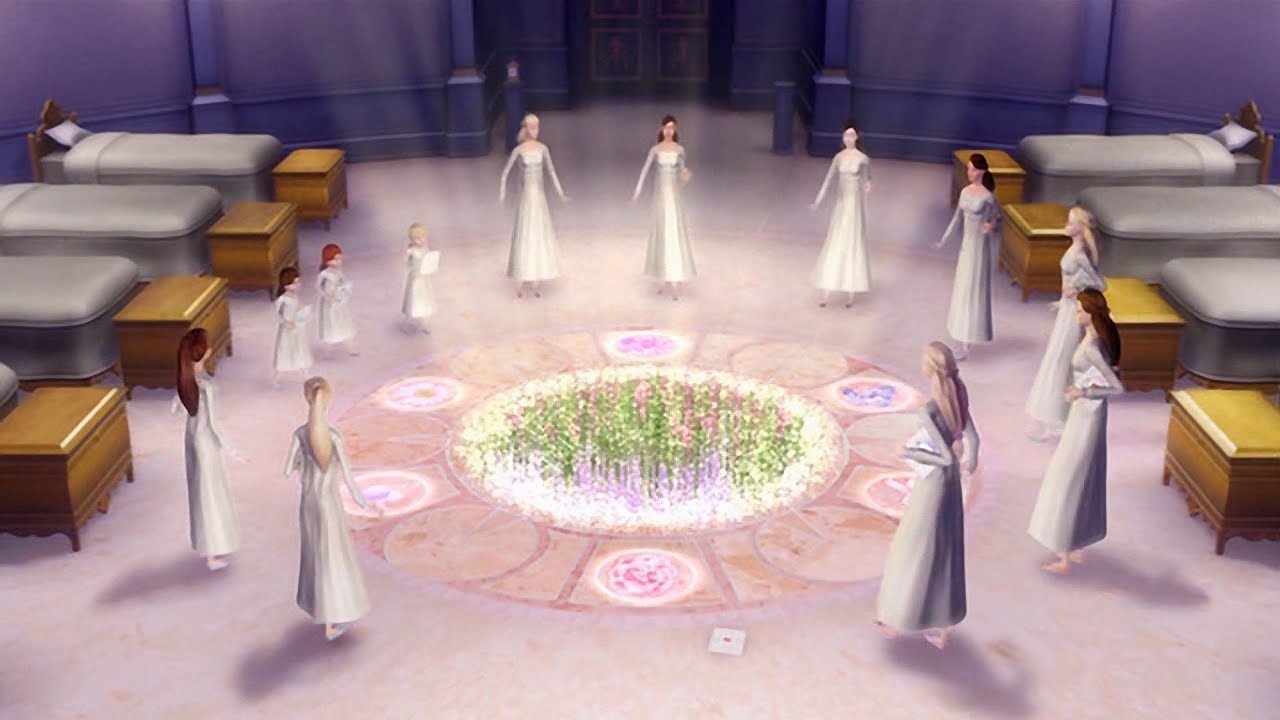
For those familiar with the plot (though it is less relevant to this discussion), the dance sequence in question here is the second time the princesses travel through the portal in their bedroom to dance in a magical land.
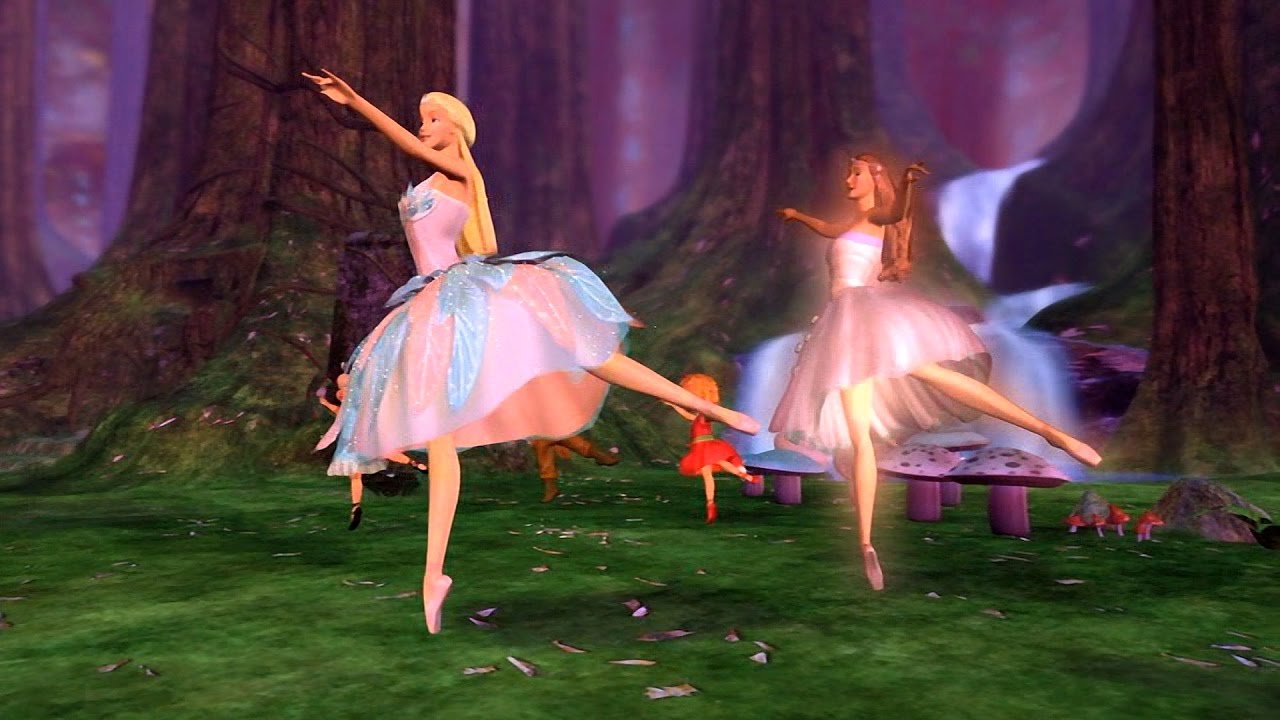
The movement vocabulary of the sequence is dominated by tour jetés, sauts de chat, chaîné turns, and hops on relevé — that is, large, traveling leaps, continuous turning sequences, and jumps executed while the dancer remains elevated on the balls of the feet or fully en pointe.


The sequence is dominated by unison, meaning they all dance the same step at the same time. While the princesses occasionally break off into smaller groups, they typically dance together in groups of at least three — there are no solos in this scene. Dancers travel in straight lines across the space as opposed to arcs or erratic pathways, and the formations emphasize quantity, with one or two straight lines featuring all twelve of the dancing princesses. No one is highlighted, and no one is left behind.

These elements alone make the viewing experience almost trance-like as each of the twelve princesses bounds and twirls together across the magical realm. What is most pertinent, though, is not what they do but how they do it. Their bodies are floaty and almost inconsequential, lacking any real weight behind their movement. While their timing is not egregious, there is a complete divorce between the dancing and the music, a sin in terms of the dance arts across styles. Indeed, this lack of weight and musicality is arguably Barbie’s greatest shortcoming in her portrayal of dance.
Dancers In Wonderland — Unreality Through Movement And Presentation
Artistic faults aside, the cloudy weightlessness and relationship to music are critical in creating a sense of intangible unreality, but they are not the only contributors. The cinematography is surprisingly ambitious for what one might expect from the film; the camera is always moving, gently sailing across the realm along with the dancers.
It never holds one angle for long and continuously searches for new perspectives from which to capture the elegance of the princesses. Similarly, the editing discourages a perception of the dance as a cohesive whole. Each cut interrupts the choreography of any given moment and quickly flickers to the next shot so that no phrase is given a proper beginning or end.

This may sound like an indictment, and from a dance perspective, it is, but its effect rather contributes to the whimsy of the trance and unreality that animation is particularly well-suited to engage. The unreality of the scene is further heightened by the dancers’ apparent weightlessness, alongside cinematography and editing that construct a meticulously controlled visual arrangement — one that privileges transient moments of aesthetic pleasure and idealized beauty.
The dancers’ traveling patterns are smooth and linear, while the choreography — and their execution of it — is lofted and wispy. The camera angles are rounded and enticing, and the editing permits one to enjoy these qualities in only small doses. Rather than allow the audience to ground themselves in a stable and realistic dance performance, the film encourages viewers to indulge in the beatific elegance of the dancers, however evanescent. This evanescence, in fact, along with the lack of consequence discussed earlier, are the primary contributors to the film’s unreality.
Perfectly Imperfect Or Imperfectly Perfect?
It is worth returning to the dancers’ technique in this segment because, as it occurs in an unreality that emphasizes control and beauty, one would think that such a technique would be perfect. After all, the filmmakers used motion capture in collaboration with The New York City Ballet, and animators ultimately possess control over the final product. The technique, then, should be perfect.
And yet, the perfection that ballet often seems to demand is not the full story. The dancers’ port de bras, or use of arms, is genuinely difficult to watch, as are their tense shoulders and bent knees. In addition to the integrity of their pointe shoes being questionable at best, they frequently fail to arrive completely over the box of the shoe (that is, fully en pointe), and their toes fall considerably short of completing the line of the foot and leg.


Further evading perfection is the dancers’ timing or, more thoughtfully put, relationship to the music. While there are artistic choices to be made in dancing on the front-end or back-end of the rhythm, the issue here is a lack of awareness of the music. This makes sense — these are CG animated figures dancing with independently recorded music laid on top, not real humans genuinely responding to live music. Still, this relationship to music is important to dance, and when it is absent, there is a notable impact.
While the dancers’ technique and timing in this unreal dream world leave much to be desired, the dancers’ hypnotic unison and weightless control are perfect in no uncertain terms. While we will return to this construction of perfection later, it is first worth delving deeper into the notion of unreality as it manifests in children’s animation.
Creation Over Escapism — Children As Co-Creators Of The Barbie Universe
In his 2006 book The Fundamentals of Animation, author Paul Wells writes, “Animation can offer a different representation of ‘reality’ or create worlds governed by their own codes and conventions that radically differ from the ‘real world.'”1 The nitpicks of classical ballet technique, then, are completely obsolete, as the film operates (as most animated films do) on its own “illogical logic,” as Wells describes it.2
It is this phrase — illogical logic — that best describes the movement aesthetic of the princesses in this film. While they may not resemble the conventions of ballet in the real world, they do resemble a world that is all too real to the target audience: children’s play.

Stiff, controlled, and weightless, the dancing in Barbie in the 12 Dancing Princesses may be condemned in classical ballet spaces, but it is loyal to the way a child might actually bring the scene to life with their own dolls. Rather than trying to create a world all their own, the animators instead allude to the world of children’s imagination and making.
In so doing, child viewers are then invited into the film not only as spectators of an adult-made creation but as active participants in their own dream world. In other words, by animating the dancing as a child might do it with their physical dolls, the animators are not saying We have brought Barbie to life for you, but rather, You have brought Barbie to life for us.
In creating worlds, as Paul Wells suggests, and bringing characters to life, as children do during playtime, animators take on an elevated role in relation to their creations: gods. Robby Gilbert, Assistant Professor of Visual Arts and Animation at Northern Vermont University, wrote as much in a 2018 blog post3:
“It seems no coincidence that the early animators showed their hands in the creation (and sometimes destruction) of their animated characters, representing themselves as “gods” of an infinitely regressing and simultaneously expanding universe where they could…breathe life into form and become the ultimate arbiters of life and death. Animation’s vexed relationship with truth and its formal composition allows the artist/philosopher to work in an applied practice of philosophy, where questions of reality, mortality, illusion, relativity, space, time, and the unknown can be explored and manipulated as materials.”
While Gilbert takes a philosophical approach, his argument also applies to children as gods in regard to the film and their dolls. Their relationship to truth is similarly vexed, and the playtime which the film simulates is exactly the kind of exploration and manipulation that Gilbert references. Philosophical questions, even for children, are examined as materials — more specifically, as dolls.
Children As Philosophers — Playing With Big Ideas In Little Worlds
It is a tall order to view child audiences as gods in the Barbie Cinematic Universe (as one might call it), but it has several important implications in a variety of frameworks. One such implication is, of course, control.
Admittedly, the idea of control is something of a farce in the ephemeral art of dance, so its prevalence in the dance sequences here in Barbie could be given further dialogue in dance studies.

Additionally, granting children control via their role as animators/gods in the film is notable. Kids tend to have very little control in their own lives, so such a dynamic could explain part of the film’s underlying draw. What is most relevant to the discussion, however, is the value of creation over escapism.
Regardless of intent, the animators take children’s real-life play patterns and transport them into this fictional unreality. Children’s ideas of a perfect and beautiful dreamland are taken from the very reality which they may very well like to escape.
Perhaps, then, this dream realm and reality are not so different after all. In imitating how children play with dolls, the film (whether intentionally or not) makes children honorary contributors and emphasizes their role in creating the world rather than merely escaping from the one in which they live.
Granted, escapism is not a wholly bad aim or achievement. Indeed, all of the animated Barbie movies benefit from their audiences looking for an escape. In a subreddit thread about Barbie in the 12 Dancing Princesses, one user writes about what draws them to the film:
“The music and also disappearing to a secret world that manifests what you want into existence certainly helped too.”4
But even with the acknowledgement of the potential for escape, the user also identifies the focus on creation as a primary draw. While it is in reference to the specific plot of Barbie in the 12 Dancing Princesses, the drive to create is still relevant.
The final implication to consider brings us back to the ways in which the film’s depiction of dance functions as a construction of perfection. As described earlier, there is a striking dissonance between the imperfection of the performance quality and technique and the perfection of the dancers’ unison. What does this say about the film’s perception of perfection?
Picture Perfect — Finding Balance Between Individuality And Unity
Despite the potential for animation to portray flawless physical technique and performance, the dance sequences in the Barbie films express perfection through the unison of the twelve sisters, suggesting that what we as humans should strive for is not necessarily impeccable execution but social togetherness.

This idea can be taken further into discussions of individuality and community. In the film, dance is used as a vehicle for togetherness among the twelve princesses, each of whom has a unique personality, interests, temperaments, and, of course, color schemes. The same Reddit post cited earlier touches on this as well:
“Although my passion lies with Princess and the Pauper, the 12 dancing princess [sic] really ticked something in my child brain. I used to stare at the doll poster for all 12 sisters…There is something so addictive about multiple differently coloured dolls with slight differences.”5
Each princess has her own individuality, and it is respected, but it is not highlighted. In the dance sequence discussed here, no one girl is given preference over the others. While solos and duets, of course, are prevalent throughout the animated Barbie films, including Barbie in the 12 Dancing Princesses, the perfect unison is a throughline. The princesses’ individuality complements the unison; neither their uniqueness nor cohesion are sacrificed for the sake of the other.

In Barbie’s utopian world, individuality and social harmony do not have to be at odds with one another. In fact, therein lies the utopia—perfection is the peace between the two.
Barbie In The 12 Dancing Princesses — Revisiting The Ballerina Fantasy Film That Shaped Childhoods Twenty Years Later
It would be easy to dismiss these interpretations as overreaching. It is unlikely that the animators intentionally crafted the dance sequences to evoke the stiffness of children’s play, or that they deliberately set out to interrogate themes of creation, escapism, or societal ideals of perfection.
And yet, returning to these animated Barbie films — full of fairies, mermaids, and dancing princesses — as a means of coping with the stressors of adult life in the 2020s is neither frivolous nor inherently harmful. In fact, such nostalgic engagements may reveal more about our cultural anxieties and desires than the films were ever meant to contain.

That said, if we find ourselves continually returning to these films, it is worth reexamining them not only through the lens of adulthood but from the specific vantage point of an adult living in 2025. We are navigating profoundly turbulent times — marked by political unrest, social uncertainty, and personal strife that permeate both the headlines and our day-to-day realities. In such a climate, the allure of escape is powerful.
It may not offer a permanent solution, but it presents a momentary reprieve — an imaginative sanctuary that feels, if not attainable, then deeply necessary.

But perhaps Barbie offers something more than escapism. Perhaps she gestures toward a quieter, more imaginative solution: the possibility that our dream worlds need not stand in opposition to reality. Instead, we hold the power to blur the boundary between them through acts of creation — of play, of storytelling, of belief. We are free to dance, after all, if only we choose to hear the music.
It is equally indisputable that the personal anxieties we experience are echoed — and often amplified — on a broader societal scale, revealing themselves through widespread disconnection and social fragmentation. And yet, once again, Barbie may offer a quiet kind of wisdom. Individuality is a vital and beautiful expression of our humanity; to deny it would be to reject a core part of ourselves.

Still, as the films so often illustrate — through Genevieve and her eleven sisters, and the many dancing heroines across the Barbie cinematic universe — individuality reaches its fullest, most luminous potential within the context of community.
Joy, grace, and meaning emerge not from isolation but from shared experience. In this way, the Barbie films remind us that the self and the collective need not be at odds, but can coexist in mutual affirmation.
Perhaps this harmony can serve as a guiding light in a moment that so often feels shrouded in darkness.
Footnotes
- Wells, Paul. The Fundamentals of Animation. AVA Publishing SA, 2006, page 10. ↩︎
- Wells, Paul. The Fundamentals of Animation. AVA Publishing SA, 2006, page 33. ↩︎
- Gilbert, Robby. “Mind the Gap: Considering the Practice of Animation as a Form of Applied Philosophy.” Animation Studies Blog, 3 Dec. 2018. ↩︎
- @Est33m. “Although my passion lies with…” Reddit, February 2025. ↩︎
- @Est33m. “Although my passion lies with…” Reddit, February 2025. ↩︎