
Table of Contents Show
The stories Batman: Year One (1986), written by Frank Miller with art by David Mazzucchelli, colors by Richmond Lewis, and letters by Todd Klein and Batman: Zero Year (2013), written by Scott Snyder and James Tynion IV with art by Greg Capullo, inks by Danny Miki, colors by FCO Plascencia, and letters by Nick J. Napolitano and Steve Wands represent different approaches to the iconic character of Batman and demonstrate how he has changed over the years. They also showcase the versatility of the character.

Books starring Batman have been in publication for over eighty years. Despite the longevity of the series, Batman’s origin story can easily be adapted to different tones and settings without betraying the essence of the character.
Though both of these stories focus on Batman’s origin and his early career as a vigilante, they are told in radically different ways. Each of them finds success in their respective approach to the hero and his mythos.

Year One and Zero Year examine Batman through the perspective of different genres, different characters, and different eras, presenting two different takes on the Dark Knight’s early years. Despite these differences, the core elements of Batman and his world are present in both of these stories.
How Year One (1986) & Zero Year (2013) Redefine Gotham
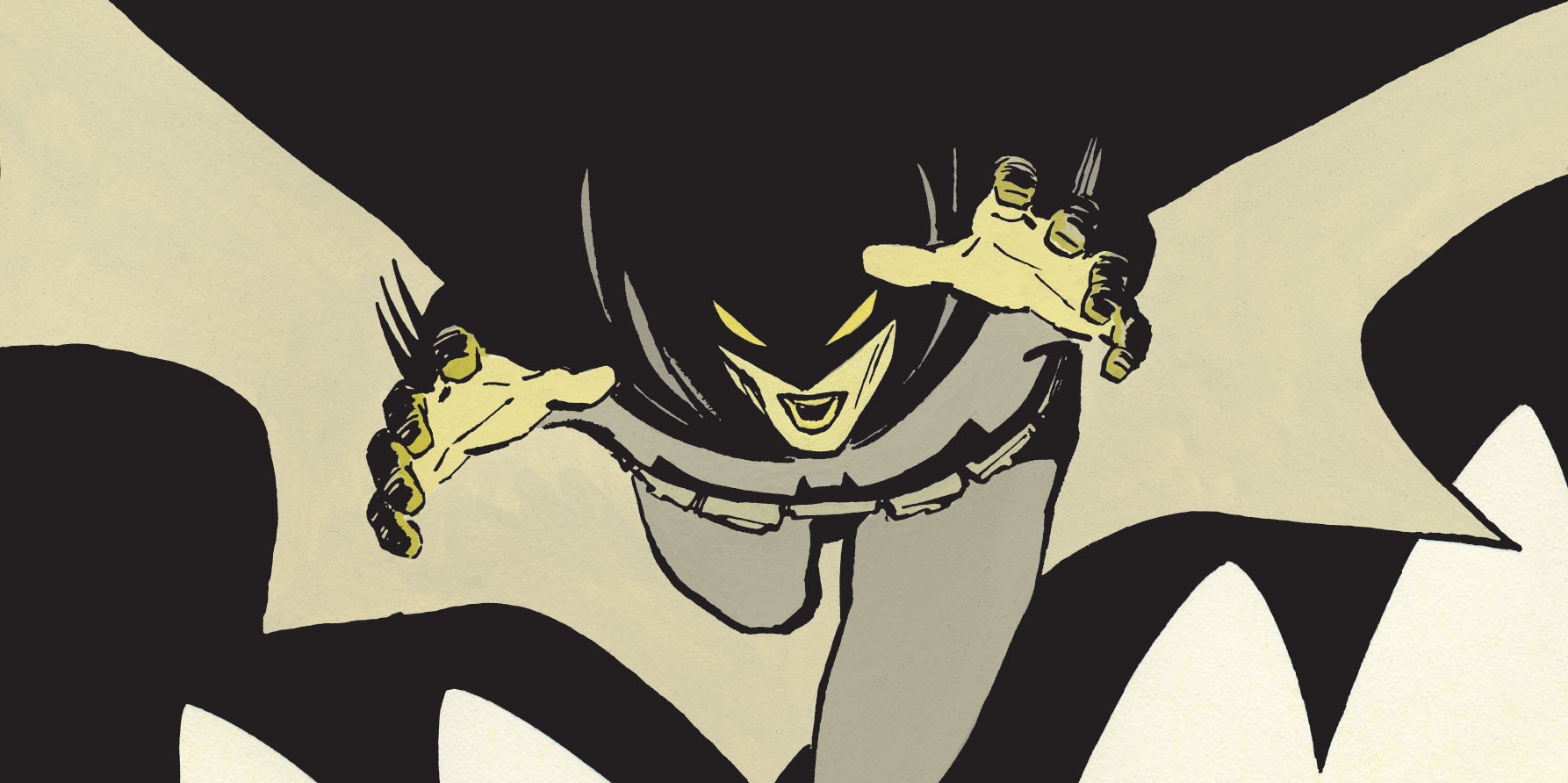
Batman: Year One grounds both Batman and its setting in a gritty, realistic world. The comic’s narration, which is shared between Batman and Jim Gordon, a former Chicago cop who was transferred to Gotham along with his wife and expecting a child, evokes the style of an old film noir.
The art invokes this gritty tone as much as the writing does. Mazzucchelli’s pencils render a version of Gotham that is urban and decayed. Lewis’s colors emphasize that grit with shades of black that are especially dark and colors that are muted, but striking.1 The villains of Year One are much more ordinary than the foes Batman typically fights.
The main forces Batman battles against are street crooks, dirty cops, and organized crime.2 Though Catwoman begins her criminal career3 in the comic and its final pages hint at the first encounter between Batman and the Joker,4 it doesn’t focus on the idea of Batman fighting costumed supervillains. The enemies he faces in Year One are grounded in reality instead of fantasy.

The focus of Batman: Zero Year is the opposite of that of Year One. It’s grandiose and bombastic rather than gritty and realistic, embracing the spectacle and fantastical elements of Batman stories. Capullo depicts a version of Gotham that is larger than life and feels unlike any city in the real world.
FCO Plascencia brings Zero Year’s version of Gotham to life with colors that defy reality. The comic embraces a bright and vibrant color palette, even when depicting the city at night.

This focus on spectacle is evident in the villains of Zero Year. Batman’s first enemies are the Red Hood Gang, a group of criminals based around an ideology of senseless violence5 who steal high tech weaponry. Their leader is heavily implied to become the Joker.6
The story’s second major villain is the Riddler, who seeks to take over Gotham and eventually succeeds,7 forcing Batman to fight back after initially failing to stop him.8 By using established characters from the Batman series, Zero Year unreservedly embraces the fantastical elements of the character’s setting, creating a version of Batman’s origin story that feels grandiose and larger than life.
Jim Gordon Vs. Bruce Wayne As A Narrative Anchor
Year One focuses on Jim Gordon as he grapples with the corruption in Gotham’s Police Department, struggling to try to be good in a system that fights him every step of the way. When Bruce Wayne begins his career of vigilantism as Batman, Gordon is the officer who is tasked with bringing him in.9 Meanwhile, Gordon begins an affair with Sarah Essen, one of his fellow officers.10
Throughout Year One, Jim Gordon is shown to be a conflicted man in how he relates to other members of the Gotham Police Department and in his personal life. His refusal to take bribes or engage in other forms of corruption makes him an enemy within the department to Detective Flass, another cop on the force, and the corrupt Commissioner Loeb, which results in Flass and other detectives beating Gordon to convince him to toe the line.11

Gordon’s dedication to his work of catching Batman keeps him away from home, estranging his wife. His marriage is further complicated by his late nights of work making him closer to Essen, resulting in Gordon’s affair and his guilt over it.12
This contrasts with Year One’s version of Batman, who doesn’t have the same sense of internal conflict that Gordon does. As Gordon sits awake while his wife sleeps, he reflects, “He’s a criminal. I’m a cop. It’s that simple. But — but I’m a cop in a city where the mayor and the commissioner of police use cops as hired killers… he saved that old woman. He saved that cat.”13 Gordon is trapped in a system that is deeply corroded, so Batman’s unambiguous heroism stands out in contrast.

Gordon’s internal conflict about arresting Batman comes to a head in the story’s finale when Loeb and Flass attempt to blackmail Gordon with evidence of his affair with Essen, threatening to tell his wife about it. However, Gordon tells his wife about his affair of his own accord even though doing so clearly strains his marriage.
When Loeb’s plan fails, he hires a member of the Falcone Crime Family to kidnap Gordon’s infant son. Batman, out of costume and in broad daylight, saves Gordon’s son. Gordon, who lost his glasses in the struggle to rescue his son, says that he’s blind without them and tells Batman to leave before the cops arrive.14
The story keeps how truthful Gordon was about his glasses and therefore whether he made the choice to conceal Batman’s identity ambiguous, but the point of the scene is that Gordon chooses to let Batman go. He recognizes Batman as a necessary symbol of good in Gotham City.

Zero Year spends more time with Batman than Jim Gordon and follows Bruce Wayne’s journey from vigilante to superhero. Bruce Wayne begins the story as an anonymous vigilante who does not combat the legal declaration of his death because he believes that leading a public life as Bruce Wayne will only distract him from his mission.15
Though he learns that being a Wayne is another way he can help Gotham and honor the memory of his parents as well as adopting the identity of Batman,16 Bruce remains consumed by his anger. The second part of the story sees Bruce refusing aid from anyone except for Alfred and being especially hostile towards Jim Gordon.17 Alfred even makes a point of saying that he believes Batman is Bruce’s way of punishing the people in his life by making them bear witness to what he’s become.18
After Batman fails to stop the Riddler from flooding Gotham in the final act of Zero Year, he allows himself to take on allies, and it’s only because he has allies that he’s able to save Gotham.19

Batman’s arc in Zero Year is about his learning how to find meaning in life after the deaths of his parents. Bruce Wayne struggled following this tragic event. The finale of Zero Year reveals that before his training, he planned to receive electroshock therapy at Arkham Asylum to stop being himself, but he stopped at the last second when he realized that he needed to find a way to make his life mean something.
He begins the story as a young and angry vigilante lashing out against the world and ends it embracing his role as a superhero that became a symbol of hope and resilience in Gotham. Bruce ultimately finds meaning in being Batman. He serves as a lightning rod to attract new threats towards him and away from civilians and accepts that he’ll never know the joys of a normal life as Batman.20
What Each Origin Says About Its Era
The greatest factor that sets Year One and Zero Year apart other than the characters they focus on or the directions their narratives follow is the different time periods they were made in. Both the real world and the DC Universe changed in significant ways between the publication of Year One and that of Zero Year. Each story’s take on Batman’s origin reflects the time in which it was created.
Batman: Year One was published in the 1980s, and Frank Miller’s version of the origin story sets out to make the character match that time.21 Scott Snyder notes in an interview with Chris Sims for Comics Alliance that “…the thing that made Year One so potent at the time was that that was the city. You weren’t allowed to go to Times Square, where Frank Miller lived; that sense of danger and rot and corruption was everywhere.”22

By visually and narratively grounding its story in a sense of reality, Year One responds to urban decay, the fears people had about violence in the city, and their distrust in authority figures to do anything about it.
Batman: Zero Year was published in the 2010s, and Scott Snyder has claimed that his version of Batman’s origin story makes the character match that time. In another interview about Zero Year with Chris Sims for Comics Alliance, he states
“You’re writing it for you. It’s about your fears and what you perceive as the fears of the modern city and what Batman would come up against if he was coming up today, versus the city you grew up in in the ’80s that was reflected in Year One.”23
Batman’s major enemies in Zero Year are the Red Hood Gang, a group of faceless criminals who enact senseless acts of meaningless violence,24 and the Riddler, who turns Gotham into a post-apocalyptic world with him centered at the top.25
By reflecting the fear of ultraviolence in the Red Hood Gang and the fear of the apocalypse in the Riddler, Zero Year is a story in conversation with 21st century fears of a world of erratic and senseless violence.

Neither story becomes consumed by fear of the world it inhabits. Instead, these stories offer messages of hope. Year One finds hope in the growing camaraderie between Batman and Gordon. Both men see the corruption and decay surrounding them and wish to do something about it.
Batman acts outside of the law as a vigilante and Gordon acts inside of it as a police officer, but neither man can make a meaningful difference on their own. These problems are too great for one man to tackle by himself. Batman and Gordon can only start making a difference when they work together to attack corruption and decay on two fronts.

Zero Year finds hope in confronting fears about the world, facing them, and finding meaning in a world despite those fears. Batman’s entire journey in Zero Year is about facing off against the fears the story reflects and becoming a symbol of resilience that representing something more powerful than them. In a speech Bruce Wayne gives in the finale of the story, he says
“Right now, this city, ruined, beautiful… it’s ours and ours alone. Its fears — they’re ours, too… …And our fears are great, but so are our hopes. Our ambitions. Our resilience.”
Bruce’s speech summarizes how Zero Year approaches the questions of hope and heroism by owning them and recognizing that hope can be just as strong as fear. Bruce Wayne finds meaning and happiness in being Batman because being Batman is what he can do for other people.26
The Impact Of Batman: Year One (1986) & Batman: Zero Year (2013)
Batman is a character who exists beyond the realm of comic books. He has found a lasting legacy in nearly all forms of pop culture. The ideas presented in Year One and Zero Year have found a second life in the many adaptations of the Caped Crusader.
Christopher Nolan’s film Batman Begins (2005), which stars Christian Bale in the lead role, pulls heavily from Miller’s Year One. While the film features characters who weren’t present in Year One, such as Rachel Dawes, Jonathan Crane, and Ra’s al Ghul, its depiction of a budding friendship between Batman and Gordon and Batman’s early battles against police corruption are taken from the pages of Year One.
Additionally, the more grounded and human perspective of Batman Begins calls to mind Year One’s approach to its characters and setting. Though the film’s use of Ra’s al Ghul and Scarecrow pays homage to the fantastical elements of the franchise, Nolan’s vision of Batman’s origin, like Year One, is centered around Bruce’s character development and the beginning of Batman’s partnership with Jim Gordon.27

Zero Year itself was also influenced by Year One. When discussing the process of creating Zero Year, Snyder stated that he purposefully set out to create something which contrasted with Year One, citing the pacing of the story, its use of color, and its bombastic elements as being deliberately antithetical to Year One.28
Zero Year contrasts with Year One not out of any malice towards the story, but out of a desire to stand as its own entity and not a mere retelling of Year One. Another key way Zero Year differentiates itself from Year One is via its influences from other pieces of Batman media. A brief car chase Batman has with the GCPD is reminiscent of a similar scene in Batman Begins.29 The purple gloves Batman wears throughout Zero Year are an element of his costume lifted directly from the suit he wears in his first appearance.30

By finding inspiration from Batman stories other than Year One, Zero Year uses the character’s history within pop culture to find its own identity and stand on its own merits.
Matt Reeves’ film The Batman (2022), which features Robert Pattinson as the Dark Knight, draws some inspiration from Year One as well. Reeves cites the story as a visual, stylistic, and narrative influence on the film in addition.31 Stylistic elements from Year One can be seen in the way Reeves’ version of Gotham City is gritty and decayed as well as when Pattinson’s depiction of Batman uses a drifter disguise just as he did in Year One. The film also pulls some elements from Zero Year, such as the Riddler being the main antagonist and his plan involving the flooding of Gotham City.
However, The Batman’s depiction of the Riddler differs greatly from his characterization in Zero Year, casting him in the role of a serial killer32 as opposed to a maniacal mastermind.
Batman As A Reflection Of The Years — Batman: Year One (1986) & Batman: Zero Year (2013)
Both Batman: Year One and Batman: Zero Year demonstrate the inherent versatility of Batman’s character and his origin story. The stories examine the foundations of the character’s mythos and utilize them in a fashion that is contemporary with the respective time periods in which they were made. Their usage of the characters and the ways they approach using them makes them timeless entries in the library of Batman comics.

However, the approaches these stories take set them apart because each one is meant to be in dialogue with the era it was produced in. To compare the two to crown a canon story is a futile effort because they are different comics made in different eras. Each story set out to retell the origin of Batman, but the two stories used different methods to accomplish that goal.
At the end of Zero Year, Bruce says to a crowd that “Gotham as we know it, you and I, it exists for a moment in time, its people, it’s neighborhoods, the hopes and fears that power it, and then… poof! It’s gone. And a new city stands in its place.”33 This speaks to the endless versatility and appeal of Batman.

The Gotham of Year One and the Gotham of Zero Year are distinctly different Gothams. Each version of Gotham City exists in a moment of time and reflects the era it was written in. But as time passes, a new version of Gotham made for a new generation takes its place to reflect their hopes and fears.
The characters, setting, and themes of Batman are adaptable enough for there to always be new versions of Gotham and Batman to speak to the fears of every generation.
Footnotes
- Miller, Frank and Mazzucchelli, David. “Batman #404.” Year One, Chapter One: Who I Am – How I Came To Be. DC Comics. 21 Oct. 1986. ↩︎
- Miller, Frank and Mazzucchelli, David. “Batman #405.” Year One, Chapter Two: War Is Declared. DC Comics. 18 Nov. 1986. ↩︎
- Miller, Frank and Mazzucchelli, David. “Batman #406.” Year One, Chapter Three: Black Dawn. DC Comics. 16 Dec. 1986. ↩︎
- Miller, Frank and Mazzucchelli, David. “Batman #407.” Year One, Chapter Four: Friend In Need. DC Comics. 20 Jan. 1987. ↩︎
- Snyder, Scott and Capullo, Greg. “Batman #23.” Zero Year: Secret City, Part Three. DC Comics. 14 Aug. 2013. ↩︎
- Snyder, Scott and Capullo, Greg. “Batman #24.” Zero Year: Dark City, Part One. DC Comics. 9 Oct. 2013. ↩︎
- Snyder, Scott and Capullo, Greg. “Batman #29.” Zero Year: Dark City, Part Five. DC Comics. 12 Mar. 2014. ↩︎
- Snyder, Scott and Capullo, Greg. “Batman #30.” Zero Year: Savage City, Part One. DC Comics. 16 Apr. 2014. ↩︎
- Miller, Frank and Mazzucchelli, David. “Batman #405.” Year One, Chapter Two: War Is Declared. DC Comics. 18 Nov. 1986. ↩︎
- Miller, Frank and Mazzucchelli, David. “Batman #406.” Year One, Chapter Three: Black Dawn. DC Comics. 16 Dec. 1986. ↩︎
- Miller, Frank, and Mazzucchelli, David. “Batman #404.” Year One, Chapter One: Who I Am – How I Came To Be. DC Comics. 21 Oct. 1986. ↩︎
- Miller, Frank, and Mazzucchelli, David. “Batman #406.” Year One, Chapter Three: Black Dawn. DC Comics. 16 Dec. 1986. ↩︎
- Miller, Frank and Mazzucchelli, David. “Batman #406.” Year One, Chapter Three: Black Dawn. DC Comics. 16 Dec. 1986. ↩︎
- Miller, Frank and Mazzucchelli, David. “Batman #407.” Year One, Chapter Four: Friend In Need. DC Comics. 20 Jan. 1987. ↩︎
- Snyder, Scott and Capullo, Greg. “Batman #21.” Zero Year: Secret City, Part One. DC Comics. 12 Jun. 2013. ↩︎
- Snyder, Scott and Capullo, Greg. “Batman #24.” Zero Year: Dark City, Part One. DC Comics. 9 Oct. 2013. ↩︎
- Snyder, Scott and Capullo, Greg. “Batman #26.” Zero Year: Dark City, Part Three. DC Comics. 11 Dec. 2013. ↩︎
- Snyder, Scott and Capullo, Greg. “Batman #27.” Zero Year: Dark City, Part Four. DC Comics. 22 Jan. 2014. ↩︎
- Snyder, Scott, and Capullo, Greg. “Batman #33.” Zero Year: Savage City, Part Four. DC Comics. 23 Jul. 2014. ↩︎
- Snyder, Scott, and Capullo, Greg. “Batman #33.” Zero Year: Savage City, Part Four. DC Comics. 23 Jul. 2014. ↩︎
- Sanderson, Peter. “Amazing Heroes #102.” Fantagraphics Books. 1 Sep. 1986. ↩︎
- Sims, Chris. “I’ll Never Go That Big Again: Scott Snyder On ‘Zero Year: Savage City,’ Part One [Interview]” Comics Alliance. 21 Aug. 2014. ↩︎
- Sims, Chris. “Batman Writer Scott Snyder on ‘Zero Year: Secret City’: The Comics Alliance Interview, Part One.” Comics Alliance. 19 Nov. 2013. ↩︎
- Snyder, Scott and Capullo, Greg. “Batman #23.” Zero Year: Secret City, Part Three. DC Comics. 14 Aug. 2013. ↩︎
- Snyder, Scott and Capullo, Greg. “Batman #30.” Zero Year: Savage City, Part One. DC Comics. 16 Apr. 2014. ↩︎
- Snyder, Scott, and Capullo, Greg. “Batman #33.” Zero Year: Savage City, Part Four. DC Comics. 23 Jul. 2014. ↩︎
- Nolan, Christopher, dir. Batman Begins. 2005. ↩︎
- Sims, Chris. “Batman Writer Scott Snyder on ‘Zero Year: Secret City’: The Comics Alliance Interview, Part One.” Comics Alliance. 19 Nov. 2013. ↩︎
- Snyder, Scott, and Capullo, Greg. “Batman #25.” Zero Year: Dark City, Part Two. DC Comics. 13 Nov. 2013. ↩︎
- Snyder, Scott, and Capullo, Greg. “Batman #24.” Zero Year: Dark City, Part One. DC Comics. 9 Oct. 2013. ↩︎
- Davis, Johnny. “Director Matt Reeves Says ‘The Batman’ Is Inspired by 1970s Cinema, 1980s Comic Books and… Nirvana.” Esquire. 25 Jan. 2022. ↩︎
- Reeves, Matt, dir. The Batman. 2022. ↩︎
- Snyder, Scott and Capullo, Greg. “Batman #33.” Zero Year: Savage City, Part Four. DC Comics. 23 Jul. 2014. ↩︎