

Table of Contents Show
For humanity, it has always been eat or be eaten. In the twenty-first century, feminist art has become increasingly prevalent, taking over watchlists, cinemas, and film classes year after year. From films like Ridley Scott‘s 1991 film Thelma and Louise to Greta Gerwig‘s Barbie (2023), many women have been lucky enough to watch films that promote female friendship and empowerment in exciting ways.
Audiences owe a lot of this work to the second wave of feminism (1960s-1970s). During this time, filmmakers and artists across America and Europe were sharing stories that would later be referenced repeatedly. One film that sticks out among the early batch is Vera Chytilová‘s 1966 film Daisies.1

Daisies (originally titled Sedmikrásky) is a Czechoslovakian film that has left both a positive and negative impact on its viewers. While it has inspired generations of filmmakers since its release, there was a time when Chytilová’s work was banned thanks to political backlash and censorship by the Czech government. Using alleged food waste as an official reason, the Czech government deemed it inappropriate for its ongoing theatrical release. It’s no secret that people tend to want what they don’t have, whether that be power, freedom, or wine. That remains true for not only the characters in the film, but also those who weren’t able to access it.
Chytilová’s film included themes and artistic choices that are still being hinted at in today’s media. From chaotic female leads to the utilization of kaleidoscopic effects, Daisies has an anarchic approach to storytelling. The Maries flirt and cheat their way through the hearts of upper-class men, all for the sake of having a little fun in this harsh world.
Daisies — A Feminist Revolution On Screen
Daisies begins in a jarring way, cutting in between the gears of a mill, symbolizing the working class, and naval warfare footage from World War II. The audience is immediately thrown into the trenches of Europe in the mid-1900s. Then, Chytilová cuts to two girls, lounging around in their bikinis. In classic teenage-girl fashion, Marie I, the brunette (played by Jitka Cerhová), and Marie II, the blonde (played by Ivana Karbanová), discuss the state of the world through the lens of their untrained eyes, coming to a conclusion they believe most males won’t comprehend until the mid to late twenties: the world is terribly rotten.

In the heat of the summer, Marie and Marie decide to become as spoiled as the rest of the world. If thousands upon thousands of dollars are spent on destruction, then why can’t someone spend a little money on them? Thus, they begin their journey into the hearts of older men, getting themselves whisked away to nice dinners, only to leave their suitor on the first train out of town.
The Maries were able to manage the goal many women dream of in their youth, which is to turn men who swear undying love to them into tools for no-strings-attached cake. From art like Daisies and second-wave feminism,2 it’s no wonder that women watched the end of the film with an idea in mind. They were ready to start acting in new ways, to throw caution to the wind and indulge, and they finally had ways of doing so.

In the 1960s, feminism saw an increase in attention after a lull period that came around in the 1920s, caused by women gaining the right to vote in the United States. In the forty years between the two major stepping stones, two novels gained the attention of the world: The Second Sex, by Simone de Beauvoir, originally published in 1949, and The Feminine Mystique, by Betty Friedan, published in 1963. These two novels rekindled the desire to continue to fight for equality.
In the United States, President John F. Kennedy passed the Equal Pay Act in 1963, and the UK passed its in 1970. Worldwide, women marched for their reproductive rights, against gender roles, legal rights in marriage and in the workplace, and more. But how does this tie into Daisies?
Men are completely decentered in their lives, only existing for their own entertainment. The film’s distinctive use of male characters, use them and lose them, goes directly against what society had deemed appropriate at the time. The two girls had their food and their fun, but that was all they needed. No plans to settle down with any of them, no desire to keep one around.

The Maries are in every single shot that contains a person, and, while there are instances where they are alone, the two are usually together. They have a deep feminine connection that hadn’t been deeply explored in cinema before. They do everything for the sake of fun, for the sake of being foolish together.
Towards the end of the film, they take a milk bath together, contemplating their existence. Marie II feels she isn’t real because she has no ties to the rest of the world, while Marie I feels the only tie she needs in the world is her friend. They have each other; they know the other person is real, and that’s enough.

Chytilová’s early showcase of the ‘girls just wanna have fun’ mindset opened up more artists to the idea that their female characters don’t need to end up with a man by the end of the film. They are allowed to explore their characters without the desire to lock them down. At no point in the film did they entertain the idea of actually running off with one of the men. All they needed was each other.
Marie I & Marie II’s Rebellion Against Expectations
The political nature of this film isn’t the only aspect that challenged the norms; Daisies takes an equally rebellious and bold stylistic approach to enforce this. Throughout the film, Chytilová features exciting cuts, cinematic choices, and editing styles that keep the viewer engaged.
Just like the characters, Daisies’ editing style goes against what traditional cinema had trained viewers to expect. Chytilová and her cinematographer, who was also her husband, Jaroslav Kučera, combined film stock to play with the color shown in the film. When the girls are alone in their bedroom, the scenes are lively and colorful, showing how free they are. When they are with men, the film switches to black and white or sepia, draining the image of all color.

The color choices compel the audience to crave the bedroom’s sweet serenity; they wish the girls could get rid of the men faster, so they can enjoy the richness that comes from that small space. In there, the girls cut up magazines, their bedding, food, and each other. In here, they still tease men, but without truly interacting with them, keeping them safe from the rest of the world. In there, they can be exactly what they are: young, silly, reckless girls.
It’s not just the use of color that shakes up the typical movie-watching experience, but also the collage editing style. The film can be seen as a series of vignettes, each one diving deeper into their freedom. Throughout the film, collages of food and flowers snap the viewer into their dream world. For the Maries, there is a surplus of everything. They never worry about running out, because there’s always going to be another man who will fall victim to their games.
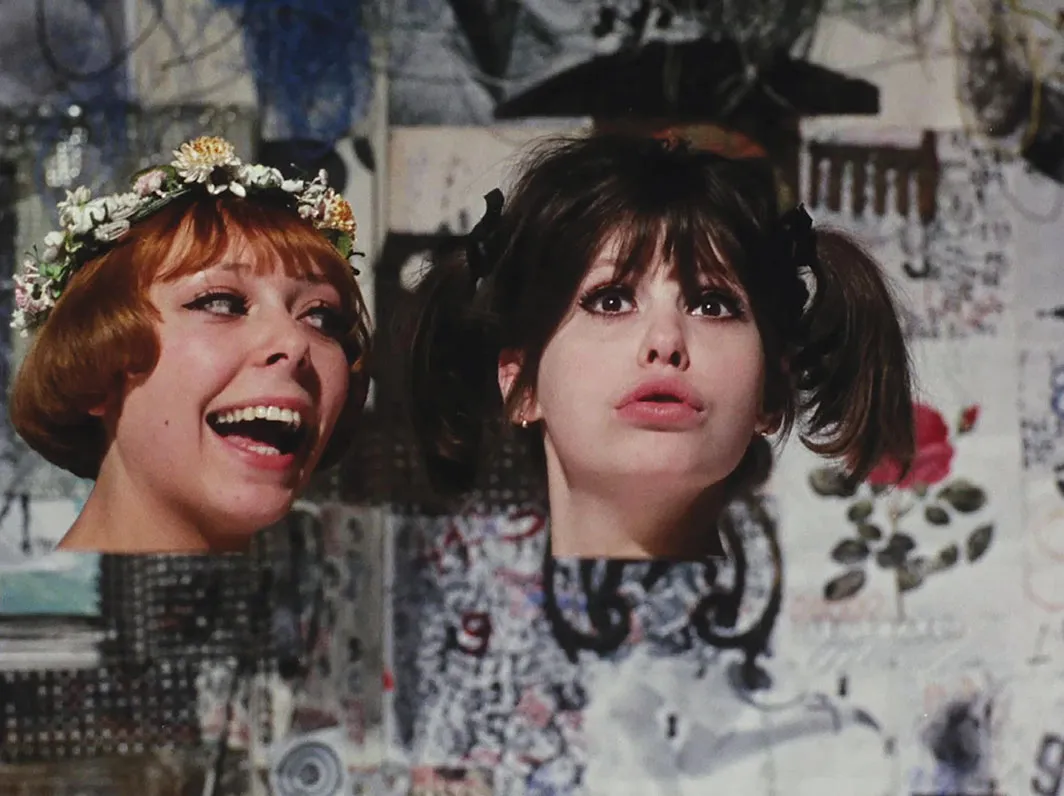
The scenes feature visible cuts in the film strip as well as cuts in the actors, showing just what could be possible in their own little world. As their own destruction goes on, the Maries end up with their heads and arms detached from their bodies, as if they were paper dolls. After their declairation to become spoiled, they seem to hav ebecome omnipotent.
Throughout the majority of the film, they hardly ever face consequences for their actions, so, naturally, they can dismember themselves and enter the next scene unscathed. The destruction of their space and their bodies plays into the war that began the film. Like the Maries, people in power can easily move past their crimes without worry. Time and time again, they use their influence, money, and power to avoid facing the consequences.
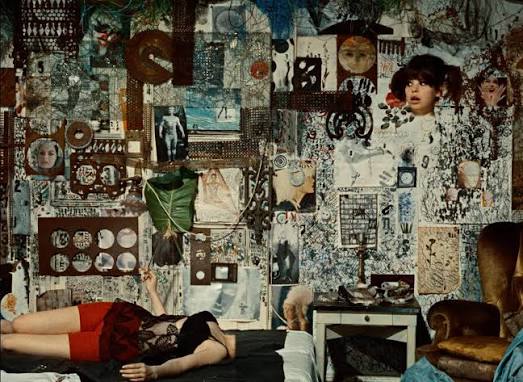
For the Maries to be cut up like a magazine, giggling and playing around without care, is a way to show how the girls have found freedom in their bodies. Because they started treating men the way humanity treats the world, how governments treat their citizens, they have free rein to do as they please. The girls adopted the “if you can’t beat them, join them” mindset, allowing them to break societal rules and also create their own rules for what’s possible in their world.
In Feminism, Destruction and Joy in Daisies,3 an article by Elena Pachner Sarno for the East European Film Bulletin, references a ‘feminist deaesthetic.’ This idea in Daisies, proposed by Teresa De Lauretis, an Italian author and academic, centers itself around the idea of breaking down moral norms through image and sound. This stylistic ‘assault on manners’ flirts with the plot of the film, making the actions of the two girls seem even more unimaginable for the time. The surreal traits, like the cutting of the girls’ heads, make audiences feel uneasy but free.

This destruction occurs outside of the safety of their bedroom, as well. In the final minutes of the film, the Maries ruin a beautifully decorated banquet for the wealthy before regretting all of the events that led to their downfall. The destruction of the banquet was their tipping point. The Maries became so lost in their own selfishness that they were forced to reflect on the beauty of rules. Chytilová was so determined to break every rule she could with her editing and the film’s contents that she ultimately ended up being censored by the Czech government.
Food, Excess, & The Politics Of Consumption In Daisies
If there’s a film history nerd who is aware of this particular film, they’ve probably already told everyone that it was banned shortly after its successful theatrical release. Since it came out in 1966, the censors of Czechoslovakia, a communist country at the time, were on high alert because of the themes this film explored. While there are obvious reasons, with its clear political commentary, the government hoped to find a loophole for banning the piece.
In the end, they banned the film due to the food waste, claiming it was a targeted attack at agricultural farmers. Yes, the Maries did waste a bunch of food, but that feels like it should be the least of the government’s issues with this. The ban took the film out of circulation for about ten months before being lifted in March of 1968, ending a brief period of liberalization. Don’t get too excited, though, because the Soviets invaded Czechoslovakia in August of the same year, and the film was banned indefinitely.4

For years, Chytilová was blacklisted from filmmaking by the government due to the nature of her work. Her projects, which continuously mocked the patriarchy, were found to be too rebellious. She had to push for her creative freedom, and only got the green light after raising international pressure against the censorship boards. Still, Chytilová is considered one of the great feminist filmmakers, regardless of whether she considered herself one.
When the term ‘feminist’ was brought up around Chytilová, she would dismiss it, not wanting to be tied down by a title. Her ideals fit the world, but, for her, it felt too conformative — exactly what one could expect from an artist like her. However, this seemed to be a common mindset for many feminists during the second wave, as they viewed the term to be too closely associated with the older generation, making it seem outdated. Many preferred terms like “women’s liberation” or “women’s freedom movement” rather than feminism.
How Absurdism Becomes Feminist Resistance
Artists love to pull ideas and themes from other creatives, and even though Daisies isn’t a super popular film, it has inspired other filmmakers when creating their own stories decades later. Not only was this a great reference piece for feminist filmmakers, but it also contained the key to remaining fresh: to disobey the rules is to create something transformative. Because of Daisies’ bold attacks on “the norm,” Chytilová founded a new and exciting approach to filmmaking. Two modern films that focus on aspects of Chytilová’s work are The Favourite (2018), directed by Yorgos Lanthimos,5 and Tragedy Girls (2017), directed by Tyler MacIntyre.6

For The Favourite, Yorgos Lanthimos7 was open about wanting to bring in absurd and playful camera angles and editing pace for the film, which are unique choices for the period piece. The Czech New Wave era of filmmaking was a big inspiration for him. He also utilized the montage editing style to create a non-linear narrative, allowing the events to become blurred in time. The Favourite carries on the bold and experimental style of Daisies, introducing many young artists to the rebellious style and keeping Chytilová’s legacy.

As for Tyler MacIntyre’s8 Tragedy Girls, the inspiration is pulled from the chaotic female duo that led the film. In Daisies, the two teenage girls turn their own rage against the world into a spending spree for the men they encounter, but in Tragedy Girls, these teenagers use their anger to take out those who annoy them. Their boredom takes a step further than that of the Maries, completely taking their victims out of the narrative. While the Maries never physically harmed their victims, besides a broken heart here or there, Tragedy Girls makes it a point to show how easily it can be to get carried away when embracing the world’s dark side.
Why Daisies Remains A Feminist Classic
The 1966 Czech film has caused an uproar of emotions since its release sixty years ago. Inspiring feminists and filmmakers to turn female fun on its head, Chytilová was one of the first to contribute to visually stunning anarchy.
Next time someone is looking for a beautifully anti-patriarchal film, send them over to HBO Max to stream Vera Chytilová’s Daisies. And please, don’t let the subtitles scare you; in this film, you get to see a grown man cry while the Maries shove cake in their faces, and that’s truly beautiful.
Footnotes
- Chytilová, Vera. Daisies. 1966. Filmove Studio Barrandov. ↩︎
- Feminism: The Second Wave. National Women’s History Museum. June 18, 2020. ↩︎
- Sarno Pachner, Elena. Feminism, Destruction and Joy in Daisies. East Europe Film Bulletin. October, 2018. ↩︎
- Gray, Carmen. Daisies: Giggling Generals; One and Two. Criterion Collection. November 1, 2022. ↩︎
- Lanthimos, Yorgos. The Favourite. 2018. Fox Searchlight Pictures. ↩︎
- MacIntyre, Tyler. Tragedy Girls. 2017. It’s The Comeback Kids. ↩︎
- IMDb. (2026). Yorgos Lanthimos ↩︎
- IMDb. (2026). Tyler MacIntyre. ↩︎