

Table of Contents Show
In a time when nostalgia seems to be at its most profitable with the release of live-action childhood shows and movies, such as: How To Train Your Dragon (2025; Dean DeBlois), The Little Mermaid (2023; Rob Marshall), and Avatar: The Last Airbender (2024-present; Netflix), audiences begin to question the necessity of these retellings. More specifically, the production of these remakes brings into question why they sell so well in the first place when the original already exists.
Gravity Falls (2012-2016), a short two-season series created by Alex Hirsch, has become a marketable success that continues to generate profit nearly a decade after its final episode. Without the modern updates of live-action, spin-offs, or sequels, it has kept its fans rewatching it later in life and brought new, younger groups into the mystery of it all.
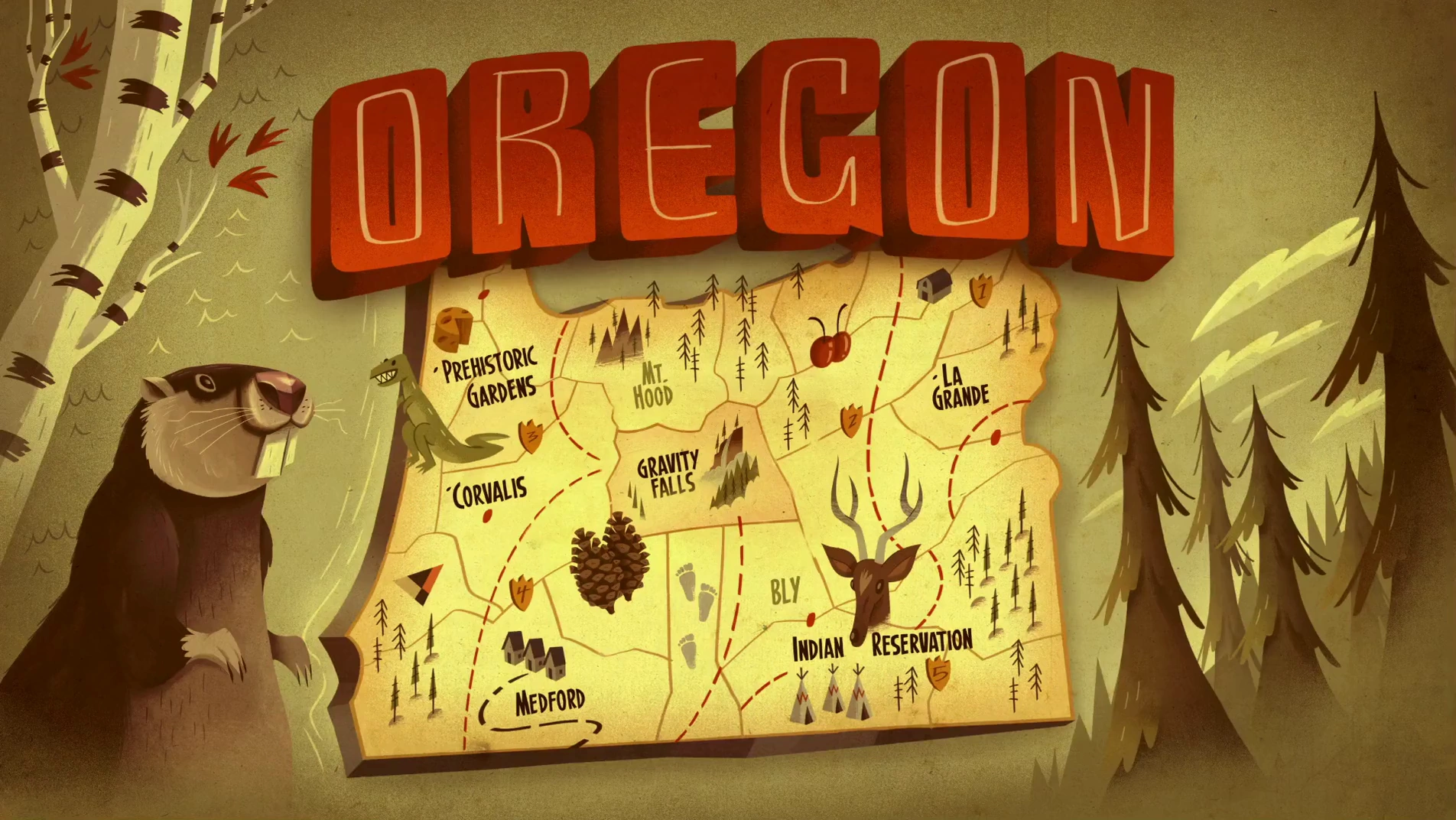
Despite Gravity Falls being labeled as a children’s and teen show, adult audiences continue to rewatch the show without a maturity barrier between the two. The separation between Gravity Falls and its more mature audiences is non-existent due to the show’s layers of ageless humour, nostalgic atmospheres, and a plot surrounded in lore to promote discussions within the fanbase.
“Summer Meets Autumn” — Nostalgia, Mystery, & The Magic Of Memory
The comforting nostalgia of Gravity Falls can be seen in the atmosphere the show creates. The plot revolves around the premise of Summer vacation, and the freeing, adventurous memories that evoke our childhood during that time. Despite it being during the heat of summer, the backdrop of the plot is depicted through a lens of mystery and the supernatural.

Much like the 1990s show, Twin Peaks (1990-1991; David Lynch), which inspired Alex Hirsch, Gravity Falls centers around the mysteries hidden behind a small idyllic mountain town. The colors enveloping Gravity Falls resemble the quiet late days of summer camp and autumn nights; shades of purple, green, brown, and black telling the story.
Season 1 episode 12, titled “Summerween,” represents this perfectly balanced atmosphere that evokes the nostalgic feeling of a mystical October. Despite it being summer, the town participates in a ‘summerween’ tradition — the community’s second celebration of Halloween. The episode shows the kids trick-or-treating, with a threat also looming from an ominous creature after them. There is a focus on both the light-hearted familiarity of a Halloween night and a tonal focus on the eerie, suspenseful monster.

Many shows and movies represent the light-hearted feeling of summer during childhood, such as the two classic 90s movies: The Parent Trap (1998; Nancy Meyers), a comedy revolving around summer camp, growing up, and family dynamics, and The Sandlot (1993; David Mickey Evans), which concentrates on looking back at the protagonist’s boyhood and friendship.
There are also hundreds of Halloween and autumn movies that highlight suspense, monsters, and the unknown; however, there have been very few that have successfully combined the two distinct aesthetics — summer and fall — into one storyline.
These seasons, when represented in film, can create parallel feelings of thrill in their audiences. By grabbing at both the heat of summer and the mystery of fall, Gravity Falls was able to amplify our nostalgia with the combination of adventure, family, childhood, and mystery to keep its audience watching.
Emotional Writing/Evolving Bonds — How Gravity Falls (2012-2016) Connects With Its Viewers
The writing in the show revolves around humor and the comforting dynamics of the family and friends. Dipper and Mabel, the protagonists of the show, are twins visiting their estranged great-uncle in a small town called “Gravity Falls.”
Their dynamic shows both the bickering and vexations between siblings, as well as their bond and love for each other. There is often playful fighting while also having relatable character arcs surrounding how they treat each other.
The siblings’ character arcs can be seen in chapters like Season 2, Episode 4, “Sock Opera,” where Mabel puts on a sock puppet play to impress a boy, and in the process, puts Dippers’ needs last. In the end, Mabel ruins her opera to save him and his prized journal. This scene marked a significant part of her character arc, especially in contrast to the episodes leading up to this, where Dipper was usually the one making the sacrifices for his sister’s happiness.

The character arcs are what make watching the entirety of Gravity Falls so satisfying, even during the rewatches, as some of the most minor side characters adapt, though they never lose the core of what made their character funny to watch.
Grunkle Stan is depicted as a money-hungry con artist, and even though he is still a morally grey character in the end, he shows his newfound love for the kids with the self-sacrifices he makes for them. He has one of the most extreme character arcs as he begins as a seemingly one-dimensional character whose law-breaking agenda seems only to be a punchline.
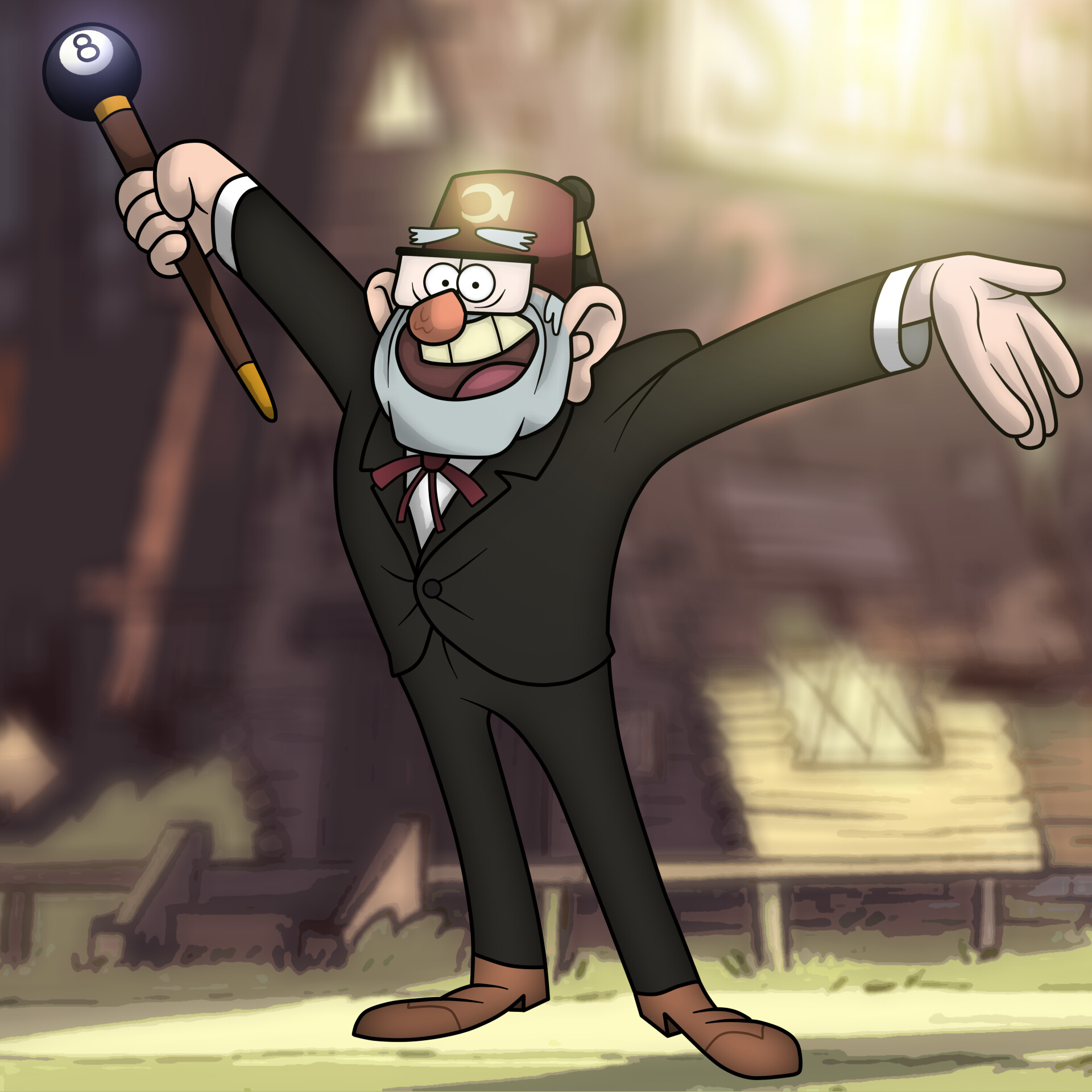
However, as time goes on, he begins to show his love for his family, and the mystery surrounding what he’s doing in the secret room builds. After the central mystery revolving around Grunkle Stan and the Pines’ family is revealed, Season 2, Episode 12, “A Tale of Two Stans,” is aired, showcasing Stan’s past. He becomes a complex character full of mistakes, hardships, and complicated family relationships.
Uncovering Hidden Depths In Side Characters
Other, more minor characters are also given character arcs or insights into the complexities of their life. Soos, the friendly but awkward handyman for Stan, is shown to live with his abuelita.
It is revealed that his father is not in his life by choice, and his mom is never mentioned. Pacifica, the seemingly spoiled rich girl of the town, is shown to be controlled and unloved by her parents. Wendy, the older, cool girl Dipper develops a crush on, is revealed to be struggling with anxiety. Gideon, the antagonist of the family for the first season, ends up becoming one of their main allies in the final episodes.

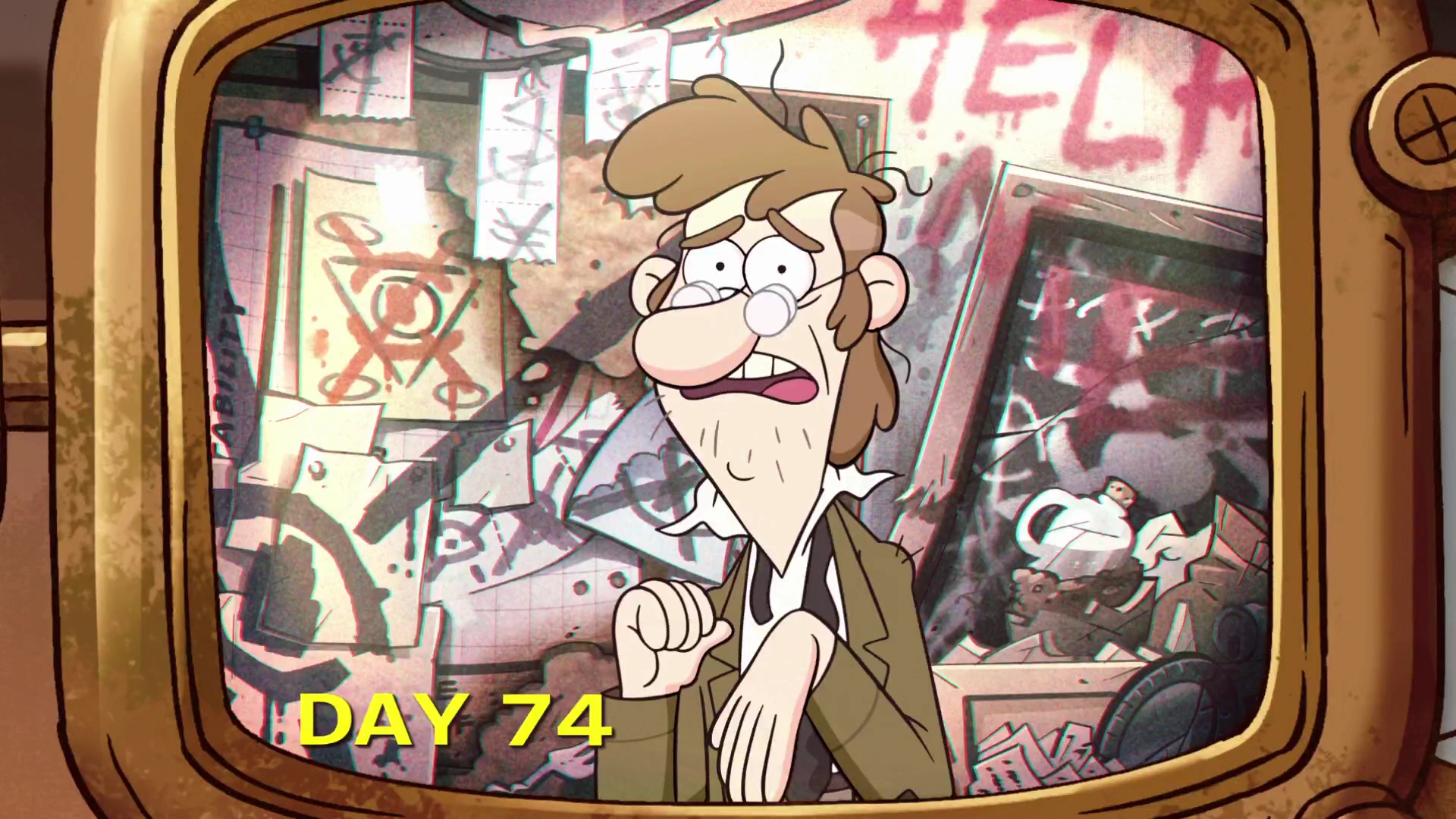
Like Stan, Fiddleford ‘old man’ McGucket, is seen as a one-dimensional side character — a hillbilly mad-scientist only there for comedic relief. However, in Season 2, Episode 7, “Society of the blind eye,” it is revealed that McGucket had invented a memory eraser and used it so much that he began to forget himself and turned into a caricature of himself.
His journey of lost memory is a devastating parallel to many dementia patients and mental illness. These character arcs show mature content of toxic family dynamics, anxiety, and self-esteem tribulations during teenage years, as well as the devastating loss of oneself later in life.
Comedy As Emotional Armor In Gravity Falls
Gravity Falls allows for these mature and heartbreaking topics to be digestible through comedy. Like McGucket, despite his similarities to dementia patients, he is still able to evoke laughter through his nonsensical phrasing and light-hearted attitude. Grunkle Stan, despite his family trauma, still showcases his grumpy persona and sarcastic dialogue. Comedy becomes Gravity Falls’s coping mechanism, something relatable to the majority of the audience.
The humor, although at times is childish and immature, masks serious topics, making the writing in the show adaptable to a wide range of ages. Because of this, when rewatching the childhood show or watching it for the first time in adulthood, the writing doesn’t feel young and instead is still just as enjoyable.
Youth, Maturity, & The Dual Nature Of Humor
A fair example of both ends of the humor is seen in Dipper and Mabel, as Dipper seems to desire to grow and move on, while Mabel desires to stay young. Dipper’s humor is more mature, set against the backdrop of coping with high school cliques, falling behind, and unrequited love.
A good example of Dipper’s older humor focusing on the hardship of trying to fit in is in Season 1, Episode 6 of Gravity Falls, “Dipper vs. Manliness.” Embarrassed that he isn’t “manly” enough, Dipper befriends a group of “manotars.” The episode makes jokes about toxic masculinity, with his need to be “man enough” being at the center of the joke.
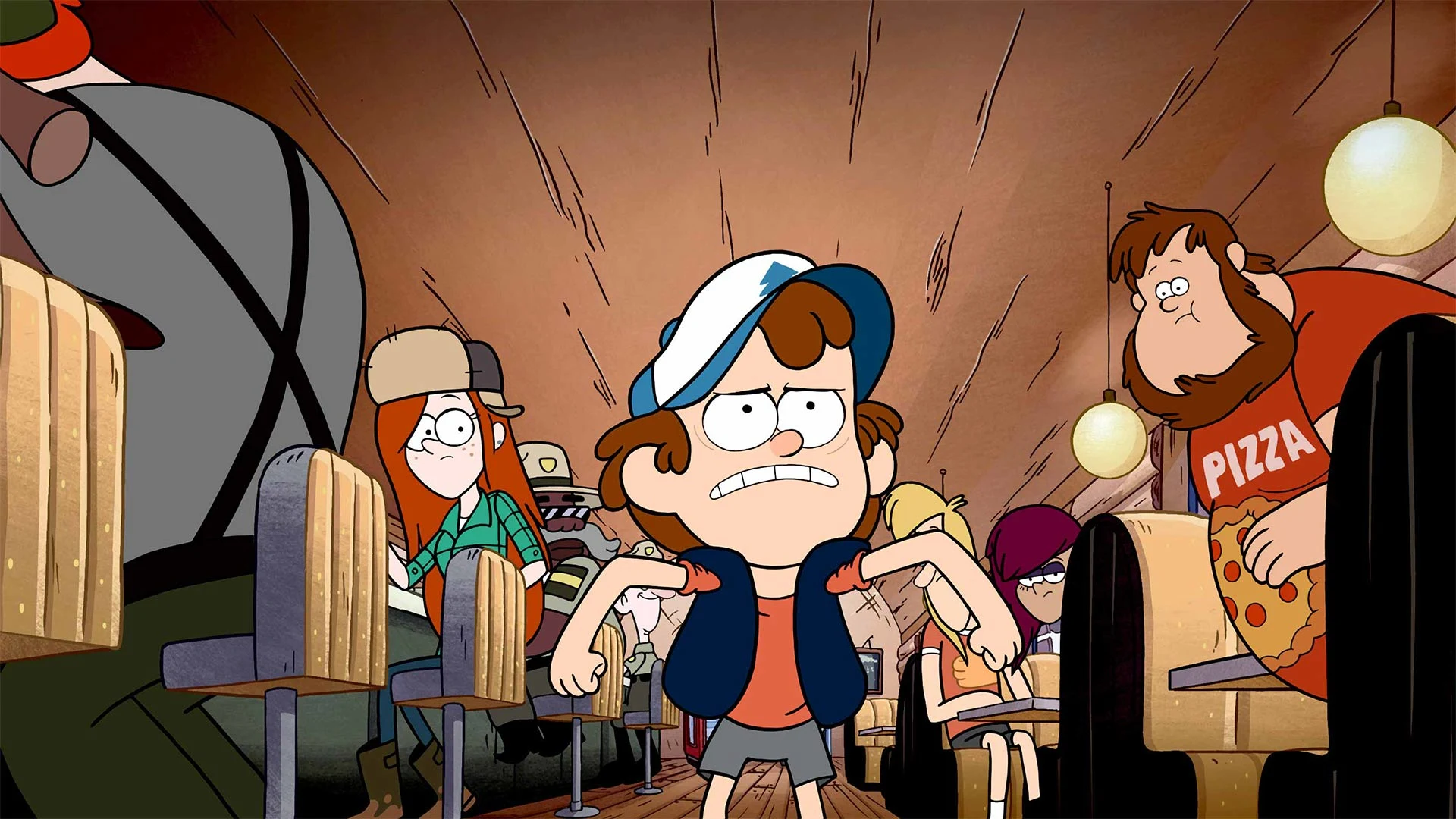
The episode comes to a close when Dipper refuses to finish his journey of becoming a man by killing the legendary ‘multibear.’ He doesn’t kill the bear because it also listens to his favorite song, “Disco girl,” which had made Dipper feel emasculated in the first place. Afterwards, Dipper becomes more confident in himself despite not being the ideal version of masculinity.
This episode caters its humor to a more mature audience, appealing to men who feel the need to embody a specific type of masculinity, an experience common among teenage boys and young men on their journey to self-discovery.
Mabel, however, is coded in juvenile comedy revolving around her naivety, immaturity, and fear of growing up. Though both of these are very separate types of comedy, they both balance each other so that either one is digestible to different ages. A good example of this is in Season 2, Episode 15 of Gravity Falls, “The Last Mabelcorn.”
The episode revolves around Mabel’s search for a unicorn because their hair is needed for a safety barrier. After finding one, it tells her she needs to be more “pure of heart.”
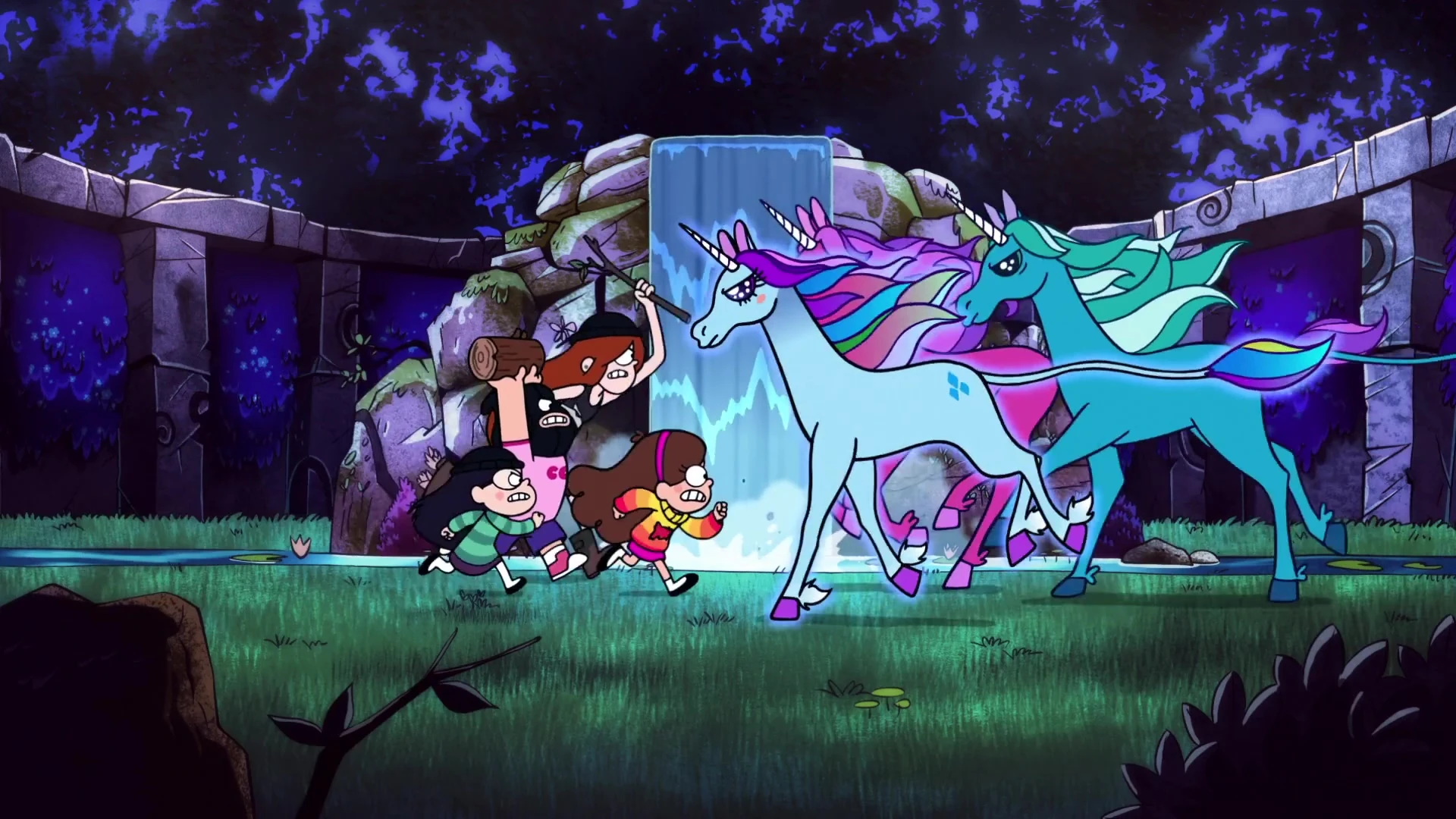
The episode is random and silly as it portrays condescending unicorns that can play rave music, telling Mabel that she isn’t ‘pure of heart.’ Though at face value, this episode and the comedy it showcases can seem juvenile, it is still digestible to older audiences, as this episode also represents Mabel’s desire for her childhood.
The unicorns represent the impossible imaginations of young girls, and Mabel, who is the embodiment of childhood innocence, struggles to be ‘pure’ enough for the youthful creatures. The relatable representation that lies beneath the humor allows adult audiences to accept and appreciate the satire in its entirety.
Secrets, Suspense, & The Story Engine Of Gravity Falls (2012-2016)
The driving factor behind the popularity of Gravity Falls is its mystery and the great reveal. The show instantly sets up its two most critical questions in the first episode. At the beginning of the first episode, Dipper finds a journal in the woods with tons of different creatures living among them, ready to be explored. The questions surrounding the author of the mysterious journal remain unanswered.
The final scene of the pilot shows their Grunkle Stan unlocking a secret door behind the vending machine, setting up the second crucial question: What is Stan hiding?
Episode by episode, the audience sees more creatures and experiments come to life, most of which are from his journal. However, answers are not given until the Season 1 finale, “Gideon Rises.” In this finale, another journal is discovered, though it only opens up more questions and possibilities for Dipper and the audience.

With the reveal that there are three books in total, and the last is yet to be found by Dipper, Gravity Falls creates more questions for the characters and incites more fan theories as it moves into the second season. The most significant breakaway of the first season comes in the very last scene as Stan activates a machine with the missing journal, something that only the audience now knows.
Moving into Season 2, viewers begin to see the genuine dangers of the supernatural forces, such as Bill Cipher. Introduced in Season 1, Bill would become the show’s main antagonist. Depicted as a yellow triangle figure with one eye, he is a multidimensional entity that can enter people’s minds, creating havoc in their lives.

His importance is only hinted at as the story unfolds, but it’s not until after the reveal of Stan’s twin that the true nature of the figure is revealed, along with what he wants from the Pines’ family. After the final secrets are unveiled, the story takes a dramatic turn as the events quickly unravel and the suspense of defeating the God-like figure takes hold.
After the final battle and the summer comes to an end, so does the show. No new mysteries take over as everything has already been revealed. So the question still stands: if the audience already knows the answers to the mystery — the driving force of the show — then why do they rewatch?
Foreshadowing, Easter Eggs, & The Rewatchability Of Gravity Falls
Many people, after a plot twist, like to go back and rewatch or reread to see the foreshadowing and the signs that they had initially missed. With Gravity Falls, there are many hidden details that not only hint at Bill Cipher’s presence or the history of another brother, but also hide lore of the town and the other dimensions in easter eggs. Even with the central secret revealed, audiences can still discover the answers to hidden puzzles around town.

A foreshadowing of the end is found at the beginning of every episode: Bill Cipher’s final takedown can be seen in the show’s intro sequence. There are easter eggs scattered around multiple characters in the background of the Pines family, such as Bill Cipher and the two secret agents watching them, the “Sev’ral Timez” members crawling around, and Blendin picking up anomalies.
The Enduring Puzzle Of Gravity Falls
A lot of what kept the fan base watching was the amount of investigation some of the riddles took and the external discussion of other mysteries never solved, such as the backwards talking, coded messages at the end of episodes, and various town secrets like the hidden UFO crash.
These detailed hidden riddles have allowed the fanbase to establish a stronger community that, even a decade later, is still looking for more answers.
Childhood, Closure, & Cultural Memory In Gravity Falls (2012-2016)
Gravity Falls focuses its world-building around the mysteries of the town; however, the love and support for the show stems from the comfort it brings and the community it holds together. It showcases close family bonds, growing up, and humor at the forefront of the complexities of it all.
It’s a show that brings people closure in its reliability despite its impossible premise. That reliability also allows the fan base to come together to discuss not only their theories and discoveries, but also the representation that different characters showcase.
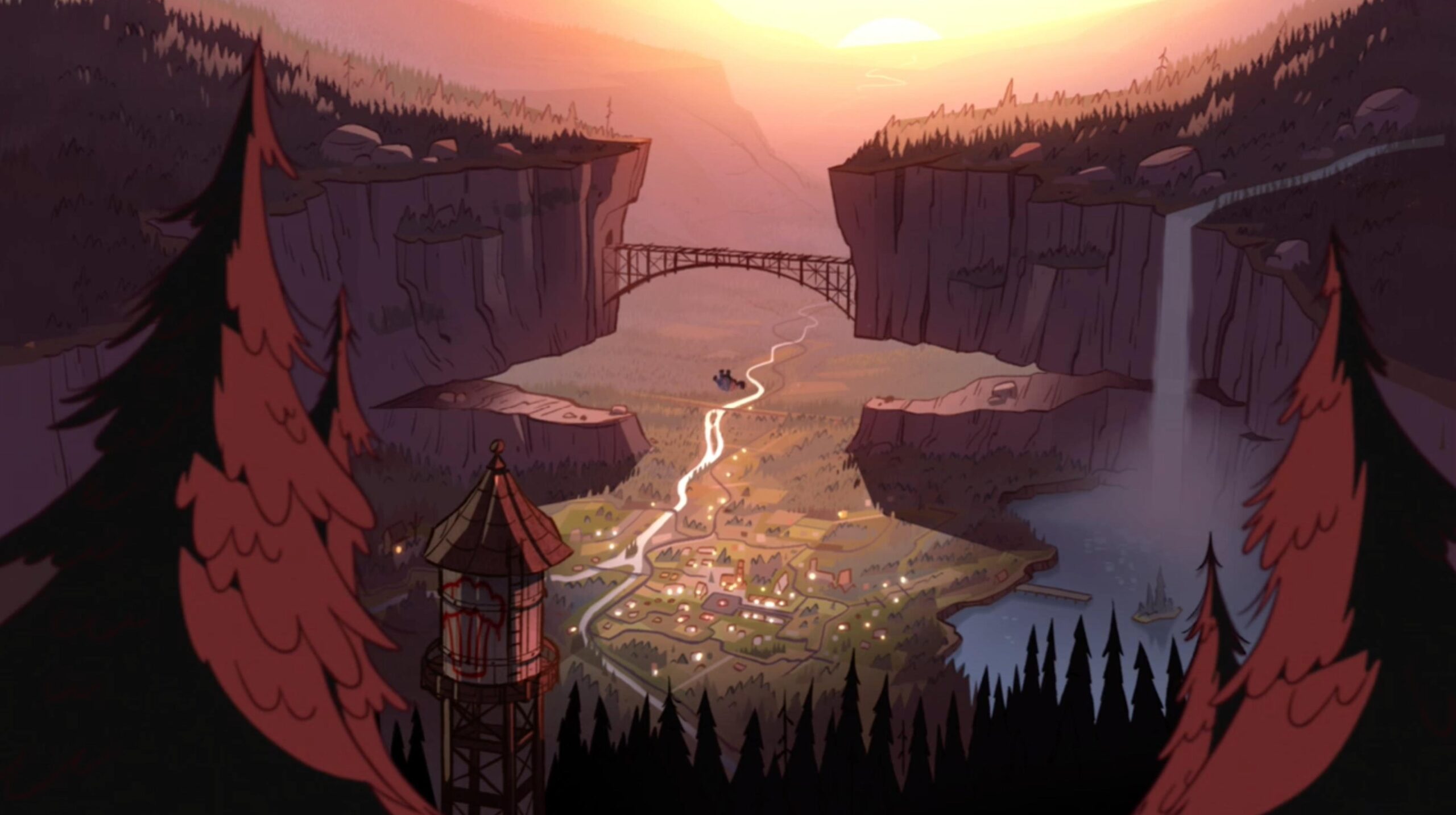
With the combination of worldbuilding, storytelling, and mysteries, Alex Hirsch, in his animated show, Gravity Falls, was able to blend two fond childhood feelings of summer vacation and fall mystery into a story about growing up, family, and adventure, evoking what could be deemed a perfect nostalgic show. One that will evoke sentimentality, whether it’s the hundredth rewatch or the first.