

Table of Contents Show
For any fan of the popular Christmas film Home Alone (1990) or the horror-comedy Beetlejuice (1988), the death of Catherine O’Hara (1954-2026) came as a heartbreaking surprise. The Canadian actress died in February due to a pulmonary embolism during a brief battle with cancer.

Grieving fans have honored O’Hara’s memory by reflecting on her most famous work — especially her performance as Moira Rose on the Emmy-spangled Schitt’s Creek (2015-2020). Moira’s grip on popular culture is impressive — O’Hara’s peculiar line delivery and expert physical comedy have inspired many reaction GIFs and Schitt’s Creek references.
But O’Hara’s screen presence is not all that sets Moira apart from other sitcom moms. Careful collaboration between the showrunners and O’Hara — whom Seth Rogen recently lauded for her script rewriting — drove Moira past the confines of comedy tropes for middle-aged women.
Creating Moira Rose — Collaboration, Freedom, & Character Design
Schitt’s Creek is the riches-to-rags family sitcom nobody saw coming. The CBC comedy was a sleeper hit, its popularity mainly growing through word of mouth until Netflix picked up the series in 2017. By the show’s final season, the cast and crew netted nine Primetime Emmy awards1. This was in no small part due to the creative environment fostered by the showrunners and stars, Eugene Levy and Dan Levy — father and son, both in reality and on the show.

As they prepared to film the pilot episode, Eugene Levy already had O’Hara in mind for the role of Moira. Levy and O’Hara had worked in film together for decades, co-starring in films like Best In Show (2000), A Mighty Wind (2003), and For Your Consideration (2006). When Levy reached out to O’Hara, however, she was hesitant to star in a television series2. Her career primarily consisted of brief projects like film or sketch comedy; she didn’t want to be boxed into one character for several years. Her answer, in the beginning, was “no.”
The Levys’ response to this discomfort was accommodation: they offered O’Hara an out after one season3, adjusted the shooting schedule to meet her needs, and welcomed her to take creative control of Moira Rose’s character. This degree of freedom — for a woman who once had to pitch her sketch ideas through the filter of her male co-star — drew O’Hara into the project.
From then on, O’Hara and Levy exchanged emails in which O’Hara pitched hilarious and outlandish character traits for Moira Rose, and Levy worked to make them happen. From O’Hara’s mind came Moira’s avant-garde wardrobe, eclectic “accent,” abundant vocabulary, and even her wall of wigs.

O’Hara was empowered to create something entirely new for herself. There was a strong precedent set for Moira Rose — sitcom moms, like most female characters, have been haunted by many reductive tropes over the years.
O’Hara, along with the Levys and the other Schitt’s Creek writers, managed to avoid many pitfalls of the stereotypical sitcom matriarch. This careful subversion is best understood by comparing Moira to the mothers who came before her.
The Sitcom Matriarch Trope — A History Of Stress, Sacrifice, & Stereotype
Though women have made their way into writers’ rooms, the patterns laid by decades of male-dominated comedy are still present in modern TV. The classic sitcom matriarch, as designed by men, is not positive representation for women. The matriarch is characterized by a handful of personality traits, the most recognizable of which is stress.
The sitcom mom is typically overworked, handling domestic tasks, raising children, and sometimes keeping a job on top of it all. Despite this pressure, her justified emotions are often repressed, manifesting in sarcasm, substance use, and eventual outbursts played for laughs.

When the straight-laced mother uses substances — usually alcohol, in typical “wine mom” fashion — she is briefly allowed both to express herself and to deliver punchlines. Otherwise, she functions as the “straight man:” a blank backboard where other characters’ jokes can land.
Another feature of the sitcom matriarch is her lack of personal fulfillment. Goals and desires, beyond getting the kids to school on time, are usually not relevant to the matriarch. A career is positioned as a struggle — a difficult balancing act that creates tension for everyone around her. The sitcom mom’s story primarily revolves around her husband and children, meeting their needs and solving their problems.

The classic sitcom mom, like most middle-aged female characters, is not respected or considered desirable. She is past her prime; her husband jokingly leers at younger women before snapping back to his senses. Her marriage ranges from tense to loveless, with the matriarch sometimes behaving more like a caretaker than a wife. If she has a daughter, the matriarch often pays the sexism and disrespect forward, while doting on the son instead.
This reductive caricature of motherhood — and its slow unraveling — is best represented by a few of the most famous sitcom mothers over the past few decades, beginning in the ’90s.
Case Study — Kitty Forman & The Overworked Sitcom Mother
A strong example of the downtrodden sitcom mom comes from That ‘70s Show (1998-2006). The hilarious Debra Jo Rupp plays Kitty Forman, the picture of an American mother in the 1970s. Kitty is a workhorse — while raising two kids, she manages the cooking, cleaning, and shopping for the entire family.

On top of that, she periodically works as a nurse at the local hospital. The punchline of it all is that despite her hard work, she’s emotionally neglected by her husband and kids. She has to beg her husband to be sentimental or take her on a date. It’s made clear that Kitty is considered past her prime and no longer worthy of attention.
“I’m not doing anything else for men today.”4
Her character primarily orbits around her son and husband, while she avoids her daughter and seems to actively dislike her. One notable solo plotline involves Kitty reaching menopause, a storyline that brought menopause out of the shadows and onto the screen.
Otherwise, Kitty’s most iconic moments emerge from her coping mechanisms: drinking, smoking (until Rupp requested this be written out of the show), and anxious laughter. Any internet-goer will be familiar with the image of Kitty Forman sadly pouring alcohol into a pitcher with a straw.
Case Study — Claire Dunphy & The Modernized Sitcom Mom
The ABC sitcom Modern Family (2009-2020) features another well-known sitcom matriarch. The show centers on three main couples, the most traditional of which is played by Ty Burrell and Julie Bowen. Bowen’s character, Claire Dunphy, is an improved version of the same blueprint: a stay-at-home mother who steps back from a career to raise her children.

Her husband is loving but incompetent; her children are snarky and disrespectful; and a mountain of chores grows ever-higher atop her shoulders. Her clenched jaw and type-A personality don’t make her the life of every scene, but Bowen does well with the scripts she’s given.
“You can’t have two fun parents. That’s a carnival.”5
As the show progresses, Claire does undergo character development as a middle-aged woman approaching an empty nest. She channels her repressed frustration into a bid for town council, though she ultimately is not elected. She then inherits her father’s company and works as CEO. These plotlines garner Claire some agency and respect from her peers. All the while, she maintains an arguably happy marriage, which is rare in the sitcom world.
Case Study — Lucille Bluth & The Weaponized Matriarch
The late Jessica Walter (1941-2021) cemented herself into internet culture with her performance in Arrested Development (2003-2019).

Walter plays the venomous Lucille Bluth, mother and grandmother to the disgustingly-wealthy Bluth family. Lucille can hardly be called repressed — she indulges every whim, speaks her mind at any cost, and refuses to be held responsible for others. She’s incapable of domesticity with no need or desire to learn it. She’s given some of the funniest punchlines in the series, and Walter nails every delivery.
“It’s one banana, Michael. What could it cost? Ten dollars?”6
However, Lucille is frequently on the receiving end of some nasty jokes about her age, her appearance, her personality, her parenting, and her alcoholism. She garners very little respect — on par with most other characters in the show — but in her case, this echoes a real-life sentiment of a woman’s value expiring at a certain age.

She is stereotypically nagging, controlling, and manipulative with her children. She is incredibly sexist and verbally abusive to her daughter in particular. Her marriage is a mess of infidelity and dishonesty, and any attempt at companionship or sexuality is usually played for laughs. In these ways, Lucille Bluth is still behind the times.
How Moira Rose Subverts The Sitcom Matriarch In Schitt’s Creek (2015-2020)
Moira Rose is the matriarch of a once-wealthy family who are sued by the IRS and forcibly relocated to the small town of Schitt’s Creek.

Like the rest of the Rose family, Moira at first appears shallow, judgmental, selfish, helpless, and vain — because she is. She is an incredibly flawed character with a lot of room to grow, and, like the rest of the Rose family, she’s virtually a different person by the end of the series.

Still, Moira subverts sitcom tropes as early as Season 1, Episode 5, titled “The Cabin.”7 In this episode, Moira and her husband, Johnny (Eugene Levy), exhibit a few traits uncommon for middle-aged characters: a romantic relationship, an active sex life, and a conversation about maintaining a healthy marriage.
Though these two characters initially have little interest in connecting with other human beings, including their children, their connection with each other is surprisingly respectful. Throughout the series, there’s surprisingly little conflict between the two — notably, both Moira and Johnny are seen screaming at other characters, but never at each other.

Much like Lucille Bluth, Moira displays remarkable domestic ineptitude. In Season 2, Episode 6, “Family Dinner,”8 Moira and her son David (Dan Levy) are tasked with cooking a meal for the first time in…ever. They create something that’s supposed to be enchiladas, but nobody can stomach any.
Moira’s inability to cook is considered ridiculous — just as it is for her husband and her children, who are equally helpless. Even when Moira issues an apology for never teaching her son basic skills, the commentary doesn’t feel gendered. Moira used to know how to cook, but wealth and paid labor led to her losing this skill.

Season 2, Episode 7, “The Candidate”9 shows Moira taking a page out of Claire Dunphy’s book — she’s fed up with the dilapidated state of Schitt’s Creek, so she runs for council. This episode presents an opportunity for a gendered conflict between Moira and Johnny, who also expresses a desire to run. Ultimately, Johnny detects that there is more support for Moira’s candidacy, so he bows out and supports her without a fuss. Moira is elected, and keeps the job for the remainder of the series.
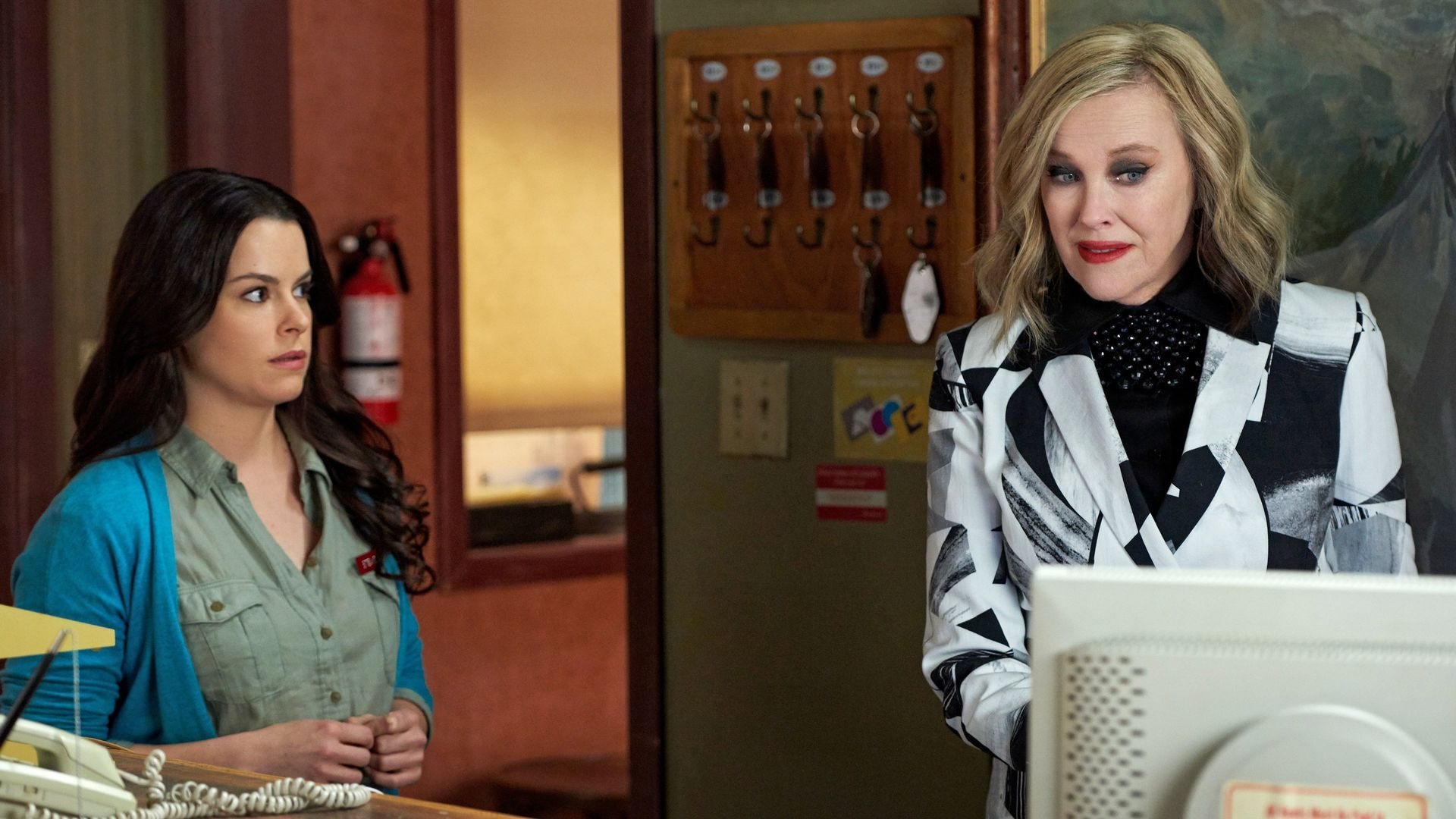
You can probably guess the subject of Season 2, Episode 9, “Moira’s Nudes.”10 During her council campaign, Moira attempts to do preventative internet research and find naked photographs of herself. For a middle-aged woman and a mother, Moira is surprisingly liberal on the topic, urging her daughter to never take nude photographs — ”Never without proper lighting.”
The episode culminates in a heartwarming discussion with a younger woman, Stevie (Emily Hampshire), who runs the motel. She advises Stevie to take plenty of nude photographs while she’s young — even if she doesn’t like to look at herself now, someday, she’ll have a kinder perspective on her body.
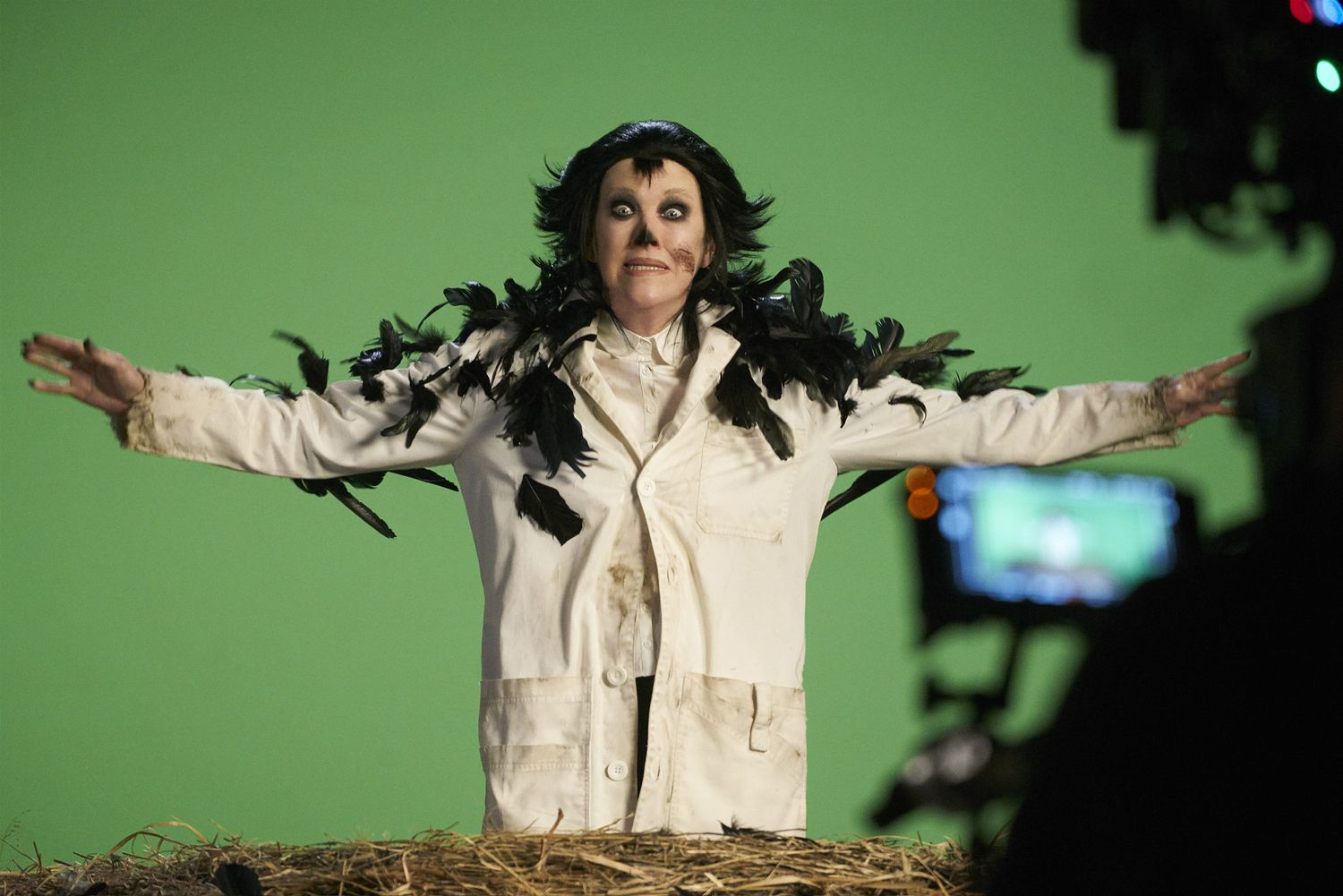
Moira’s acting career is frequently revived in small ways, but in Seasons 5 and 6, Moira receives a major role in a horror film. Not only does this plotline not involve her husband or kids — she actually leaves the family for weeks to film on location. In Season 5, Episode 1, “The Crowening,”11 Moira does call home with doubts; Johnny wonders if she’s worried about her family.
But Moira’s only concerned about the quality of the work and the future of her career. This isn’t the world of Kitty Forman or Claire Dunphy — Moira isn’t wracked with anxiety or guilt for getting a job. In Schitt’s Creek, a mother is empowered to work, just like everybody else.
Where Moira Still Reflects Sitcom Tradition
Of course, Moira is not the paragon of sitcom moms. In keeping with the previous examples, Moira does have a pretty serious substance issue. She’s frequently popping pills, drinking to excess, and behaving erratically.

In Season 1, Episode 6, “Wine and Roses,” a tense acting job results in Moira getting absolutely wasted and nearly losing the role. As Johnny talks her down, he reveals her years of alcoholism, back when she was a television star. Moira’s eyes light up, and she slurs the realization,
“Did I used to have a drinking problem?”
A large part of Moira’s character development is realizing she was not present for her kids’ lives, and now that they are adults, she doesn’t know them at all. Similar to Lucille and Kitty, Moira has a tense relationship with her daughter.

This dynamic is highlighted in Season 3, Episode 2, “The Throuple,”12 when Moira’s daughter, Alexis (Annie Murphy), points out her mother’s favoritism toward her brother, David. Moira invites Alexis to lunch, though both women search for an excuse to cancel. When they meet, they can barely hold a conversation without Moira resorting to conversational flashcards.
Though this relationship does improve — as both Moira and Alexis develop considerably throughout the series — it does follow a sad trend of misogyny between sitcom mothers and daughters.
What Schitt’s Creek (2015-2020) Teaches Us About Writing Mothers On Television
Moira Rose is the result of many crucial ingredients, including the characters that came before her. Catherine O’Hara’s experience, both as a mother herself and as a woman in comedy for over fifty years, informed a truly unique matriarch.
The writers of Schitt’s Creek developed and maintained this multidimensional character over the course of six seasons. And her story takes place in Dan Levy’s unique vision of a slightly utopian small town, where sexuality and gender roles are less of a hurdle for its inhabitants.

The message Moira sends to the sitcom world: real women should be included in the process at every turn. When female actors, writers, and producers are heard, valued, and accommodated, they will create characters men could never imagine. They will deliver performances the world has never seen. They will subvert the expectations set before them.
And they’ll win a ton of awards while they’re at it.
Footnotes
- Bahr, Sarah. “Schitt’s Creek Sets an Emmy Record.” The New York Times, September 20, 2020. ↩︎
- Aurthur, Kate. “Eugene Levy and Catherine O’Hara Reflect on the Charms of ‘Schitt’s Creek.'” Variety, April 7, 2020. ↩︎
- Aurthur, Kate. “Daniel Levy Looks Back on the Evolution of ‘Schitt’s Creek.'” Variety, April 4, 2020. ↩︎
- “Jackie Says Cheese.” That ‘70s Show, Season 4, Episode 13, Fox, Jan. 8, 2002. ↩︎
- “Manny Get Your Gun.” Modern Family, Season 2, Episode 8, ABC, Nov. 17, 2010. ↩︎
- “Charity Drive.” Arrested Development, Season 1, Episode 6, Fox, Nov. 30, 2003. ↩︎
- Walsh, Amanda, Chris Pozzebon, and Michael Grassi. “The Cabin.” IMDb, March 4, 2015. ↩︎
- Read, David West, Chris Pozzebon, and Stephanie Kaliner. “Family Dinner.” IMDb, March 16, 2016. ↩︎
- White, Kevin, Chris Pozzebon, and Stephanie Kaliner. “The Candidate.” IMDb, February 16, 2016. ↩︎
- Read, David West, Chris Pozzebon, and Stephanie Kaliner. “Moira’s Nudes.” IMDb, March 2016. ↩︎
- Levy, Dan, Pavan Moondi, and Salvatore Antonio. “The Crowening.” IMDb, January 19, 2019. ↩︎
- Read, David West, Matt Kippen, and Monica Heisey. “The Throuple.” IMDb, January 17, 2017. ↩︎