
Table of Contents Show
Lazarus: Fallen #2 and #3 offer an interesting contrast in how the team of Greg Rucka and Michael Lark’s storytelling has changed over the years. After many (many) delays, the series is committed to trying to finish on a regular schedule, and so far, they have stuck to it. However, the storytelling differences are front and center, with these two issues serving as a microcosm.

One issue benefits from the frantic pacing, pulling the reader into a life-or-death situation. The other falters under that same pace, with too much to cover in too little time, diminishing its emotional impact.
Why Lazarus: Fallen #2 Falters Under Its Own Speed
Lazarus: Fallen #2 delivers a long-anticipated scene years in the making, though its impact comes across as somewhat muted. It has a lot of ground to cover — and has to cover it quickly. The increase in page count during the Lazarus: Risen era proved to be a boon for the series.

It allowed quieter moments to breathe more than the traditional page count. Now we are back to normal page count, and that is great in terms of delivering quality comics month-to-month more regularly, but it also leads to some scenes feeling lost or truncated.
Forever & Jonah Reunited
Forever finally meets back up with Jonah after years, both in-universe and in the real world. It is a momentous moment, showing how these characters have grown and changed. It is also quite emotional, and Rucka’s words and Lark’s art on facial expressions show how delighted yet awkward they are to see each other. The problem is that the cast must be quickly settled into the sect of the Free, even rushing through a montage to reach the cliffhanger. The scene carries great impact, yet it passes by too quickly.
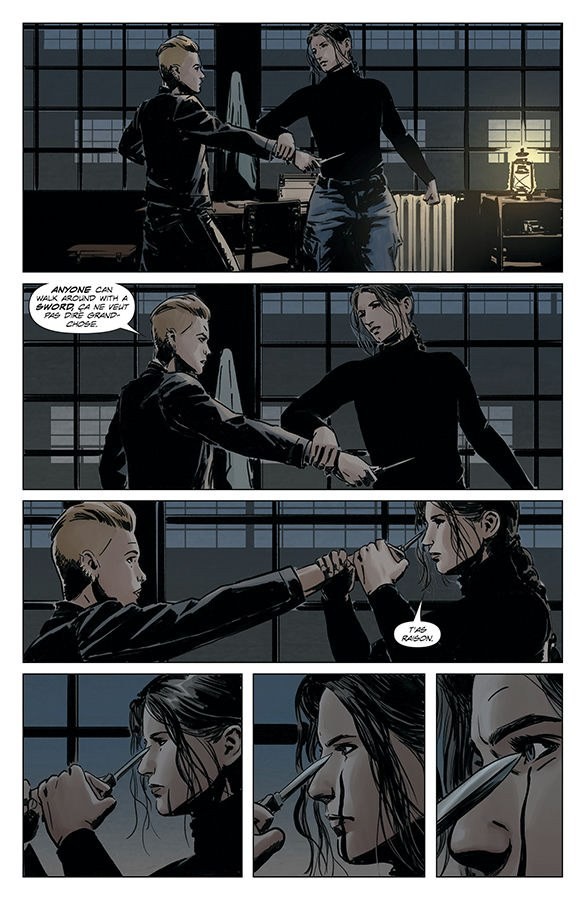
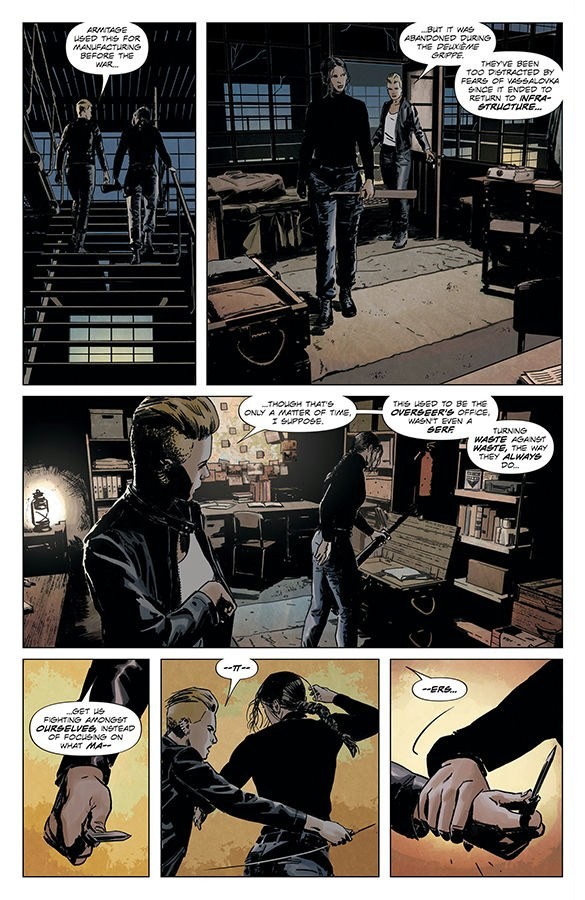

Meanwhile, the montage to ingratiate Infinity and Forever with the Free is split in two. Forever shines in a moment of vulnerability with the leader, but Infinity is never given the same opportunity. Then we are treated to a montage leading into the cliffhanger, making it feel uneven.
Could this be a consequence of the reduced page count? Infinity seems to receive too little focus, an issue that Lazarus: Fallen #3 appears intended to address.
Why Lazarus: Fallen #3 Works Better At High Speed
Whereas Lazarus: Fallen #2 suffered from the speed at which things had to go, Lazarus: Fallen #3 benefits from it greatly. The fight choreography in this series has always been fantastic, partly due to Rucka having experience staging fights for theatre and partly due to Lark’s fantastic use of body language and momentum.

The fight between Forever and Thomas is exceptionally brutal. Thomas immediately unloads a full clip into Forever, asserting the upper hand. Although Forever can heal, her recovery is slower now, and he knows he cannot defeat her in a fair fight. What follows is blow after blow of a fight that will have you on the edge of your seat. This sequence moves incredibly quickly — but that pace works in its favor, succeeding in ways the reunification of Forever and Jonah did not.
Special shout-out needs to go to Santiago Arcas in Lazarus: Fallen #3. In the letter pages, Greg Rucka talks about how Infinity’s new powers of camouflage were difficult to get to work adequately. In comics, motion is implied, and things like invisibility and similar powers need motion to be fully conveyed.

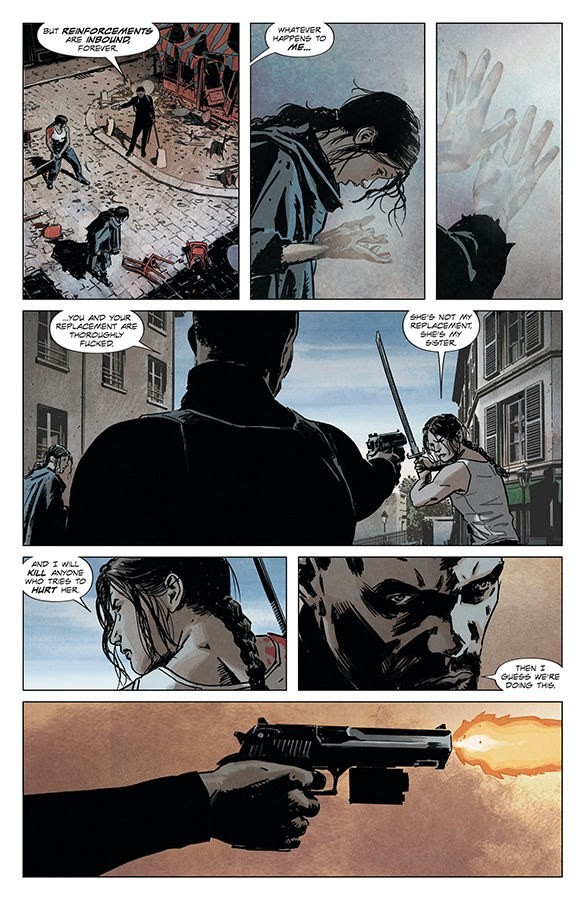
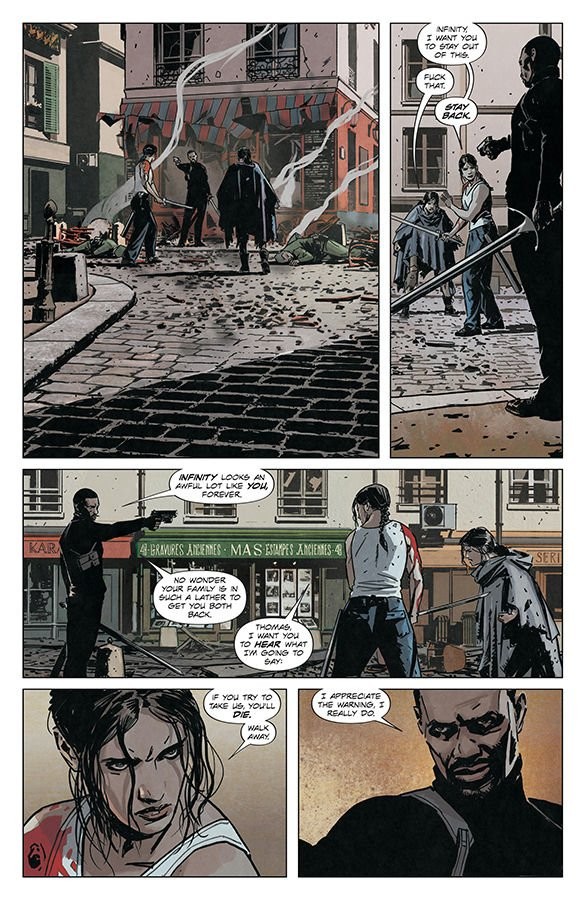
Arcas came up with the concept of smudging the colours of things that Infinity is near, drawing the eye away from her. A comic book-style way of doing what real creatures like chameleons do in real life.
Are Lazarus: Fallen #2 & #3 Rushing The Story?
Lazarus: Fallen #2 and #3 exemplify the strengths and weaknesses of this team and series. The work is meticulously crafted, thoughtfully executed, and fulfills promises made years ago. Yet the constant delays raise the question of whether the team felt pressure to speed things toward the conclusion.
As noted in the previous review of Lazarus: Fallen #1 and even the final issue of Lazarus: Risen, the delays are affecting many readers’ enjoyment of the series. Entire years have passed between single issues, and the creative team has apologized profusely on social media and in the letter pages.
While the effort is commendable, it seems the team may have taken criticism too much to heart. The issues now move so quickly that details are lost in the margins. A pause to linger with the characters would be welcome — moments like Jonah and Forever’s reunion deserve more than two pages.