
Table of Contents Show
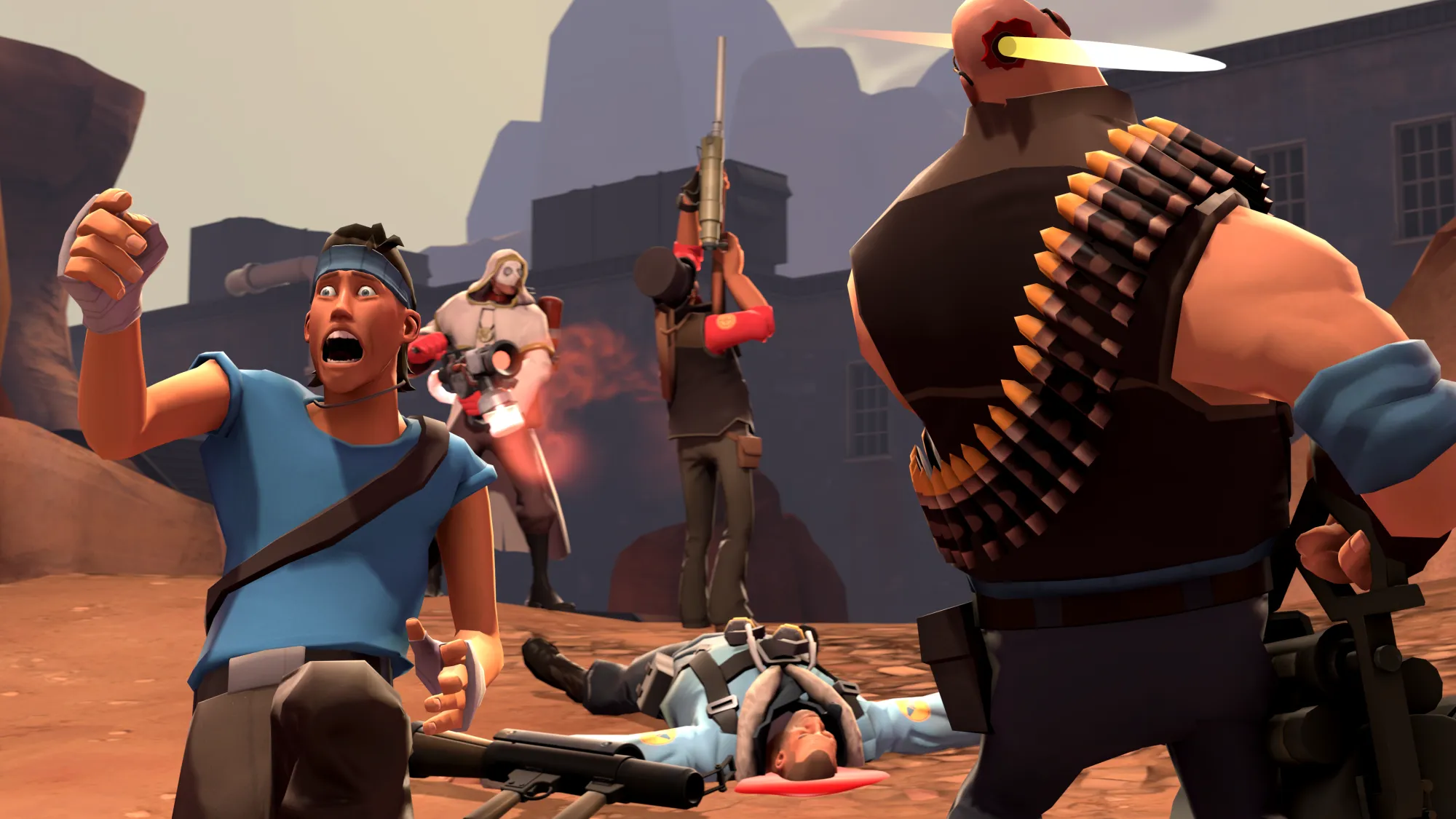
When development studio Valve released its highly anticipated sequel to the 1997 hero shooter game “Team Fortress Classic,” “Team Fortress 2″ (2007; Valve) (TF2), few could have imagined the impact the title would have on the hero shooter genre and gaming as a whole.

Yet over 18 years later, TF2 has established itself as a dominant cultural force that fosters community both online and in the real world. A talented fanbase that spread TF2’s influence across the internet and a dedicated development team that pioneered new game design mechanics have allowed TF2 to stay relevant and influence the gaming industry in ways its younger peers have not. TF2 and its fanbase set the foundations for characteristics of modern gaming. The game’s imperative role in video game history as a platform for fans to foster their creativity has transformed it from a simple shooter to a turning point in gaming history.
“Meet The Team” — A New Approach To Hero Shooters
The original “Team Fortress” was not a stand-alone title. It was developed by development studio TF Software as a free multiplayer mod for the 1996 shooter “Quake.” This release would later be repackaged as the stand-alone title “Team Fortress Classic” in 1999. TF Software was soon absorbed by development studio Valve.1 Seeing the game’s massive success and positive reviews, the studio was motivated to develop a sequel to it.
“Team Fortress 2,” initially subtitled “Brotherhood of Arms,” was initially unveiled at E3 1999 and won numerous awards, including “Best Online Game” and “Best Action Game.” The sequel then faced multiple days, resulting in it being in development hell for six years. Between switching to Valve’s proprietary source engine Source, Valve focusing their efforts on sister game “Half-Life 2,” and an asset leak halfway through development of the second build, the game went through multiple renditions before settling on its final version.2
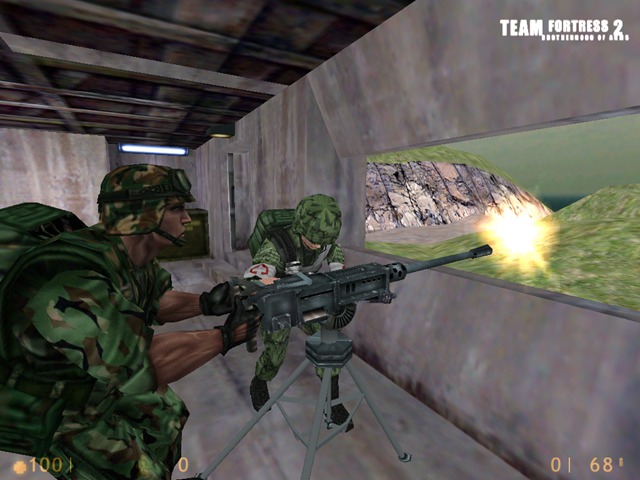
In the final build, TF2’s developers gave the game’s assets a retro aesthetic reminiscent of mid-20th century cartoons.3 This was in stark contrast to other games based on the Source engine like “Half-Life 2,” which attempt more realistic graphics. Humor was also introduced as part of the game’s art direction, becoming an defining characteristic of the Team Fortress franchise. These two focal points allowed the game’s developers to solve or sidestep many of the issues present in previous shooter games.
“There are realistic games that aren’t intended to be humorous, but you have ragdolls, you have people fighting with non-realistic tactics…We said, let’s just embrace the exaggerated funny things that happen. We used that to our advantage,” developers Charlie Brown (CB) and Robin Walker (RW) said in an interview with publication Rock Paper Shotgun.4
For example, the game’s “Death Cam,” which allows players to see who took them out and where, derives from the game’s focus on comedy, but it allows players to quickly recognize why they lost. In the beta release of the game, some of the maps include developer commentary. One of these pieces of commentary explains how the developers fixed the issue of realistic shading. By choosing not to make the game’s graphics realistic, they were able to sidestep the issue entirely.5

Class readability and accessibility were also improved as a result of the developers’ focus on a retro aesthetic and comedy. The nine different classes in the game are all represented by archetypes with similar character design traits, creating characters that can be recognized by their silhouettes. Similarly, the game’s color palette uses both variation and consistency to show who is on the BLU team and who is on the RED Team.6 Although each character’s voice lines are iconic, the game cycles between them depending on context, allowing players to pick up on what is happening in the game instantly.
CB: We’ve had a few play-testers who weren’t really aware of the game, and the Engineers building up his…
RW: “Building a teleporter!”
CB: And we’ve got this person going…
RW: “Hey, it’s a teleporter.”
CB: And they figured out what teleporters were at that point.
“An Ongoing Project” — How “TF2” Introduced Live Updates & Virtual Economies
”Planned as an ongoing project,” TF2 set up the foundation for modern games receiving live service and content updates, creating multi-year support from the developers.7 On April 29, 2008, TF2 fans received a surprise when Valve released the first major update to the game, “The Gold Rush Update,” which is alternatively known as “The Medic Update.” The update was released free of charge. It introduced the “Payload” game mode, in which one team has to push a cart all the way across the map, and the item system.8
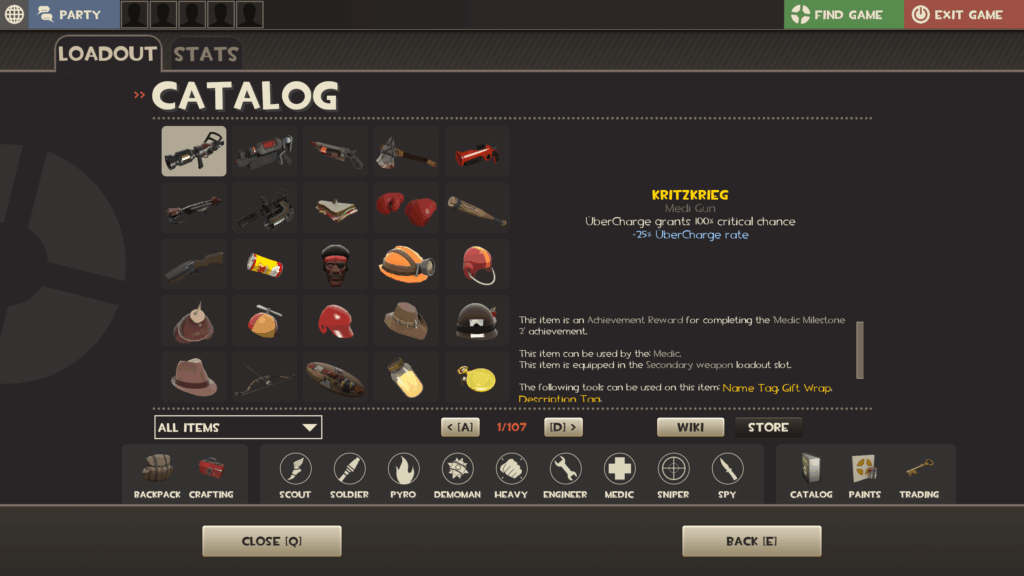
Items, whether they were weapons that enhance one aspect of a class while weakening another or cosmetic items like hats, provided a substantial new aspect to gameplay. This was accentuated by the “Mann-Economy Update” two years later. That update added the “Mann Co. Store,” which allowed players to buy items with real world currency. These two updates caused an economy to develop as an integral part of TF2’s gameplay, especially among dedicated players.
However, the introduction of microtransactions into TF2 also had a side effect. They gave in-game items real world monetary value. As a result, players developed a virtual economy where in-game product “keys” (purchased through real-world money) and “refined metal” (created through smelting or combining other types of metal) serve double duty as their own forms of currency. They even fluctuate in value depending on market conditions. These two forms of currency allowed players to essentially buy items through the trade system, including “unusuals,” items with special particle effects that are considered to be the rarest and most sought after items in TF2’s economy.9
“Meet the Fans” — How Players Use “TF2” As A Game, A Canvas, & A Community
While TF2 and Valve are recognized for the innovative game mechanics they introduced to players, an even more influential part of TF2’s legacy lies in its community. The game, although engaging on its own, has also been propped up by a fanbase who have driven the title forward and kept the game alive through their creativity and unity. Fan engagement has become one of the most defining features of the franchise, if not its most defining feature. It drove much of TF2’s success and separated it from other titles of its genre.

The community has set up private game servers with their own plugins and mods that add to the official maps and modes released by Valve. These custom servers allow players to play custom game modes on fan-made maps, providing them with alternative ways to play the game. Popular examples include x10, where stats and attributes are multiplied by ten, Randomizer, where players are assigned to random classes and weapons every time they respawn, and Class Wars, where all players on one team are placed in a single class and play against a team of a different one.
Meanwhile, third-party websites like the now defunct Facepunch became pockets of community for ambitious TF2 fanatics who created their own models and assets. The fanbase became so actively engaged with the developers that Valve would sometimes end up officially including fan-made contributions in the game. As a user named Cufflux on the forum page Knockout put it, “they had so much output that they would create mock updates.”10
“As Valve would eventually let the community make their own updates for a while, you could trace practically all of the contributors to these pages back to people who posted in these threads. You had the resources, the tools, feedback, a community, everything you needed to start and a massive resumé, if not actual cold hard cash if you successfully got an item into the game,” said Cufflux.
Beyond fans’ contribution of new features, TF2 has acted as a common factor for avid gamers to unite to honor and protect what the game has become. The death of Soldier’s voice actor Rick May in April 2020 caused fans to come together and pay tribute to his legacy and work in the game, both through fanart and videos and also in-game. TF2 has also acted as a common factor for avid gamers to unite to honor and protect what the game has become. The death of Soldier’s voice actor Rick May in April 2020 caused fans to come together and pay tribute to his legacy and work in the game through fanart and videos as well as in-game. Servers globally called for a truce and played his taunts and voice lines, 21-gun salutes were played commemorating him, and Valve placed a permanent tribute memorial to him in one of the game’s maps.11

More recently, the onset of bots in TF2 servers beginning around 2022 negatively impacted normal matchmaking, causing many in the community to unite again to push Valve to fix the game’s issues. Through community movements #SaveTF2 and #FixTF2, TF2 players rallied the developers to pay attention to the game and fix official servers so people could actually enjoy matchmaking. These movements culminated in a petition with over 340,000 signatures being delivered in-person to Valve’s headquarters.12 As a result, Valve released an update and banned most of the bot accounts plaguing official servers, allowing players to properly enjoy the game again, at least temporarily.
“Meet The Directors” — Source Filmmaker (SFM) & How It Introduced Internet Culture
Beyond the gaming world, TF2 has also made an insurmountable impact on pop culture thanks to the rise of tools that helped creators develop works of art around the game, increasing its mainstream exposure and relevancy.
Most notably, Valve released a set of shorts called “Meet the Team” that detailed the hero shooter’s classes to promote TF2’s release. In addition to showcasing the gameplay styles of each class, the “Meet the Team” shorts also introduced each TF2 character’s personality, fully fleshing out what were simply gameplay styles into a lovable cast that fans felt drawn to.13
“In a short few minutes, the animation and voice acting of these pieces told you exactly who these people were. And if you didn’t want to play the game, that was fine. You could just enjoy the craftsmanship on display,” said Imogen Meller of PC Gamer.
However, Valve’s “Meet the Team” shorts also had an important impact on TF2’s fandom and other games’ fandoms as well. By showcasing fluid animation through their in-house 3D-graphics and the animation tool“Source Filmmaker (SFM),” the shorts pioneered a new way for fans to make memes, compose screenshots of epic fight sequences, and most impactfully, write their own fan films. Fans found the SFM software accessible yet powerful, and soon both TF2 fans and non-TF2 fans began to upload their own “machinimas.”
The term “machinima” originally meant “video game footage that is edited to form a story” but now commonly refers to any storytelling involving video games or their characters.14
SFM was another way for fans to bring their creativity to life. Over a decade later, SFM creators have left behind an influential subgenre of videos online on platforms like YouTube.Not only have they entertained and captured the hearts of viewers with stories told through 3D animation, but they also introduced new fans to TF2’s jokes and references.
Many SFM videos and films were influential within the TF2 circle. When SFM creator McVee released a trailer for her newest project, “End of the Line [SFM],” in 2013, her teaser became so popular among TF2 fans that Valve themselves invited her to their headquarters to propose developing an official content update based wholly around her work.15 The release of the final animation, which revolved around the BLU Team trying to set a payload of bombs towards the RED Team’s base, coincided with the content update and introduction of the game mode of the same name.

Valve also hosted the Saxxy Awards, an annual awards show for SFM films, and many of the show’s entries became increasingly polished over the years. Other than these Saxxy-nominated or award-winning films, many other SFM videos have also been revered as legendary among the community. Valve and SFM have not hosted the Saxxy Awards since 2017, but plenty of SFM videos released since then have gone on to achieve acclaim independently. The community even hosted their own “Community Saxxy Awards” in 2021.
“It’s just invigorating for something you love [TF2] to have new and original life breathed into it. It takes genuine knowledge and creativity to take a pre-established universe and make something new and exciting from it,” said Martin Johnson from Medium.
In 2023, Australian director Chad Payne and fan group Fortress Films broke ground when they released the 108-minute full-length horror film Emesis Blue. The SFM film, which revolves around the theme of corporate abuse through the malfunction of TF2’s respawn mechanic, is based on assets and elements of the original game and its lore, but it tells an original story. Notably, the film was critically acclaimed as a body of work that pushed “Source Filmmaker” to its absolute zenith, with “even the film’s technical limitations being artistically expressed.”16

“Consistent stylization and mysterious lighting allow Emesis Blue to depict its lawmen as shadowy, obscured figures. A choice that could have been a lazy cop-out (no pun intended) in a less focused movie is instead a strong, in fact advantageous characterization,” said Kayvon Bumpus of Bright Lights Film Journal.
SFM complemented the emergence of a side of TF2’s fanbase that focuses less on the game itself and more on its characters’ likenesses. The rise of SFM animation on YouTube and TF2’s increasing permeance in internet culture introduced more people to the creative side of the fandom, whether through SFMs about TF2 itself or SFMs where TF2 characters interacted with characters from other intellectual properties (IPs).
TF2 is no longer just celebrated for how fun the game is or the many memes it inspires. It is also celebrated for its influence on cosplayers, directors, writers, artists, Tumblr bloggers, and many others.
A Team-Driven Community — “TF2″‘s Influence On Online Fandom & The Gaming Industry
Valve’s innovative mechanics and team-driven approach have helped keep the “Team Fortress 2″ community alive even through its setbacks. Although the game’s content updates have stopped, the creativity of the game’s fanbase has not, drawing both loyal fans and newcomers to the franchise. Fans and casual players appreciate and value the game for the impact it had on shooters and the gaming industry as well as the impact it had on internet culture and fandom, allowing TF2 to stand the test of time.

Some of the features Valve introduced in TF2, such as virtual economies and limited multi-year support from the developers that ends when content updates stop being released, have been somewhat controversial yet widely adopted across the gaming industry. These features and TF2’s highly focused player roles have become associated with future pioneers in the hero shooter genre like “Overwatch” (2015) and “Splatoon” (2015), making it clear that the gaming industry continues to follow in the footsteps of what is arguably Valve’s most influential work. TF2 servers continue to see consistent player counts, showing that the game and the IP associated with it have fans to this day.
The character and lore-focused side of TF2’s fanbase has continued to thrive, becoming arguably more influential than its in-game oriented side. TF2’s association with “Source Filmmaker” transformed what were simply characters and settings in a game into characters with fleshed out personalities and a setting with lore, introducing variables that writers, artists, and directors could play with to tell their own stories, whether they be comedic or atmospheric.
“Team Fortress 2″ and its fans revolutionized the world of gaming fandom by elevating it to the same level as fandoms of TV shows or movies. Since TF2’s release, the hero shooters that followed it and the gaming industry have prioritized developing characters with backstories and personalities fans can feel attached to.
Footnotes
- “About Team Fortress Classic.” Planet Fortress. 13 December 2006. Accessed 9 November 2025. ↩︎
- Valve. “Half-Life 2: 20th Anniversary Documentary.” YouTube. 15 November 2025. Accessed 9 November 2025. ↩︎
- Walker, John. “RPS Exclusive: Team Fortress 2 Interview.” Rock Paper Scissors. 1 October 2007. Accessed 10 November 2025. ↩︎
- Walker, John. “RPS Team Fortress 2 Interview – Part 2.” Rock Paper Scissors. 3 October 2007. Accessed 10 November 2025. ↩︎
- Anonymous. “Team Fortress 2.” Official TF2 Wiki. 31 July 2025. Accessed 9 November 2025. ↩︎
- Coelho-Kostolny, Xavier. “Character Readability in Team Fortress 2 and Overwatch.” Medium. 16 November 2020. Accessed 10 November 2025. ↩︎
- Anonymous. “Once Upon a Time…” TeamFortress.com. 5 October 2022. Accessed 9 November 2025. ↩︎
- Anonymous. “Team Fortress 2 Gold Rush Update.” TeamFortress.com. 29 April 2008. Accessed 9 November 2025. ↩︎
- slideFN. “The TF2 Economy Explained in 60 Seconds.” YouTube. 21 October 2022. Accessed 10 November 2025. ↩︎
- Cufflux. “30,000 Words of TF2/SFM Nostalgia.” Knockout! 2022. Accessed 10 November 2025. ↩︎
- Clayton, Natalie. “Tributes to Soldier voice actor Rick May appear across Team Fortress 2.” Rock Paper Scissors. 2 May 2020. Accessed 11 November 2025. ↩︎
- The WhatShow. “We Visited Valve to Save TF2.” YouTube. 16 September 2024. Accessed 11 November 2025. ↩︎
- Mellor, Imogen. “How Team Fortress 2’s silly videos sparked a whole new era of shooters.” PC Gamer. 27 May 2022. Accessed 11 November 2025. ↩︎
- Johnson, Martin. “The Spirit of Source Filmmaker. …Explained through the Cult of Personality.” Medium. 3 June 2023. Accessed 10 November 2025. ↩︎
- Anonymous. “Kritzkast Presents: Meet Your Makers | The Content Contributors of Team Fortress 2: Day 2.” KritzKast. 30 Janurary 2020. Accessed 10 November 2025. ↩︎
- Bumpus, Kayvon. “Mercs and Mortality: Emesis Blue, a Fan-Made Team Fortress 2 Horror Flick.” Bright Lights Film Journal. 16 April 2024. Accessed 10 November 2025. ↩︎