
Table of Contents Show
With the release of Spider-Man: Brand New Day (2026), the Jean Grey of Earth-616 has made her first appearance. Thunderbolts* (2025) director Jake Schreier is set to take the reins and welcome mutants into the Marvel Cinematic Universe (MCU),1 and fans are eagerly awaiting more news about the upcoming reboot of the beloved X-Men franchise.
But Jean is not the first mutant to appear in the MCU. Both Kamala Khan and Namor were confirmed to be mutants in Ms. Marvel (2022) and Black Panther: Wakanda Forever (2022), respectively. And, while it has not been confirmed, some fans theorize that the MCU’s Simon Williams developed his ionic powers through the X-Gene. Marvel’s mutants are distinguished from other characters born with superpowers because they have this gene, which typically activates around puberty and gives the individual mutant powers.

Mutants in the comics have long been used as an allegory for real-life oppression. For instance, the 1988 Genosha story arc drew many similarities to South African apartheid,2 and many X-Men stories have featured imminent threats from hate groups or anti-mutant legislation. The randomness of the X-Gene can also be read as a metaphor for queer awakenings, as one of the major fears of anti-mutant bigots is that anyone can be born a mutant. Humans in the Marvel universe fear their child could be a mutant just as homophobes in the real world fear the prospect of their child being gay.
As the MCU builds toward the proper introduction of the X-Men, the artists behind recent projects have both foreshadowed and employed a modern interpretation of the mutant metaphor. The injustices on the screen are not dissimilar to the ones that pervade American society in the 21st century.
How Ms. Marvel Introduces The Mutant Metaphor Through Surveillance
The Department of Damage Control (DODC) serves as the secondary antagonist of the Disney+ series. It was introduced in Spider-Man: Homecoming (2017) as a new federal organization created in the wake of the Battle of New York. The department’s purpose was originally to salvage exotic materials from superhero battles, but over time the DODC became something else. Their agents were given the authority to arrest and detain enhanced individuals or suspected associates. They assumed the responsibility of building a case against those people, and they ran the prisons that held them.
Before this development, prosecuting vigilantes and other criminals, enhanced or otherwise, would have fallen under the jurisdiction of the Department of Justice. Damage Control’s history in the MCU has some parallels with the creation of the Department of Homeland Security as a response to the September 11 attacks.
Ms. Marvel focused on two DODC officials: Agent Sadie Deever and her superior Agent P. Cleary, who had previously been in charge of investigating Peter Parker in Spider-Man: No Way Home (2021). Cleary authorized Deever to open an investigation into the recent appearance of an enhanced individual in Jersey City.
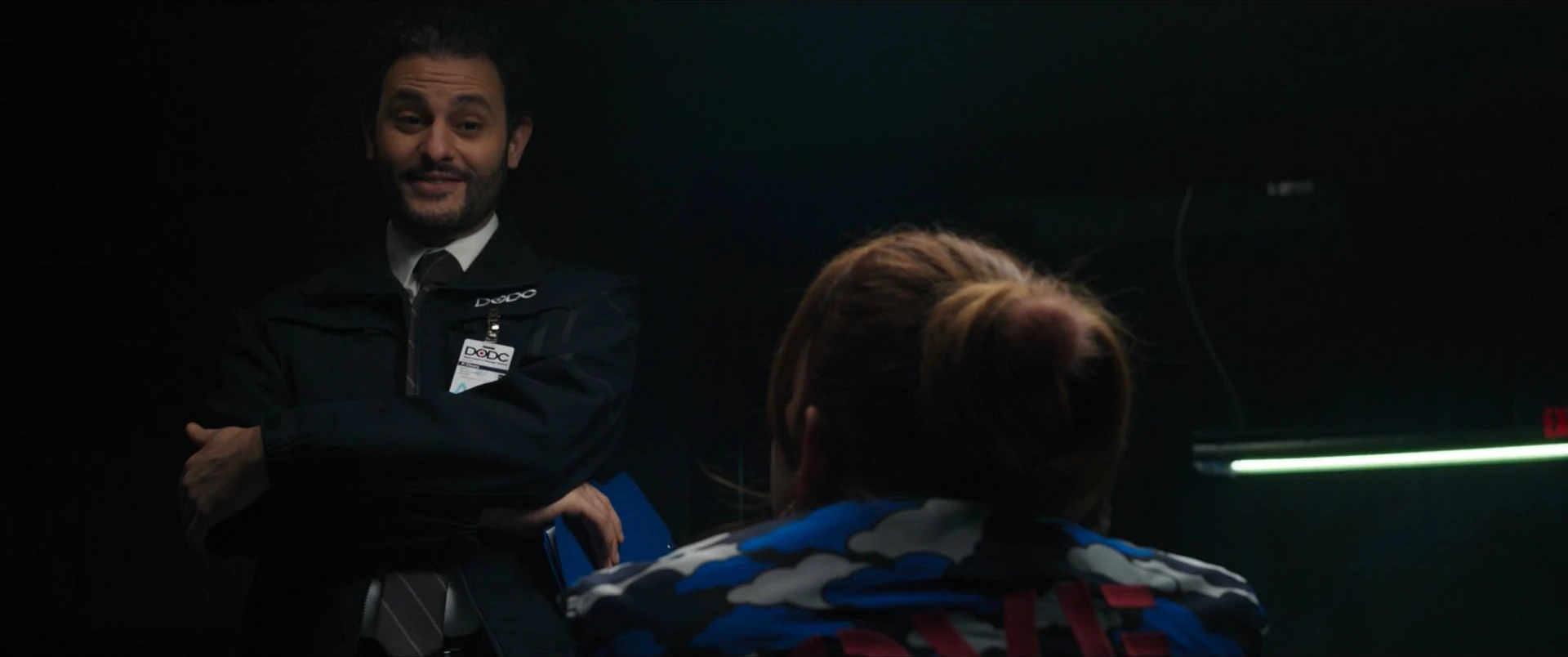
While Damage Control introduced Kamala to the perils of being a mutant in the MCU, even if that label didn’t exist yet, the creatives behind the show gave the audience glimpses into the discrimination faced by Muslims in the United States. When Cleary and Deever are interrogating Zoe Zimmer to learn more about Ms. Marvel, Cleary attempts to build rapport and extract information to narrow in on Kamala’s identity and whereabouts. Deever, on the other hand, begins by pressuring Zoe to reveal Ms. Marvel’s ethnicity and whether or not she had an accent.
“Let’s do the tri-state sweep. Search every temple, community center, and mosque. Just be respectful. The FBI is already surveilling them, you know that.”3
Agent Cleary to agent deever. Menon, Meera. 2022. “Crushed.” Episode 2, Season 1 of Ms. Marvel. Marvel Studios.
What this scene is referencing is the widespread surveillance of Muslims and Muslim communities across the United States. Government agencies, both local and federal, mark behavior as suspicious because the individual in question practices Islam. From December 2008 through March 2009, the FBI initiated assessments of 11,667 people and organizations, with 427 cases being opened for further investigation. Muslims were disproportionally represented in the FBI’s data collection, and behavior that they would have seen as normal for white, Christian Americans was interpreted as indicative of wrongdoing.4
Cleary acts uncomfortable with Deever’s prejudice, but he is an instrument of this machinery whether he is as openly hostile towards Muslims as she is or not. The scene establishes the parallels between the DODC’s treatment of superhumans and the FBI’s treatment of Muslims, like the mutant metaphor functions in the comics.
How Wonder Man Connects The Mutant Metaphor To Mass Incarceration
The DODC returned in Wonder Man (2026), seeking to gather evidence that Simon Williams had potentially dangerous superpowers. However, their motivation was not public safety. Rather, the top brass at Damage Control was worried that Congress would limit their budget if they did not incarcerate more people within their high-security prison.5 Agent Cleary, fearing for his job security rather than justice, began an investigation into Simon before the events of the series.

This premise shares many similarities with the realities of the American private prison system. Many private prisons put occupancy clauses into their contracts, meaning that states must pay a fine if the population of a facility dips below a certain threshold. This incentivizes putting more people in prisons and keeping them there for as long as possible. Rates of incarceration have increased dramatically over the last fifty years, but the effect on crime rates has been negligible.6
Cleary never had a confrontation with Simon, though. The conflict between the DODC and Williams was almost entirely one-sided. Damage Control’s strategy was to send actor-turned-fake-terrorist Trevor Slattery to befriend Simon and spy on him for proof of superpowers.
Cleary pressured Trevor into becoming an informant by threatening to send him back to prison. This same tactic has been used to spy on and attempt to entrap American Muslims.
“Craig Monteilh, a felon convicted of robbing cocaine dealers, sued his FBI handlers for manipulating him into spying on the Islamic Center of Irvine, California, where he would encourage co-worshippers to visit Jihadist websites. By one such accounting, such FBI tactics in the course of a decade resulted in a network of fifteen thousand informants.”7
Ackerman, Spencer. Reign of Terror: How the 9/11 Era Destabilized America and Produced Trump. Viking Press. 10 Aug. 2021.
Local law enforcement like the Chicago PD have also been known to utilize similar methods to generate informants, disproportionally targeting Black people.8
Ultimately, Trevor chooses to sacrifice his own freedom to ensure Simon gets to stay out of prison. The bosses at Damage Control are satisfied as long as someone is in a cell, no matter who it is or what they’ve done. It would be easy to argue that arresting Trevor did the department more favors than arresting Simon would have.
Marvel Studios introduced Trevor Slattery in Iron Man 3 (2013) as a red herring. The promotional material for the film led audiences to believe that Sir Ben Kingsley would be starring as the Mandarin, Iron Man’s nemesis from the comics. But the Mandarin in the movie was a fiction created by the true antagonist of the movie, Aldrich Killian, with Slattery being a simple actor hired to portray the villain. Rather than yet another film about American heroes beating two-dimensional terrorists, the plot centered on an American war profiteer inflating the myth of an anti-American terrorist threat to enact a scheme that would end with him assuming economic and political control of the United States.

Trevor Slattery’s inclusion in Wonder Man is a deliberate reminder of the themes of Iron Man 3. Simon is a potential mutant and a Black man who is being spied on, scrutinized, and persecuted by the US government in the name of filling a prison cell. Trevor was used to trick people into fearing an outside threat so that they wouldn’t look too closely at the activities of American corporations. In actuality, the greatest threat to their freedoms was not terrorists, but companies like Killian’s A.I.M. and government bodies like the Department of Damage Control.
How Spider-Man: Brand New Day Explores Mutant Persecution
Jean Grey spent the majority of Spider-Man: Brand New Day trying to locate her older sister Sara, who had been abducted by Damage Control. Jean and Sara’s mother had disowned them after she found out the siblings were both mutants, an experience that may feel familiar to too many queer youths whose parents could not accept their own children.
After being captured by the DODC and transported to a black site, Director Bill Metzger subjected Sara to brutal and illegal experiments in an attempt to weaponize her telepathic powers for the US government. The William Metzger of the comics is a minor X-Men villain who led an anti-mutant hate group, whereas his MCU counterpart holds federal office. Sara Grey died in Damage Control custody, telepathically broadcasting the last thing she ever saw to her sister.

Sara’s fate is yet another similarity between Damage Control and DHS. The rate of people dying in ICE detention has risen to new heights since the beginning of the second Trump administration, indicating violations of international law.9 Recently, ICE changed their policy regarding reporting the deaths of recently released detainees to avoid accountability for the horrid conditions they subject people to.10
Secret ICE facilities similar to the one operated by Damage Control in the film have become a major issue for families searching for loved ones taken by DHS.11 But illegal detentions are an issue that extends beyond ICE. Chicago police use an off-the-books warehouse known as Homan Square to “disappear” thousands of people. Lawyers are unable to locate their clients, detainees are not allowed to use their phones to call, and no booking records come from Homan Square. 82.2% of the thousands of people detained there circa 2015 were Black, but only 45% of the 68 people who Chicago police claim had access to legal counsel at Homan Square were Black.
“No contemporaneous public record of someone’s presence at Homan Square is known to exist.”12
Ackerman, Spencer. “Homan Square revealed: how Chicago police ‘disappeared’ 7,000 people.” The Guardian. 19 Oct. 2015.
Damage Control’s actions in Spider-Man: Brand New Day reflect Americans’ growing antipathy towards government organizations like ICE in response to the brutal treatment of their neighbors and loved ones. Metzger used the guise of national security to detain and torture a young woman to death. The mutant metaphor elevates the story and draws attention to one of the most pressing human rights issues in the modern United States.
The Future Of The Mutant Metaphor In The MCU
Though any speculation on the future of mutants in the MCU is merely conjecture, the pattern established by projects in the Multiverse Saga is one of Damage Control using national security frameworks to further oppress a marginalized group. X-Men comics have many stories about the US government oppressing mutants through laws like the Mutant Registration Act or through lethal means like the creation of mutant-hunting sentinels. Thus far, the MCU has offered audiences a modern take on the mutant allegory.

The legacy of the War on Terror and systemic racism can be felt in the depiction of the DODC. This aspect of the mutant metaphor will likely be expanded upon to other forms of oppression, as the Trump administration has pledged to prioritize the “identification and neutralization” of any group who is “radically pro-transgender.”13 Mutants persecuted in the name of national security and counterterrorism would certainly fit with the real government’s willingness to turn the machinery of the War on Terror on its own citizens.
But no metaphor is perfect. Mutants are not an ideal stand-in for real marginalized groups because no one in the real world can control the weather or move objects with their mind. Bigotry against mutants in the comics somewhat works as an allegory because similar hatred against other superhumans like the Fantastic Four or Avengers was not common. However, the MCU lacks that distinction. Wonder Man revealed that Hollywood in the Marvel Cinematic Universe has a blanket ban on superhumans. Because the concept of X-Gene mutants has not been officially introduced to the public yet, the metaphor is weakened.

Additionally, Marvel Studios would benefit from taking firmer stances on the issues they’re tackling. Ms. Marvel rightfully highlights the evils of mass surveillance, but Spider-Man legitimizes and normalizes it when he uses cameras across New York City to identify and locate Jean Grey.
The future of the MCU lies in the Mutant Saga, and Marvel Studios has built a strong foundation for the thematic elements of future X-Men films. The 21st century calls for an evolution of the mutant metaphor, but it is no less relevant than it was forty years ago. So long as there is injustice, the X-Men will fight for a world that hates and fears them.
Footnotes
- Hein, Michael. “Marvel’s Kevin Feige Confirms the MCU’s X-Men Movie Director.” ComicBook. 20 July 2025. ↩︎
- Claremont, Chris. “The Uncanny X-Men #235.” Welcome to Genosha. Marvel Comics. 1 Oct. 1988. ↩︎
- Menon, Meera. 2022. “Crushed.” Episode 2, Season 1 of Ms. Marvel. Marvel Studios. ↩︎
- Alimahomed-Wilson, Sabrina. “When the FBI Knocks: Racialized State Surveillance of Muslims.” Critical Sociology vol. 45, iss. 6. Sep. 2019. ↩︎
- Ponsoldt, James. 2026. “Pacoima.” Episode 3, Season 1 of Wonder Man. Marvel Studios. ↩︎
- Bowling, Julia, Lauren-Brooke Eisen, and Dr. Oliver Roeder. “What Caused the Crime Decline?” Columbia Business School Research Paper No. 15-28. 12 Feb. 2015. ↩︎
- Ackerman, Spencer. Reign of Terror: How the 9/11 Era Destabilized America and Produced Trump. Viking Press. 10 Aug. 2021. ↩︎
- Ackerman, Spencer. “Homan Square revealed: how Chicago police ‘disappeared’ 7,000 people.” The Guardian. 19 Oct. 2015. ↩︎
- “Dying in Detention: Rising Deaths in an Expanding US Immigration Detention System.” Human Rights Watch. 25 June 2026. ↩︎
- Sharman, Laura, Andy Rose, and Dalia Faheid. “ICE to stop reporting deaths of recently released detainees amid scrutiny.” CNN. 5 June 2026. ↩︎
- Davis, Logan. “Secret ICE Detention Facilities Exist Around Colorado, Data Shows.” Colorado Times Recorder. 4 Mar. 2026. ↩︎
- Ackerman, Spencer. “Homan Square revealed: how Chicago police ‘disappeared’ 7,000 people.” The Guardian. 19 Oct. 2015. ↩︎
- “United States Counter Terrorism Strategy.” The White House. 6 May 2026. ↩︎