
Table of Contents Show
Warning: This article contains spoilers for David Gordon’s Halloween trilogy (2018-2022), John Carpenter’s Halloween (1978) and discussion/images of death and violence.
In 2018’s Halloween, director David Gordon Green takes on the challenge of rebuilding Michael Myers. The mythos developed for the character across multiple sequels and differing timelines is wiped away in favor of a “requel” set forty years after Michael Myers’ one-night killing spree in John Carpenter’s Halloween (1978). As a result, Michael (played in each of the three films by James Jude Courtney) begins Green’s trilogy with a significantly lower body count than most depictions.

When he escapes once again, Michael’s legend grows, transforming him from man into a seemingly unstoppable monster. Across two sequels, Halloween Kills (2021) and Halloween Ends (2022), Green paints the killer’s evil as capable of infecting the world around him. Come the trilogy’s end, Green answers the question of what makes Michael tick with a critique of media obsession with violence and its tendency to sensationalize killers into myth.
Forty Halloweens Later — Haddonfield In The Wake Of Michael Myers
In the beginnings of Green’s Halloween, Michael Myers is largely forgotten by his hometown of Haddonfield. Those who do remember would rather forget, including Laurie Strode (Jamie Lee Curtis), the sole survivor of Michael’s Halloween massacre in 1978.

In past sequels, such as Halloween II (1981) and Halloween 4: The Return of Michael Myers (1988), Michael’s rampage extended far beyond a single night. He continually returned to Haddonfield to kill. In contrast, the Haddonfield of Green’s trilogy has been quiet since the 1978 massacre, with Michael firmly put away. As a consequence, The youth of Haddonfield view Michael’s killings as unremarkable. Dave (Miles Robbins), a friend of Laurie’s granddaughter, Allyson (Andi Matichak) remarks:
“All things considered, there’s a lot worse stuff that’s happening today… a couple people getting killed by one guy with a knife is not that big of a deal… they caught him and now he’s incarcerated.”1
Michael killed a total of five people on Halloween of 1978. “By today’s standards,”2 Dave stresses, five victims doesn’t seem like much in an age of continuous mass violence. Without saying it directly, Dave alludes to grim, real-world tragedies, such as mass shootings, which have taken the lives of 1,728 Americans since 1966.3

Dave’s comment is a reminder of how differing acts of violence are compared. Mass shootings are highly sensationalized by the media. At the forefront of media coverage is the shooter themselves. A paper for the American Journal of Health states: “When a mass shooting event occurs, there is generally extensive media coverage. This coverage often repeatedly presents the shooter’s image, manifesto, and life story and the details of the event.”4 Indeed, for most characters in Green’s film, the most intriguing aspect of the Michael Myers case is the mystery of Michael himself.
Among those fascinated by Michael are Aaron Korey (Jefferson Hall) and Dana Haines (Rhian Rees). The two are investigative journalists doing a podcast on the Michael Myers case. Aaron and Dana arrive at Smith’s Grove Sanitarium, where Michael has been incarcerated since 1978.

Aaron and Dana come hoping for a breakthrough on Michael. Under the eye of Michael’s doctor, Ranbir Sartain (Haluk Bilginer), Aaron is able to approach the killer. He remarks: “I’ve been following your case for years, but still know very little about you. I’d like to know more.”5
As his questions go unanswered, Aaron grows more and more desperate to communicate with Michael. He pulls out Michael’s old mask, holding it as if it were a mythic relic. He pleads for Michael to say something. Aaron’s desperation sheds light on his own motivation for meeting with Michael: a desire to control the narrative. What the podcasters want is a good story.

Later, Aaron and Dana come to the fortified home of Laurie Strode for an interview. Since her encounter with Michael forty years ago, Laurie has spent her life secluded and paranoid. Aaron mocks Laurie’s referral of the killer as being “the boogeyman,” declaring his belief that Michael Myers is merely a “deranged serial killer.”6
As the interview progresses, Aaron and Dana’s questions grow more intrusive. They continue to probe into the past. They ask Laurie about her estranged relationship with her daughter. Aaron then requests for Laurie to meet with Michael personally. He believes she might be able to make him speak. But Laurie asks them to leave.

On one level, Aaron and Dana are representative of how multiple characters in the film attempt to understand how Michael works. On another, they depict a different way violence is sensationalized: through true crime podcasts.
Michael In The Eyes Of True Crime
The rise of online podcasts has seen an uptick in ones revolved around true crime, a “genre of narrative that recounts real-life criminal events.”7 True crime ranks as the most common topic of top-rated podcasts in the US,8 with 19.1 million active listeners reported in 2024.9
While many of these podcasts aim to center victims of crime, they have faced their share of criticism. Specifically, they’ve been criticized for their tendency to transform murder into entertainment.
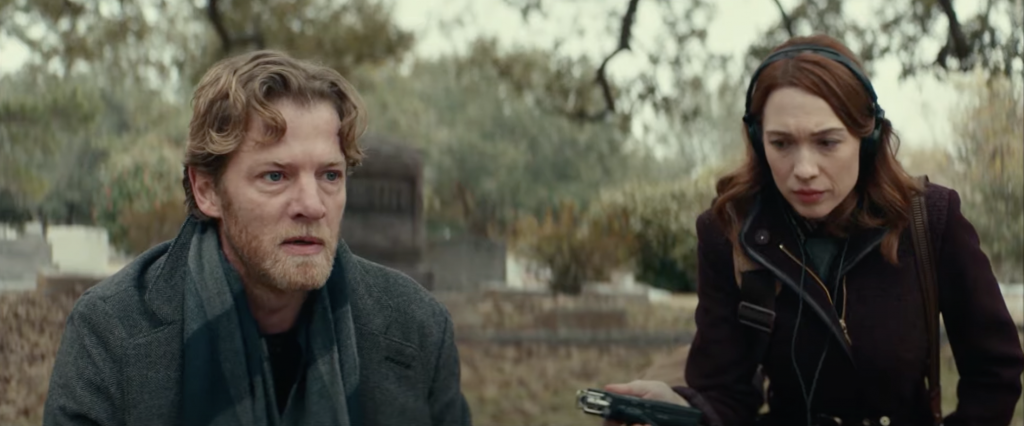
In an essay published by The Brooklynn Research and Publishing Institute, writer Kyle Gamache writes: “Many true crime replicate tabloid sensationalism by dehumanizing victims and glamorizing killers.”10 Aaron and Dana’s manner of research exemplifies this. The two discount Laurie’s trauma. They record over the grave of Judith Myers, Michael’s sister, and brutally recount her death. When Dana suggests they can learn from Laurie’s experience, Laurie shuts them down, stating:
“There’s nothing to learn. There are no new insights, or discoveries… Michael Myers killed five people, and he’s a human being we need to understand?”11
Laurie’s view of Michael is in direct opposition to the podcasters. Her statement highlights a divide between consumers of true crime and the victims of these stories.

Critics of the genre have written about true crime’s ability to retraumatize. Even “disclosing a perpetrator’s name, especially alongside graphic or intimate details, can retraumatize surviving family members.”12 Aaron and Dana embody the worst offenses of the true crime genre. Their coverage is focused on the killer, not his victims.
The Hunter, The Hunted & The Morbidly Curious
Aaron’s insistence that Laurie meet Michael ignores the killer’s traumatic impact on her life. More than that, it assigns mythic significance to what was a random act of violence. This idea is mirrored in the character of Dr. Sartain. Having studied the killer for years, Sartain also possesses a want to understand Michael. When Michael Myers is set loose upon Haddonfield once again, Sartain believes finding Laurie is his driving goal. He’s able to orchestrate a reunion between the two. Sartain remarks:
“Michael’s pursuit of Laurie Strode could be what keeps him alive. I would suspect the notion of being a predator or the fear of becoming prey keeps both of them alive.”13
Both Dr. Sartain and Aaron Korey believe there to be some sort of link between Laurie and Michael, even if none may exist. Ultimately, the podcasters and Sartain are killed by Michael, and Green depicts these scenes as moments of comeuppance.

For the podcasters, it’s as though the film wants Aaron to eat his words. His murder cements “the boogeyman” as a figure to be feared. It’s a lesson the whole town is forced to learn, including Allyson and her mother, Karen (Judy Greer), Laurie’s daughter, whose lives have been deeply impacted by Laurie’s paranoia.
With Sartain, his own obsession with Michael takes him to a dark place. He stabs Deputy Frank Hawkins (Will Patton), wanting to know how Michael feels when killing. Despite his efforts, Sartain gains no new knowledge about the killer, and the narrative punishes him for trying.

This attempt to understand Michael Myers reflects a real-world desire to understand killers. Since the early 1970s, murderers like Ted Bundy and Jeffrey Dahmer have been given celebrity status through extensive media coverage.14 Interviews and documentaries often attempt to delve into the psyche of such killers, attracting morbid curiosity from viewers as to why they kill.
An article from The University of Texas Permian Basin quotes Dr. John Fisher: “We’re taught that we’re not supposed to kill other people. So, what would cause a person to go out to target, to stalk, to track, and then to kill somebody? We are a society, a community that’s very inquisitive. And if we don’t envision ourselves in this kind of life… we wonder why other people would do that.”15
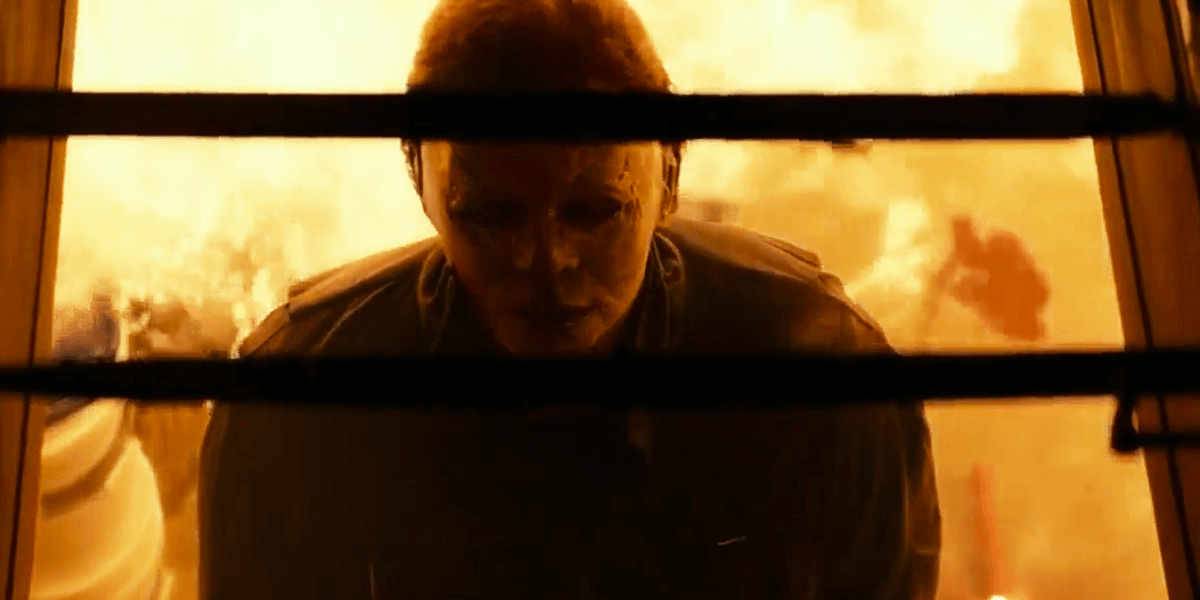
The fact that Michael doesn’t speak adds additional mystery to his motives. His status as an “unknowable” evil only serves to sensationalize him as more than a man. He becomes something for the people of Haddonfield to hunt. As a consequence, Michael quickly transforms the town into spectacle.
Evil Dies Tonight — Media Frenzy in Halloween Kills (2021)
Halloween Kills takes place on the same night as Halloween. While Michael killed in the shadows for much of 2018, TV reports reveal the killer’s return to all of Haddonfield. In retaliation, the locals form a mob to stop him. The mob is led by Tommy Doyle (Anthony Michael Hall), who was being babysat by Laurie the night she was attacked by Michael.
He’s joined by other survivors too, their past experiences giving fuel to the killer’s legend. The mob’s rallying call “Evil dies tonight!”16 further indicates Michael’s mythification.

In interviews leading up to the film’s release, Jamie Lee Curtis commented on the real-world inspirations for Halloween Kills’ mob, stating: “What we were seeing around the country of the power, of the rage of voices, big groups of people coming together enraged at the set of circumstances… The movie is about a mob. And so it’s very interesting because it takes on what happens when trauma infects an entire community.”17
However, Kills also operates as a critique of the kind of “mob justice” perpetuated by the true crime genre.
The desire to catch killers can often lead to “pointing fingers at innocent people.”18 This is exactly what ends up happening, as the Haddonfield mob chases after a man they mistakenly believe is Michael Myers. The man, an escaped mental patient, ends up jumping to his death to escape them.

In some cases, community response to violence has had positive impact. In 2017, the residents of Seminole Heights in Tampa, Florida rallied together in response to a serial killer. Thanks to cooperation between residents and law enforcement, the killer was successfully caught.19
However, although the situation in Tampa had a positive outcome, this isn’t always the case. Often, communities affected by killers become themselves victimized. Psychology Today writes: “Serial killers can trigger great fear in the communities in which they operate — possibly leading to increased policing, new laws, or a general distrust of strangers.”20

Green’s focus on the community of Haddonfield paints them as both victims and drivers of sensationalism. Over the course of Halloween Kills, Michael becomes the kind of killer Dave alludes to in Halloween. His kills are much more graphic. Near the end of the film, Laurie Strode comments on the impact Michael has on Haddonfield:
“The more he kills, the more he transcends into something else impossible to defeat. Fear. People are afraid. That is the true curse of Michael.”21
As Michael’s body count grows, so does his legend. Every charcter within Kills attatches their own weight to the killer. They all have their own reasons for wanting Michael slain, be it past trauma (Tommy and Hawkins), revenge (Allyson), or a combination of the two (Laurie), but the power they give him allows Michael to turn Haddonfield in on itself.

Upon seeing the fallen man’s body, former sheriff Leigh Brackett (Charles Cyphers) remarks that Michael is “turning us into monsters.”22 This line suggests that acts of violence can feed each other.
Fear drives the mob mentality seen in Kills. The paranoia around Michael proves a self-fulfilling prophecy. He becomes the monster Haddonfield has inadvertently built up. As a result, Michael wins. He kills the entire mob. He kills Karen too. Michael Myers is solidified on this night as legend.
Halloween Ends & The Need For A Boogeyman
Halloween Ends shifts focus from Michael Myers, but it does so in a fascinating way. The opening scene introduces Corey Cunningham (Rohan Campbell), who is babysitting a young boy named Jeremy on Halloween, just a year after the events of 2018 and Kills. After Jeremy locks Corey in a closet, Corey is able to kick the door down. But in doing so, Corey sends the boy plummeting over a staircase railing to his death. It’s an accident, but the event ostracizes Corey from the rest of the town.

The remainder of Ends takes place three year later. Laurie now lives with Allyson, and is writing a book about her trauma. She explains that after killing the mob, Michael vanished completely. As a result, the paranoia of Haddonfield has only grown.
Halloween Ends continues the idea of Michael Myers as an infection, where one monster can create another. Mirroring Brackett’s lines from Kills, philosopher Friedrich Nietzsche’s famous quote is spoken verbatim in this film: “He who fights with monsters should look to it that he himself does not become a monster.”23 The line is spoken to DJ Willy the Kid (Keraun Harris), who spends the movie sensationalizing the events of the previous films through his radio show.

Willy is another character to propagate Michael Myers as more than a man. Later, he blames Laurie for causing the killer to “snap.” In essence, Willy distorts the truth. The rest of Haddonfield does much of the same.
Green paints the people of Haddonfield as “needing” a boogeyman to project their fear. Corey Cunningham fills that role for them. The truth about his case is sensationalized. He becomes the “psycho babysitter.” On a similar level, Haddonfield projects its anger onto Laurie Strode, blaming her for Michael’s actions. Once again, fingers are pointed at the wrong people.

The similarities between Laurie and Corey bring the two together. She introduces him to Allyson, who begins a romance with Corey. All the while, Ends focuses on Corey’s descent into the dark. He’s repeatedly — and violently — harassed by a group of bullies. In one encounter, they throw Corey over a bridge and leave him for dead. When Corey wakes up, he finds himself in the Haddonfield sewers, where he encounters a deteriorating Michael.
The killer grabs Corey, but something surprising happens. As Corey looks into Michael’s eyes, scenes suddenly flash through his vision, including Jeremy’s death. The killer lets him go, but the event seemingly brings Corey’s violent side to the surface. He kills a homeless man in self-defense. He lures a police officer, an ex of Allyson’s, into the sewers to be killed by Michael. Eventually, Corey teams up with Michael for a dual murder. One monster has created another.

Laurie Strode is the first to notice Corey’s shift in character. She remarks that she “sees Michael’s eyes in Corey.”24 Fearing for Allyson’s safety, Laurie confronts Corey. Here, Green gives another perspective on the nature of evil. Laurie says:
“You know, there are two kinds of evil. There’s the evil that exists as an external force that threatens the well-being of the tribe… The other kind of evil lives inside of us. Like a sickness or an infection.”25
Halloween Ends posits the idea that Michael’s evil is transferrable. In an interview with EW, Green explains: “Bringing in a new character of Corey Cunningham, and discovering first his own immediate trauma… and then how that affects him, and then how an encounter with our already established evil could become kind of an infectious thing. It’s a study of the contagiousness of these negative entities that are in our lives.”26


When it comes to figures like serial killers, there is heavy debate on what creates them, be it biological or environmental. Films and television often parrot the idea that serial killers are born through childhood trauma or abuse. In reality, it’s a complex number of factors, and these factors can vary by individual.27
Between the hostile treatment he receives from Haddonfield, and the inappropriate manner in which his mother acts toward him, there is indeed a “perfect storm” within Corey. While Ends doesn’t give a definitive answer as to nature vs nurture, what’s true is that Corey’s making into “boogeyman,” and the fear built around Michael, enable his evil actions.
The Death And Demythification Of Michael Myers
In Halloween Ends, Laurie Strode reclaims her life from Michael Myers. She writes her book as a way to heal from her trauma, having had four years to reflect. It’s a sharp contrast from the way the podcasters covered her story in Halloween. In writing, Laurie, as victim, is made the center of her own story.

Laurie becomes a target for Corey Cunningham, who sees her as an obstacle to obtaining Allyson. Corey steals Michael’s mask, and after killing his bullies, he attacks Laurie in her own home. Laurie subdues Corey, but Michael comes back. He reclaims his mask before killing Corey. An intense struggle ensues between Michael and Laurie. The fight only ends when Laurie is able to pin Michael down. Following this, she strips Michael of his mask, stating:
“I’ve run from you. I have chased you. I have tried to contain you. I have tried to forgive you. I thought maybe you were the Boogeyman. No, you’re just a man who’s about to stop breathing.”28
Together, this line and the unmasking of Michael give Laurie power over the killer. The dialogue is important for the fact it’s the first time Laurie acknowledges Michael as a human being; he’s not “the boogeyman.” This begins the final step in Michael’s death: his demythification from monster into man.
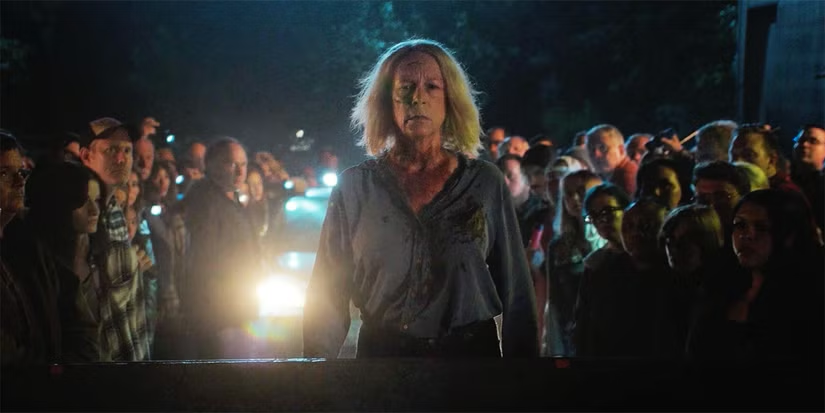
Halloween Ends concludes with the destruction of Michael Myers’ body. The event is witnessed by all of Haddonfield, putting the town on the path to healing. Laurie notes: “There would be no tombstone. No memorial. The mysteries were put to bed, and the story as we told it was to fade with time.”29 In the end, Michael Myers is rendered flesh and blood. He’s killed, but more importantly, so is his legend. It’s the most permanent possible death.
A Controversial But Necessary End
Halloween Ends proved a controversial ending for fans. Much of that criticism centered around the film’s “sidelining,” and general treatment of Michael’s character.30 When comparing the Michael of Ends to the previous two, it’s understandable. Michael in Ends is sluggish and old, a far cry from the unstoppable killing machine of Halloween Kills. To see a character like Michael rendered human is not the ending most fans wanted, but it is vital for the trilogy’s arc.

The existence of Corey Cunningham, divisive in itself, suggests that Michael’s evil is not in itself unique. And maybe that’s the whole point. Green ends his trilogy with the notion that anyone is capable of evil, especially in a society that makes myths of violent figures.
Serial killers and mass shooters continue to receive media attention. In 2022, Netflix’s Monster: The Jeffrey Dahmer Story, starring Evan Peters as the titular killer, released to record viewership, ranking among the top ten most watched series on the platform.31 Despite its popularity, the show faced extensive backlash for its perceived glamorization of Dahmer, including criticism from the families of victims.32

While it would be inappropriate to compare Michael Myers to real-world killers like Dahmer, Green’s trilogy asks a similar question to critics of true crime: at what point does a killer become mythologized? TV shows, documentaries, and films keep violent killers alive in the public consciousness. They become larger than life figures. In Halloween, Michael’s legend is allowed to grow because of his treatment and build-up as mythic “boogeyman.”
People are fascinated by killers. So too are the characters in Green’s trilogy. But Green isn’t interested in answering what drives Michael, or why he is the way he is. Instead, he focuses merely on the fact that evil exists, both internally and externally, and the role society plays in sensationalizing those who commit evil acts.
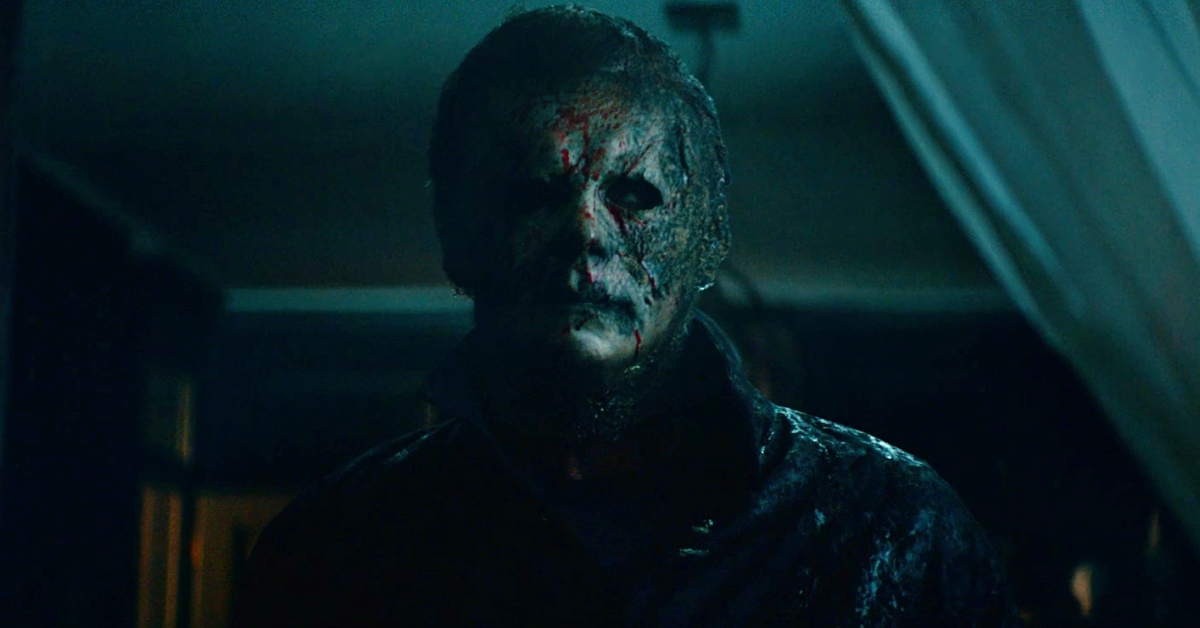
Characters like Laurie posit Michael Myers as the personification of evil itself. Others are punished for trying to understand him. Does this mean there’s no use in studying evil? Not necessarily. If Corey Cunningham proves anything, it’s that early signs of cruelty shouldn’t be allowed to fester.
What Green’s Halloween Says About Our Fascination With Killers
Slasher villains like Michael have always been the main draw of their movies. There’s a morbid fascination with onscreen murder as much as there is in real death. Green resurrects the killer in an age where grizzly headlines are commonplace and audiences are more interested than ever in those who kill. As a result, he reframes the killer to fit the times. Michael’s killers are gorier, meeting the increased demand for spectacularized bloodshed.

But Michael’s death in Ends serves as a reminder that the monsters we make are often human. “Evil doesn’t die,” Laurie says, “It just changes shape.”33 And maybe that’s true. Maybe no matter how much attention is given to them, one monster can easily replace another.
What can change, however, is our obsession with making these figures immortal. Their stories can be told in a way that gives power to the victims, rather than at their expense. Green proves this through his trilogy, boldly demythologizing one of cinema’s most famous villains.
Footnotes
- Green, David Gordon, dir. Halloween. 2018. ↩︎
- Ibid. ↩︎
- Ibid. ↩︎
- Meindl, James, and Jonathan Ivy. “Mass Shootings: The Role of the Media in Promoting Generalized Imitation.” American Journal of Public Health. 2017. ↩︎
- Halloween. 2018. ↩︎
- Ibid. ↩︎
- “True-Crime Stories.” EBSCO Information Services, Inc. 2022. ↩︎
- Atske, Sara. “A Profile of the Top-Ranked Podcasts in the U.S.” Pew Research Center’s Journalism Project. 15 Jun. 2023. ↩︎
- “True Crime Podcast Listeners Triple in Five Years.” Edison Research. 20 Nov. 2024. ↩︎
- Gamache, Kyle, Karlie Rice, Ashley Allen, and Willem Pontbriand. “The Impact of True Crime Podcasts on Cold Case Investigations and Victims’ Advocacy.” Journal of Psychology and Behavioral Science. Jan. 2026. ↩︎
- Halloween. 2018. ↩︎
- “View of Murder on the Internet.” Utoronto.ca. ↩︎
- Halloween. 2018. ↩︎
- Bonn, Scott. “What Drives Our Curious Fascination with Serial Killers?” Psychology Today. 23 Oct. 2017. ↩︎
- Wyland, Jessica. 2023. “The Lure of Serial Killers: Why We’re Obsessed with Murderers” The University of Texas Permian Basin. 12 Jun. 2023. ↩︎
- Halloween Kills. 2021. ↩︎
- Barfield, Charles. 2020. “Jamie Lee Curtis Compares ‘Halloween Kills’ Plot to Black Lives Matter & Calls Sequel ‘a Masterpiece.’” The Playlist. 3 Nov. 2020. ↩︎
- Tang, Claire, and Chloe Zhao. “Killing Curiosity: The Growing Obsession with True Crime.” The Tower. Dec. 2023. ↩︎
- “Seminole Heights Community Leaders Reflect on 2017 Serial Killings.” Wtsp.com. 28 Feb. 2024. ↩︎
- Psychology Today. “Serial Killers.” 2021. ↩︎
- Green, David Gordon, dir. Halloween Kills. 2021. ↩︎
- Ibid. ↩︎
- Friedrich, Nietzsche. ↩︎
- Green, David Gordon, dir. Halloween Ends. 2022. ↩︎
- Ibid. ↩︎
- Chichizola, Corey. 2022. “Halloween Ends Director Explains Why the Threequel Focused so Much on That New Character Corey.” Cinemablend. 17 Oct. 2022. ↩︎
- Ramsland, Katherine. “The #1 Question about Serial Killers.” Psychology Today. 2018. ↩︎
- Halloween Ends. 2022. ↩︎
- Ibid. ↩︎
- Oberkrom, Jaden. “‘Halloween Ends’ Is a Divisive Conclusion to a 40-Year Saga.” NTDaily.com. 20 Oct. 2022. ↩︎
- “Netflix Top 10 – Global.” Netflix. 2024. ↩︎
- Montgomery, Hugh. “Monster: Jeffrey Dahmer: Did TV Go Too Far in 2022?” 30 Dec. 2022. ↩︎
- Halloween Ends. 2022. ↩︎