
Table of Contents Show
In the past fifty years, the narrative of The Hero’s Journey has dominated the American pop culture landscape, from George Lucas’s Star Wars (1977)1 to the MCU2 and beyond.3 However, the monomyth that the Hero’s Journey feeds into generally only allows for one kind of hero (and story), one that upholds patriarchal Western culture.4

She-Ra and the Princesses of Power (Netflix, 2018-2020), an animated children’s show by ND Stevenson, clearly harkens back to the Hero’s Journey but shifts the narrative to emphasize the importance of relationships amid imperialism. In this article, we’ll explore how community impacts the stories of both the heroes and antagonists.
The Rise & Reign Of The Hero’s Journey
First, we must understand the Hero’s Journey and how it tends to frame imperialism as the norm.
Joseph Campbell & The Hero’s Journey
While The Hero’s Journey (also known as the monomyth) has become ubiquitous in pop culture, its origin, Joseph Campbell’s book, The Hero with a Thousand Faces (1949), is relatively recent.

Campbell studied English and medieval literature, drawing on them in synthesizing the Hero’s Journey as presented in The Hero with a Thousand Faces.5 He theorized that every story follows essentially the same pattern, that of a hero being empowered to subdue a threat through many trials.2

It wasn’t until the release of George Lucas’s original Star Wars trilogy (1977-83) that the Hero’s Journey really entered the zeitgeist. Those three films clearly showed how the Monomyth could be crafted into compelling (and popular) stories.2
But it was Disney that really sold the concept. After Christopher Vogler published the studio memo “A Practical Guide to the Hero with a Thousand Faces,” the writers of the Disney Renaissance immediately latched on to the concept and incorporated the Hero’s Journey into their narratives.2
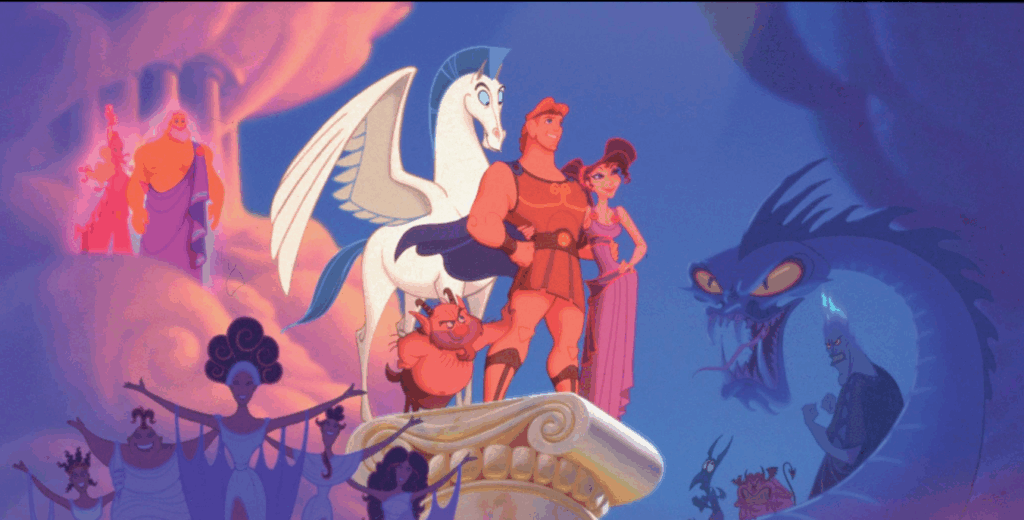
In light of Disney’s success in the 90s, Hollywood adopted the monomyth, mostly relying on Vogler’s subsequent book, The Writer’s Journey: Mythic Structure for Writers (1992).
Where The Hero’s Journey Fails
This narrative ties neatly into Thomas Carlyle’s “Great Man theory,” which posits that the history of the world is written in the biographies of “great men.”6 The monomyth merely applies this to fictional heroes, but in promoting this idea in the context of stories, it also primes people to seek such heroes in real life.2
Campbell also ignores all questions of systemic inequity, assuming that the world does not need fundamental change. The only thing that needs to change in this narrative is the hero himself.2 In addition, the Hero’s Journey is highly individualistic in nature, discounting communal efforts in order to edify a singular hero, even when he relied on the efforts of others to succeed in the first place.
Furthermore, while the Hero’s Journey fits (or can be made to fit) many Western stories, Campbell utterly ignored most stories from Asia or the global south. Which leads to another glaring omission: Campbell estimates that the hero must be a man.4
The Heroine’s Journey
Naturally, Campbell’s theory didn’t sit well with some women, who wanted to actually be the hero rather than a prize for the “real hero” to claim at the end.7 This is where Maureen Murdock came in with the concept of The Heroine’s Journey.8

While Murdock pioneered the concept of the Heroine’s Journey, Victoria Lynn Schmidt worked it into a narrative more suited to storytelling.7 It doesn’t fix all the issues with the Hero’s Journey, but it does take gender into account (and allows for a different, if similar, narrative).
The Heroine’s Journey has gained traction in the past decade or so, with Katniss from The Hunger Games franchise and Elsa from Frozen (2013) being prominent examples.9
Dorothy In The Wizard Of Oz (1900)
Since the Heroine’s Journey isn’t as well-known as its masculine counterpart (and, to be frank, isn’t quite as concrete to begin with), take Dorothy from The Wonderful Wizard of Oz (1900) as an example (the 1939 film adaptation fits the bill for the most part, but not quite as neatly as the original book).

Dorothy’s journey began with a call to adventure (much like the Hero’s Journey). After that fateful twister launched her into Oz, Dorothy wanted to find a way home, so the Good Witch of the South guided her toward the Yellow Brick Road to seek the aid of the titular Wizard. The Good Witch is important in the Heroine’s Journey as a benevolent feminine presence who teaches Dorothy and blesses her with gifts (the silver shoes and a literal blessing in the form of a kiss). Still, the heroine must leave her behind to go on her journey.10

On the Yellow Brick Road, Dorothy met trials and allies (again mirroring the Hero’s Journey), then reached the Wizard, who asked her to slay the Wicked Witch of the West before he’d do as she and her companions requested. The Wicked Witch captured Dorothy because she wanted the silver shoes and enslaved her. This part, in which the heroine is at the mercy of a “witch” (or malevolent woman), is also a component of the narrative, in which Dorothy learns from hardship.9
Dorothy returned to the Wizard after she accidentally melted the Witch, and having faced down evil, she refused to take “no” for an answer when the Wizard tried to back out on his deal. Then Toto revealed him to be a fraud, with no powers besides his balloon (and average intelligence). This, too, is part of the narrative: facing a patriarchal figure and seeing that he can’t really help the heroine.9

However, Dorothy still won control over an army (the winged monkeys), who were a great help to her, taking her and her companions to the Good Witch of the North. This is the “Eye of the Storm” in Schmidt’s variation, when the heroine finds success, but fails to achieve her true goal (getting home).8
After setting her friends up as rulers in Oz, Dorothy finally reached the Good Witch of the North, who informed her that she already had the power to go home (her shoes). In later books, Dorothy herself became a queen in Oz, reflecting the Heroine’s Journey once more, as it typically ends with the heroine as a queen, a goddess, or at the very least a teacher.9
The Hero Reimagined — Power In Community
While the Hero’s (and Heroine’s) Journey focuses on the hero as savior (even if other characters play important roles), She-Ra distinguishes itself by focusing on characters growing in community.

“There’s power, real power, in love, joy, and friendship.”11
This statement from Princess Perfuma also functions as the show’s thesis about power. It doesn’t deny that other forms of power exist, but it’s the one She-Ra promotes with its narrative. This theme resonates throughout the story, bound up with the power of community that sets it apart from the archetypal monomyth. After all, the Hero’s Journey requires a solitary hero, not a community.4
She-Ra begins with the classic scenario of a Rebellion struggling against the power of a militant empire, the Horde…
Adora
Adora opens with a pretty blatant call to adventure, just finding a magic sword and a voice telling her she has to save her world of Etheria. Significantly, though, she only starts to consider becoming the hero of Etheria because she wants to find out more about herself, and Adora knows she wouldn’t be able to pursue that line of questioning as a Horde soldier.12

Self-discovery is a primary motivation, even if she also wants to do what’s right after she realizes that the Horde isn’t what she thought it was. Which brings us to a fascinating inversion of the traditional heroine’s tale: Adora begins the story enslaved by the “witch.”

Shadow Weaver is the woman who raised Adora (and Catra) in the Horde, abusing and manipulating them for her own ends.13 Adora certainly learned a lot from her (mainly about military command), but the fact that her journey begins by escaping the witch (as opposed to leaving a loving mother) changes the Heroine’s Journey considerably. Instead, Catra represents the home she was forced to leave, and Adora is never truly at peace as long as they’re enemies.
Light Hope is initially presented as Adora’s new, “good” mentor (it’s right there in the names – Shadow and Light).14 Light Hope teaches Adora how to wield the power of She-Ra, but constantly reminds her of the failure of her last pupil, a clear allusion to the original Star Wars trilogy and Luke’s ghostly mentor.

However, as the story progresses, it becomes apparent that Light Hope isn’t so different from Shadow Weaver after all. They both encourage Adora to abandon her loved ones in order to become a “perfect hero,” similarly echoing Star Wars, where Luke running off to save his friends in Episode V was framed as a bad thing.15 Because the Hero’s Journey only requires one hero to save the day.4 But Adora refuses to give up on saving everyone — Etheria and her friends, including Catra — which brings us to her real mentor, Queen Angella.

While Angella rarely teaches Adora directly, she does offer her space to develop healthy relationships, developing a community at her fortress of Bright Moon, and before long, she comes to regard her as family. Angella consistently encourages caution and only gets in Adora’s way when she’s trying to protect her (like any good mother).16
The Eye of the Storm for Adora is probably after the first season finale, when the Rebellion successfully repels the Horde’s forces and the Princess Alliance finally unites under Glimmer. She’s found a purpose as the Hero of the Rebellion, yet she’s made little progress on her journey of self-discovery, and Catra hates her more than ever.

It’s not until Shadow Weaver flees to Bright Moon that Adora gets a hint about her origins: She’s not a native Etherian, but a First One – something that Light Hope knew but seemed to consider irrelevant.16
Shortly thereafter, when Catra captures Adora and takes her back to the Fright Zone, she has an opportunity to confront Hordak, her father figure. The confrontation is very anticlimactic, however, since he only ever thought of her as a soldier, and didn’t know (or care to know) anything more about her. He can’t help her find what she really wants.17

Adora is able to connect with Mara, the previous She-Ra (and a fellow First One), who warns her that Light Hope is only using her to activate the Heart of Etheria, which would likely destroy either Etheria or herself.18
She’s forced to break the Sword of Protection in order to stop it, preventing Adora from becoming She-Ra just when it seems most necessary, after Horde Prime discovers Etheria and invades it.19 But that’s also around the time Catra is at her lowest point, rethinking the choices that led her there and reconsidering what she actually wants.

“The romantic figure in the heroine’s journey represents the unconscious world of dreams and power she’s seeking in herself.”20
Significantly, Adora doesn’t manifest a full transformation into She-Ra again until she’s forced to save Catra.21 She still wants to save the world, but Adora’s relationships are what give her the strength to find her own power within herself, not from a sword she was given.
But Catra’s also her own person, and when she sees Adora treading a path of martyrdom, she doesn’t want to watch her die, even to save the universe.22 Catra’s first instinct is to run away, but once she realizes Adora needs help, she comes to her aid and refuses to leave her, even when they might both die.23

This is the ultimate trial for Adora, which the Hero is supposed to endure alone. But she didn’t make it this far alone. Her loved ones have always been the reason she fought, yet she never considered that they might feel the same way about her.

And so Catra becomes the Hero, saving a princess with a kiss, renewing Adora’s strength because she believes not in She-ra, but in Adora herself.
Glimmer
While Glimmer is there from the beginning, it isn’t until she loses her mother that she embarks on her own Heroine’s Journey.
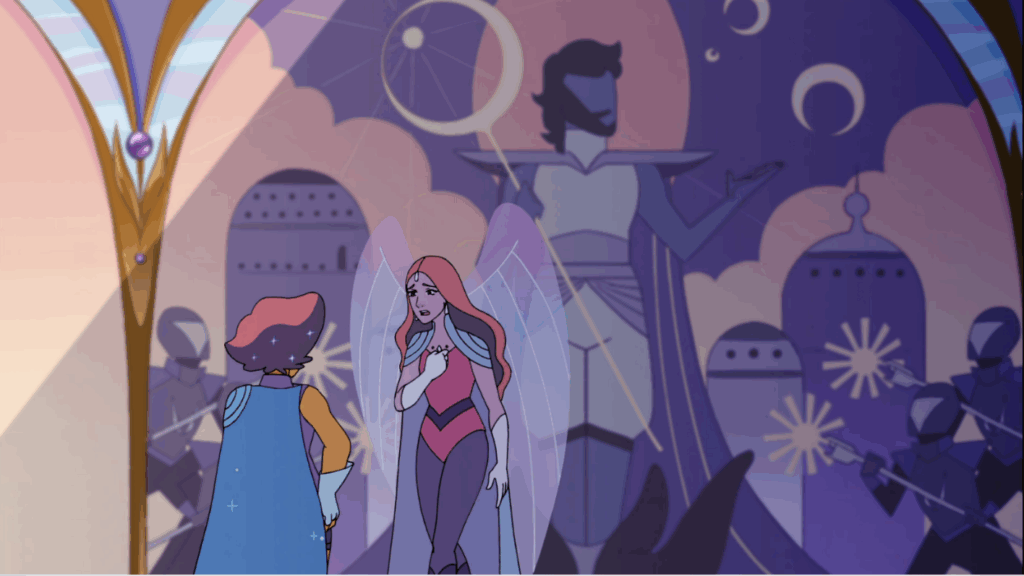
Glimmer and her mother, Queen Angella, frequently clash (mainly on strategy) in the first three seasons, but they still love each other.17 So when Angella is lost, Glimmer can’t help but feel conflicting emotions about assuming the throne. She’s finally free to do as she pleases (and has the magical power she always dreamed of), but she also carries the weight of the responsibility of leading the Rebellion.24
Her coronation is thus, arguably, also her Eye of the Storm. The Rebellion defeated the existential threat posed by the Portal, but at the cost of her mother. They’re unified under Glimmer, who is free to explore her new power, but they also know it’s only a matter of time before a greater threat, the Horde fleet, shows up.
Her stated goal is to defeat the Horde,24 but what she really wants is peace, for both herself and her people – despite (or maybe because of) the fact that she literally can’t remember a time before they had to fight to survive.

It’s at this point, feeling the need to imitate her mother by staying in Bright Moon while others do the fighting, that Glimmer gets sucked into Shadow Weaver’s orbit. At first, she just talks to her because she’s there, but Glimmer quickly latches on to her as a teacher and mentor, despite knowing how she hurt Adora.25
Angella raised her to value kindness and friendship, but Shadow Weaver is quick to encourage Glimmer to treat her friends as pawns. Before long, Shadow Weaver has become Glimmer’s chief advisor, naturally driving a wedge between her and her closest friends (her community), Adora and Bow.
Unlike with Adora, Shadow Weaver readily shows deference to Glimmer, both due to her position as queen and her immense magical power. She trains her in sorcery and appeals to her more ruthless tendencies (which her friends would normally shut down).

Most importantly, Shadow Weaver sets Glimmer up as a lone hero. Glimmer wants to become “the Queen who saves the world”, and she’s willing to sacrifice her relationships to destroy the Horde. She believes in her own intelligence over that of her friends, resulting in a grievous error that nearly dooms them all.19
When Horde Prime abducts her, she (and the entire planet) would have been killed if it weren’t for Catra’s quick thinking.19 And that is Glimmer’s low point: Being alone with the knowledge that she put herself there, and she might never even get to reconcile with her friends.26

Horde Prime then gives her an idea of his version of peace: Remaking everything in his own likeness, and killing everyone who stands in his way. Glimmer naturally refuses to cooperate when he asks her to betray her friends, because a peace like that (even if she could be reunited with her long-lost father) would be meaningless.27 A peace for oneself based on the oppression of others is unjust and evil.
Once Catra facilitates Glimmer’s escape, she merely faces the consequences of her actions. After spending so long thinking she might never have the chance to make things right (for both her friends and her people), she’s determined to do whatever she can to fix them.
When it becomes clear that Adora and Entrapta have integral missions, Glimmer is content to play a supporting role, fighting a seemingly impossible battle in the hope that others will succeed and give the world a future.28 She acknowledges that she can’t save the world on her own, and that’s alright.

With Glimmer, a powerful queen, and Adora having godlike powers, their journeys would seem to align with the Heroine’s Journey at the end, if they were alone. But each of the central characters had to learn to accept help from others, because they could never have won (or even achieved their personal goals) on their own.
Redemption & Reconstruction — Rethinking Power
Redemption is a recurring theme throughout the story, and not just for the “bad guys” – characters like Glimmer prove that anyone can make mistakes, but as long as they learn from them and change their ways, anyone can be a hero.
Humanizing the antagonists is a great strength of the show and highlights the theme of love and friendship. Additionally, these characters often hold positions of authority, making them parts of the systems which the monomyth deems irrelevant to the narrative, allowing them to change by forming community signals that the system itself can change.
The Shadow Of Empire
She-Ra presents two distinct imperial powers: The Galactic Horde and the First Ones.

While the first few seasons depict the First Ones as mostly benevolent, sharing their superior technology with the more “primitive” people of Etheria, in the end, it becomes obvious that the First Ones and the Horde are just two sides of the same coin of Empire.
Hordak & The Horde
Out of the authority figures, Hordak is one of the few that survive to the end of the series, mainly due to his willingness to change.
While he’s initially framed as a standard Evil Overlord, over time, he reveals his insecurities to Entrapta, the only person who really regards him as an equal. Whereas Shadow Weaver and Catra both treat him as a means to their own ends, Entrapta just wants to know more about him (even if she also wants to learn about Horde technology).29

Hordak was initially banished from the Horde for his physical disability, and his sole ambition in conquering Etheria is to prove himself worthy to Horde Prime.30
He perpetrates his share of war crimes along the way, such as the implied genocide (at the very least cultural genocide) of Scorpia’s people,31 because that’s what the Horde does. But in doing so, Hordak creates an identity apart from the Horde, learning to love his life as an individual, and with Entrapta’s help, even accepting his physical shortcomings.
Despite his mind being wiped more than once, his friendship with Entrapta helps Hordak remember who he is despite his conditioning.22 He (arguably) plays a crucial role in Horde Prime’s destruction, because while Prime simply transfers his consciousness to Hordak’s body when he tries to kill him, the fact that he resisted could have helped She-Ra drive Prime out.23
Light Hope And The First Ones
Both the First Ones and the Horde promote the idea of a lone hero with no attachments (or, with the Horde, no attachments outside the Horde) — echoing the mindset behind the monomyth itself.4 Light Hope is literally a computer programmed to train She-Ra accordingly.14

While the First Ones seem benevolent at first glance (at least they never seem to attempt genocide), they still tried to destroy Etheria under the guise of “enlightening” the planet.
Besides literally turning the planet into a weapon for the First Ones to use,18 they also reshaped their society by placing weight on seven runestones (out of many), empowering those princesses from whose power the Heart of Etheria is drawn, seemingly at the expense of others whose kingdoms appear to be small or nonexistent (such as Spinnerella and Netossa).32 They also appropriated She-Ra, a legendary guardian of Etheria, to essentially be a trigger they could control.18

Light Hope isn’t personally responsible for all that, of course, but she literally runs the system. And just like Hordak, she only changes because of a relationship — specifically, her friendship with Mara. She only starts to fight her programming when it forces her to forget the happiness she had with Mara.19
While Light Hope “dies” after Adora destroys the sword,19 she still exists in some form as the computer interface, and proceeds to help Adora in subtle ways. She allows Adora to meet a holographic version of Mara when she wants guidance, but she also seems to remind Adora that she shouldn’t go it alone,29 because that’s what Adora taught her: There’s power in relationships.
Shadow Weaver & Imperialist Logic
Finally, there’s Shadow Weaver, who bought into imperialist narratives despite ostensibly opposing the imperial powers themselves.

Shadow Weaver switches sides several times, mainly going where the power is, but also often motivated by resentment. She has little magical power of her own, so she latches on to promising young people and teaches them (or uses them) – first Micah, then Adora, then Glimmer. She’s a “parasite”, feeding off of powerful people when they’re most vulnerable (either when they’re young or simply emotionally unstable).33
At first, she wants to be the hero who saves Etheria, but when that fails, she settles on molding that hero.34 And by all accounts, she succeeds at that to a degree. Adora and Glimmer both become powerful heroes, and even Micah went on to become a formidable asset to the Rebellion.

But in the end, it’s Catra that actually gets through to her. In a moment of vulnerability, Shadow Weaver admits that she sees herself in Catra – fighting for power and control in a world that doesn’t want her, where she seems destined never to be the hero.34
And then, when the fate of the universe is at stake, Shadow Weaver is faced with a choice. She goes to Adora’s rescue, evidently intending on leaving Catra to die, when she realizes that Adora would abandon her mission to save Catra herself (or, more likely, die trying). So, instead, Shadow Weaver chooses to be the hero, taking Catra’s place so that she and Adora have a chance to save the world.23 In a sense, she’s finally choosing to love her younger self.
Telling New Stories
Ultimately, the Hero’s Journey is just one narrative, however influential it might be nowadays. She-Ra critiques the monomyth and its imperialist underpinnings by emphasizing the power of community and relationships, which especially stands out in light of the Star Wars sequel trilogy (2015-19).
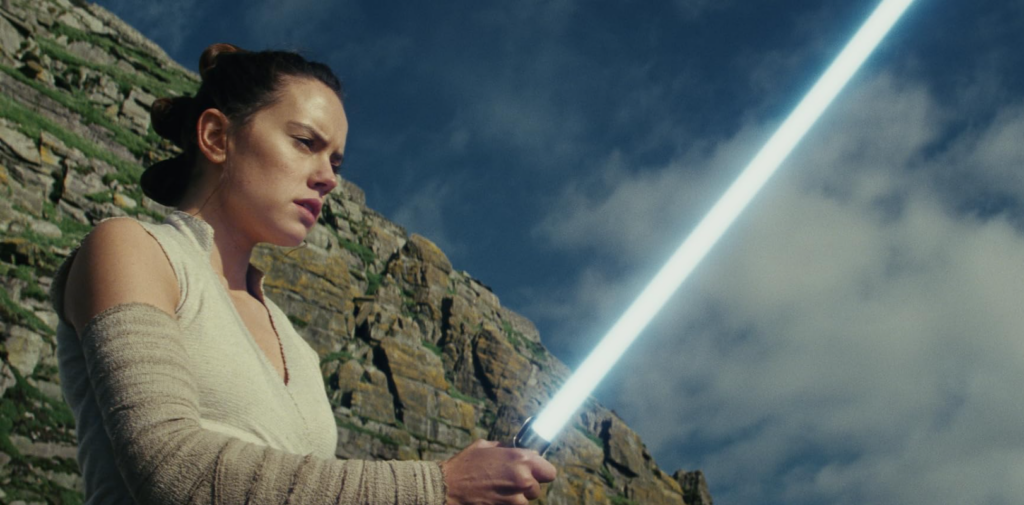
While Rey does perform a rendition of the Heroine’s Journey in The Force Awakens (2015) and The Last Jedi (2017), J. J. Abrams’ attempt to reclaim the story in The Rise of Skywalker (2019) resulted in a muddled mess that failed to satisfactorily resolve her arc. In that sense, Adora’s arc in She-Ra might be a better Heroine’s Journey than that of the franchise that popularized The Hero’s Journey, despite being a deconstruction of the narrative.
She-Ra also seemed to influence The Owl House, which featured at least two main characters who helped each other learn and grow. Even if She-Ra and the Princesses of Power isn’t as game-changing as Star Wars was, it still proves that after fifty years of the monomyth, audiences are ready for new stories. Community can be just as powerful a force as any hero.
Footnotes
- Gordon, Andrew. “Star Wars: A Myth for Our Time.” Literature/Film Quarterly, vol. 6.4, Fall 1978, pp. 314–26. ↩︎
- The Decaying Monomyth of Star Wars. Youtube, uploaded by Jessie Gender. December 16 2023. ↩︎
- The Writer’s Journey: Mythic Structure for Writers. Wikipedia, 27 November 2025. ↩︎
- Hero’s Journey. Wikipedia, 16 December 2025. ↩︎
- Joseph Campbell. Wikipedia, 30 November 2025. ↩︎
- Great man theory. Wikipedia, 18 November 2025. ↩︎
- Joseph Campbell Was Just Proto Jordan Peterson | Part 1 of 2. Youtube, uploaded by Maggie Mae Fish. July 27 2022. ↩︎
- Heroine’s Journey. Wikipedia, 30 August 2025. ↩︎
- Frankel, Valerie Estelle. Chosen One: The Heroine’s Journey of Katniss, Elsa, Tris, Bella, and Rey. 2016.
↩︎ - Baum, L. Frank. The Wonderful Wizard of Oz. 1900. ↩︎
- “Return to the Fright Zone”. She-Ra and the Princesses of Power season 5. Netflix, 2018-20. ↩︎
- “The Sword Part 2”. She-Ra and the Princesses of Power season 1. Netflix, 2018-20. ↩︎
- “Promise”. She-Ra and the Princesses of Power season 1. Netflix, 2018-20. ↩︎
- “Light Hope”. She-Ra and the Princesses of Power season 1. Netflix, 2018-20. ↩︎
- Kershner, Irvin. Star Wars: Episode V – The Empire Strikes Back. 20th Century Fox, 1980. ↩︎
- “The Price of Power”. She-Ra and the Princesses of Power season 3. Netflix, 2018-20 ↩︎
- “Moment of Truth”. She-Ra and the Princesses of Power season 3. Netflix, 2018-20 ↩︎
- “Hero”. She-Ra and the Princesses of Power season 4. Netflix, 2018-20 ↩︎
- “Destiny Part 2”. She-Ra and the Princesses of Power season 4. Netflix, 2018-20 ↩︎
- “Clary’s Lover”. Frankel, Valerie Estelle. Chosen One: The Heroine’s Journey of Katniss, Elsa, Tris, Bella, and Rey. 2016. ↩︎
- “Save the Cat”. She-Ra and the Princesses of Power season 5. Netflix, 2018-20 ↩︎
- “Failsafe”. She-Ra and the Princesses of Power season 5. Netflix, 2018-20 ↩︎
- “The Heart Part 2”. She-Ra and the Princesses of Power season 5. Netflix, 2018-20 ↩︎
- “The Coronation”. She-Ra and the Princesses of Power season 4. Netflix, 2018-20 ↩︎
- “Pulse”. She-Ra and the Princesses of Power season 4. Netflix, 2018-20 ↩︎
- “Horde Prime”. She-Ra and the Princesses of Power season 5. Netflix, 2018-20 ↩︎
- “Launch”. She-Ra and the Princesses of Power season 5. Netflix, 2018-20 ↩︎
- “The Heart Part 1”. She-Ra and the Princesses of Power season 5. Netflix, 2018-20 ↩︎
- “Signals”. She-Ra and the Princesses of Power season 2. Netflix, 2018-20 ↩︎
- “Huntara”. She-Ra and the Princesses of Power season 3. Netflix, 2018-20 ↩︎
- “Princess Scorpia”. She-Ra and the Princesses of Power season 4. Netflix, 2018-20 ↩︎
- “Destiny Part 1”. She-Ra and the Princesses of Power season 4. Netflix, 2018-20 ↩︎
- “Light Spinner”. She-Ra and the Princesses of Power season 2. Netflix, 2018-20 ↩︎