Backed by the corporation acclaimed for introducing some of the gaming industry’s biggest franchises like “Super Mario Bros.,” “Pokémon,” and “The Legend of Zelda,” Nintendo’s new-for-2015 intellectual property (IP) Splatoon should’ve become an instant classic and a worldwide pop culture icon.
“Splatoon 3.” Nintendo. 2022.
Despite bringing innovation to the shooter, “Splatoon” still remains a largely niche community outside of Japan, limited by bizzare issues that other franchises, regardless of their developers, don’t seem to suffer from. “Splatoon” is still a perfectly fun game that breathes new life into the shooter genre, but if Nintendo wants to continue growing the brand, it needs to reevaluate its decisions and learn from the series’s mistakes.
How “Splatoon” (2015) Changed The Shooter Genre
In late 2013 with the release of Nintendo’s newest console the Wii U, directors Yusuke Amano and Tsubasa Sakaguchi consolidated a team of talents to design a new game and IP for the system.1 With over seventy ideas brought to the table, one idea stood out to the development team: a multiplayer 4v4 third person shooter (TPS).
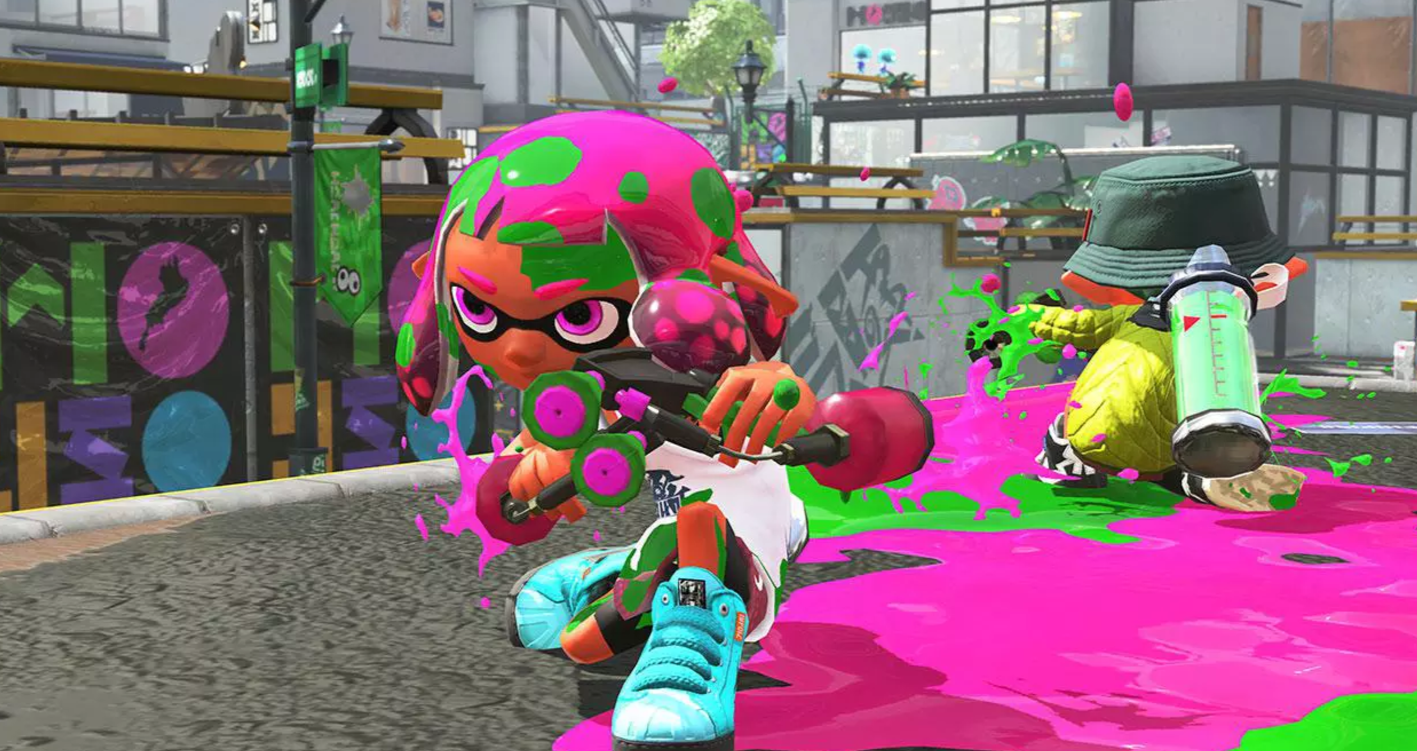
Players play as either “inklings” or “octolings,” anthropomorphic cephalopods that transform from human to squid/octopus. Assigned to teams of four with opposing colors of ink, players shoot their weapons and “splat” opponents, either to paint more of the map in their color in “Turf Wars,” or to push an objective further than the other team in the game’s “Ranked/Anarchy Battles.”
“Splatoon 3.” Nintendo. 2022.
Since the first entry’s release on the Wii U in mid-2015, the Splatoon series has been met with increasingly strong commercial and critical reception. While “Splatoon 1” was the sixth-best-selling game on the Wii U, “Splatoon 2” (2017) sold over twice as many copies, while its sequel “Splatoon 3” (2022) became the fastest selling game in Japan, while also winning Best Multiplayer Game at The Game Awards 2022. With the accolades and sales it receives, the series’s unique traits and innovations prove it deserves to regarded the same way as other landmark titles in the genre.
Innovative Movement Mechanics
In one prototype, the map was displayed on the TV, but this caused issues with players always being able to see the enemy at all times.2 From this however developed one of the game’s core concepts — being able to hide in ink.
By painting the map in their own color and then entering squid/octopus form, players move faster and more stealthily than in their human forms, allowing them to ambush players, advance quickly on enemy turf, and swim up walls for vantage points.
“The movement feels amazing, you have to use your weapon to control the flow of battle, you can paint the floor and wall to regain ammunition – there’s so many unique things Splatoon does as a shooter,” Australian streamer SRB2Dude said.3
“Splatoon 2.” Nintendo. 2017.
“Splatoon’s” mechanics also fix issues in other shooters while allowing new original ideas to come to life. In other games like “Team Fortress 2” (2007), players must keep track of ammo and health packs, and must return to the battle on foot.
By comparison, Nintendo’s “Super Jump” allows players to quickly jump back into battle, while squid form automatically reloads ammo (ink) and heals the player, reducing downtime and simplifying gameplay.4
“Splatoon 3.” Nintendo. 2022.
Certain weapon classes like dualies, brellas, and sloshers all incorporate the movement system with their attack methods, such as dodging, shielding, and hitting enemies over walls. “Splatoon 2” and “3’s” competitive Clam Blitz modes focus around moving quickly in squid form to pass clams to teammates and score goals.
And previous entries in the franchise built maps with vertical depth, creating vantage points and shortcuts the player could access by swimming up walls.
Unique Atmosphere & Lore
Though many shooter games feature background lore, “Splatoon’s” storylines subvert expectations by exploring surprisingly deep themes about the human condition.
Video game theorist Peter Christiansen suggests “Splatoon 1” subverts traditional expectations of a post-apocaltypic world. Whereas the octolings’ world where resources and electricity are scarce are more traditionally apocalyptic, the game also centers around a consumerist society where squids obsess over fashion and idols.5
“Their culture relishes the kind of excess normally reserved for villains,” Christiansen said. “They are described as creatures that live for nothing but “battle and fashion,” with their culture revolving around what is essentially ritualized gladiatorial combat.”
“Splatoon 3.” Nintendo. 2022.
Later entries in the franchise continue to hammer home these universal themes. “Splatoon 2’s” Octo Expansion spotlighted xenophobia and criticized utopian thinking through an octoling fighting to reach the surface, while an evil telephone attempts to reset the entire world with ooze.
Similarly, “Splatoon 3’s” main storyline explores humanity’s legacy and corruption through ecological collapse and a giant corporate bear. Despite “Splatoon” being rather dark, it does not distract from the time and detail the developers dedicated to breathing life into the games’ world outside of matches.
Whether it be the modern-day Japanese aesthetics of Inkopolis Plaza, the metropolitan New York City vibes of Inkopolis Square, or the multiculturally vibrant nature of Splatsville, no detail is overlooked. Even the idols derive from real world genres, including J-pop, hip hop, and world music.
A Safe Space For The LGBTQIA+ Community
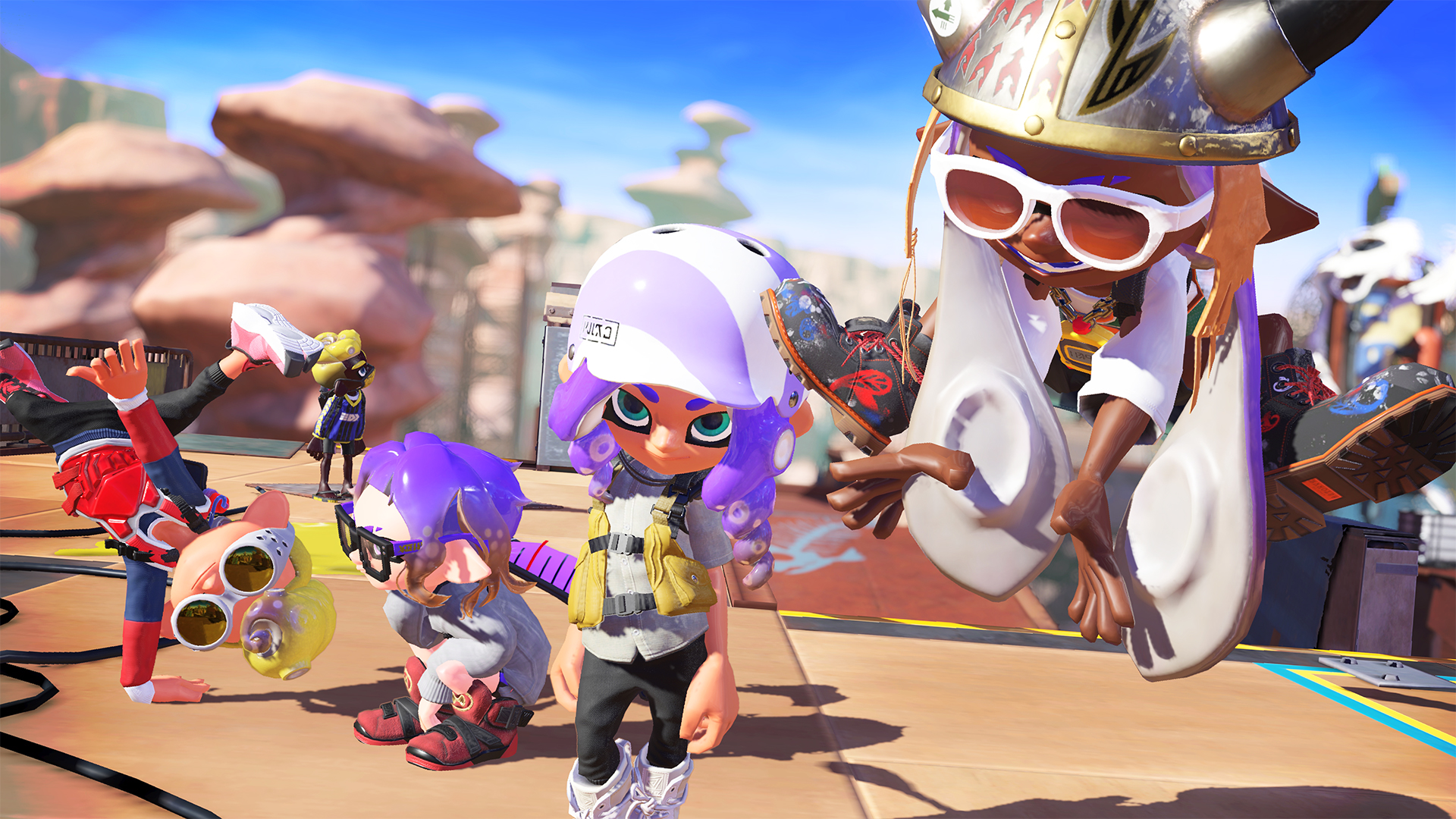
“Splatoon” has also been praised for fostering an open and welcoming community among LGBTQIA+ individuals. Outside of matches, the Splatoon games also feature a hub world with multiple shops, where players can purchase hats, shirts, and caps. These attire are not just competitively viable – they’re a way for underrepresented communities to freely express themselves.
“Splatoon 3.” Nintendo. 2022.
“It’s not queer because the creators of Splatoon are queer,” said host of “Fun n’ Games” podcast Matt Stone. “It’s queer because it gives you the freedom to express yourself in a queer way, very easily, whereas a lot of games don’t.”
“Splatoon 3.” Nintendo. 2022.
The community has also headcanoned multiple characters in the series as LGBTQ+. When “Splatoon 3” was released, players suggested new idol Shiver was non-binary due to her non-androgynous appearance, though this was later debunked. Most notably, Pearl and Marina of “Splatoon 2’s” Off the Hook are almost universally considered lesbian, backed up by unofficial evidence through the game’s dialogue and backstory.
“You’re a Kid Now, You’re a Squid Now” — How Not To Market Your New IP
It’s easy to question why the game is not given the recognition it deserves when it has so much going for it. However, part of a game’s success revolves around marketing and ensuring audiences connect with the game. And in the case of “Splatoon 1,” Nintendo managed to drop the ball hard.
Wii U. Nintendo. 2012.
Many people attribute “Splatoon 1’s” initial disconnect with mainstream audiences to its release on a failing console system. Released in the wake of the massively successful Wii, the Wii U generally failed to generate significant attention from third party publishers.
Terrible marketing was unable to establish that the Wii U was actually a seperate console, and general confusion over the Gamepad meant the Wii U managed to hold the first entry’s success back. As Nathan P. Gibson of Slashgear put it:
“The system itself was rarely shown in advertisements or commercials. This led to the idea that the GamePad was little more than an accessory that could be used with the Wii rather than being part of a brand-new console.”6
However, Nintendo also failed to promote “Splatoon” itself correctly. “Splatoon 1’s” initial advertising was plagued by an extremely annoying marketing strategy that damaged its long-term reputation.
“Splatoon-Squid Kid TV Commercial.” YouTube. Uploaded by IGN. 13 May. 2015.
Not only were “Splatoon’s” initial ads overplayed on every television and every Youtube video in 2015, they overlooked the game’s multifaceted gameplay and instead framed it as “that one kids game” where “you’re a kid now, you’re a squid now.”
Not only did these advertisements alienate older audiences who wrote it off as a meme, but they also contrasted Japan’s advertising efforts, which were subtle, but far more effective.7
Nintendo’s Ongoing Problems With The Franchise
With every new entry, Nintendo continues to evolve the game. New weapons and features are added, the lore becomes more striking, and patches fix bugs and balance issues. “Splatoon” in its current state is the strongest and most fun it has ever been, and it should be praised for what it continues to offer.
However, with every new entry and update, more and more issues arise, whether they be longstanding or out of the blue.
Nintendo’s Terrible Online Service
One of the biggest issues that has plagued all three games is Nintendo’s consistently awful online service. While other online games also suffer from lag and ping, “Splatoon” is notorious for being one of the worst offenders. Though players do not always experience it, it can severely disrupt gameplay.
Unlike other games, Nintendo does not operate dedicated servers for Splatoon matches. Instead, “Splatoon” uses what is known is as “peer-to-peer (P2P) architecture,” meaning Nintendo is only responsible for matchmaking.8 In actual gameplay, the console with the most stable connection becomes the “host,” but all information about the game is directly communicated between players.
While in theory this reduces lag and introduces smoother gameplay, if just one player’s internet connection is spotty, it can completely ruin the match.
“Why is Splatoon 3 so laggy.” YouTube. Uploaded by Chase247. 6 Apr. 2024.
Players tank shots without damage or freeze in the middle of a fight. Certain weapons completely break, including the brella class — consistently considered the worst class in the game for that reason. Players zip and teleport across the map, or end up in mid-air. Other times, players — sometimes everyone in the lobby — get randomly booted out of a match with a vague “communication error.”
With every game, Nintendo makes bigger and bigger missteps. While “Splatoon 1’s” online services may have been somewhat forgivable due to its online services being free, “Splatoon 2” and “3” gatekeep Nintendo Switch Online behind a twenty dollar paywall. Even worse, “Splatoon 3’s” different netcode means the game seems to have more difficulty reassigning the host, causing significantly greater mass disconnects.9
Extremely Slow & Infrequent Update Cycles
With the release of “Splatoon 3,” Nintendo decided to change the way it would push new downloadable content (DLC) to players. Rather than adding weapons to the game on a weekly basis, “Splatoon 3” introduces “seasons,” where every three months new attire and weapons were added to the game.
While this technically encouraged players to keep coming back, it also had the side effect of fizzling out players’ interest in the game once conversation about the season’s additions subsided.
“Splatoon 3.” Nintendo. 2022.
“The middle of the season is just absolutely absymal,” said American streamer ProChara. “The balance patches haven’t been anything significant and pretty much nothing happens between them.”10
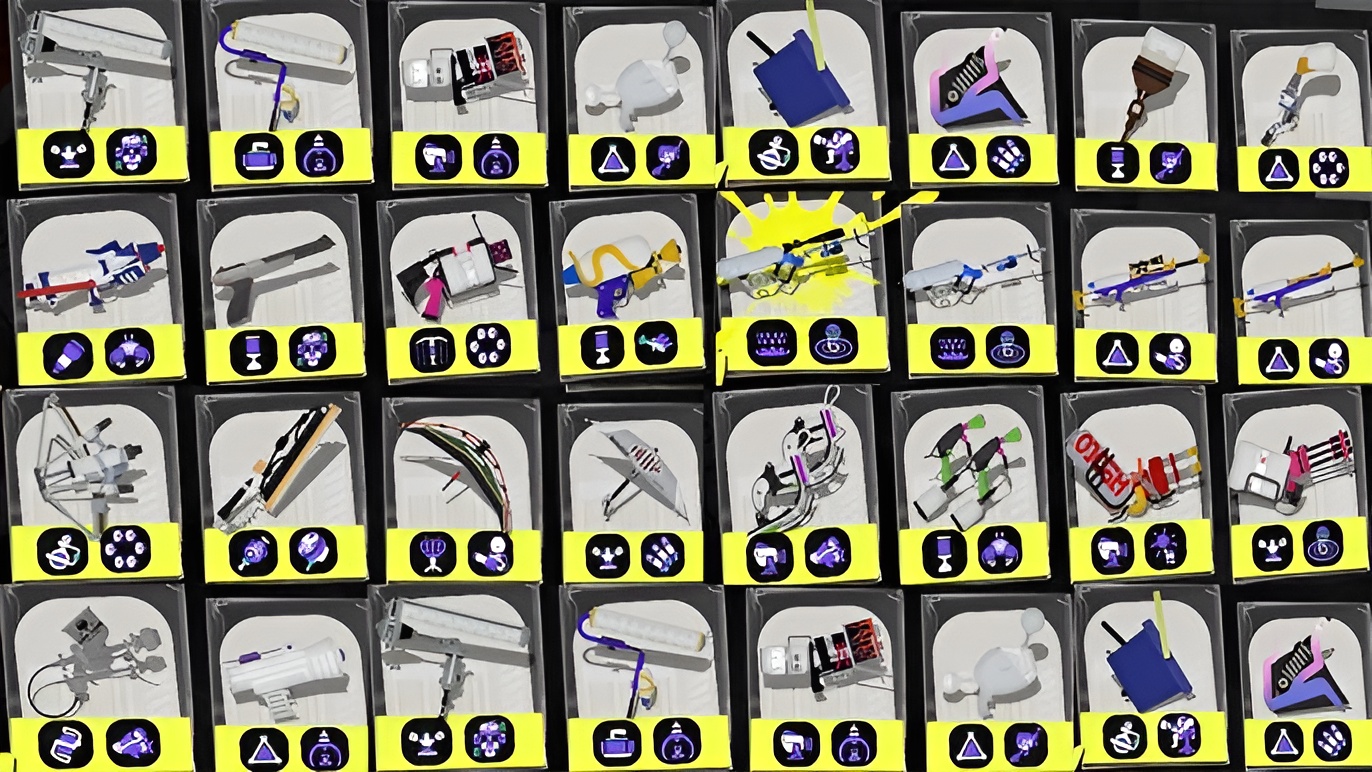
In Splatoon, weapons come in the form of “kits,” which come to form much of the excitement about new updates. A kit is where a “main weapon” — a primary form of attack like “shooters” and the aforementioned “sloshers” — is paired with a “sub weapon” — an aid in battle like bombs — and a “special weapon” — an extremely powerful yet limited use tool that can help facilitate victories. These kits mixing and matching different mains, subs, and specials, introducing new forms of gameplay.
“Splatoon 3.” Nintendo. 2022.
“Splatoon 3’s” update cycle actively fought the game’s kit system in two ways. Firstly, weapon kits were often crafted without any thought, with subs and specials that don’t synergize well with the main weapon.
Kits are everything in Splatoon, and a bad kit can make even the most powerful weapon in the game a dud. Secondly, “Splatoon 3’s” seasons were both too slow in generating kits, as well as did not generate enough kits for players.
For example, Bamboozler players in “Splatoon 2” had to wait less time for their third kit than they had to wait for their second kit in “3.”11
Disconnect Between Nintendo & The Community
There also appears to be some sort of disconnect between Nintendo and Splatoon’s community in the West. Players are generally outspoken on the series’s issues, with many in the competitive scene highlighting specific stepsSplatoon’s developers can take to fix the game’s problems. Yet, it often seems like Nintendo does not listen to its player base or flat out ignores them.
“【スプラトゥーン2】第69回エリア杯+ 実況解説配信.” YouTube, Streamed by AREA CUP. 14 May. 2022.
Though generally well-balanced, the series’s odd balance patches and flawed weapon designs sometimes lead to strange or oppressive metagames at the highest level.
In “Splatoon 2” the “.52 Gal” was called out for recieving too many buffs and a extremely defensive third kit, creating an extremely passive meta where players used the same weapons and spammed specials instead of engaging the enemy.12 “Splatoon 3’s” “Trizooka” was crticized for the opposite reason: its instant activation and inconsistent hitbox meant players could either tank shots or die at random, making gameplay too aggressive and unpredictable.13
Finally, the third entry in the franchise has become synonymous for bad map design. Players throughout the community actively called out how many maps in the game were essentially Tetrominos with straight lines to the objective. Vertical movement was also improved in “Splatoon 3” with the “Squid Roll” and “Surge” but the maps seem to actively discourage players from using them. In particular, the stage “Eeltail Alley” has been highlighted as becoming even worse after a map rework.
“Splatoon 3.” Nintendo. 2022.
“Eeltail Alley is currently the worst lockout stage of all time,” said ProChara. “Opponents holding the bridge have an extreme advantage because the only ways to push to contest the bridge are through one way drops.”
Why “Splatoon” Thrives In Japan — But Struggles Globally
With all of the criticism Splatoon recieves, its no wonder the game is held back in the West. But if Splatoon continues to remain a largely niche franchise, why do many players still see it as one of Nintendo’s most important properties? The reason is likely attributable to the series’s success specifically in Japan. For many problems Splatoon suffers from in the Western circle, the Japanese community seems to have cirumvented or outright solved.
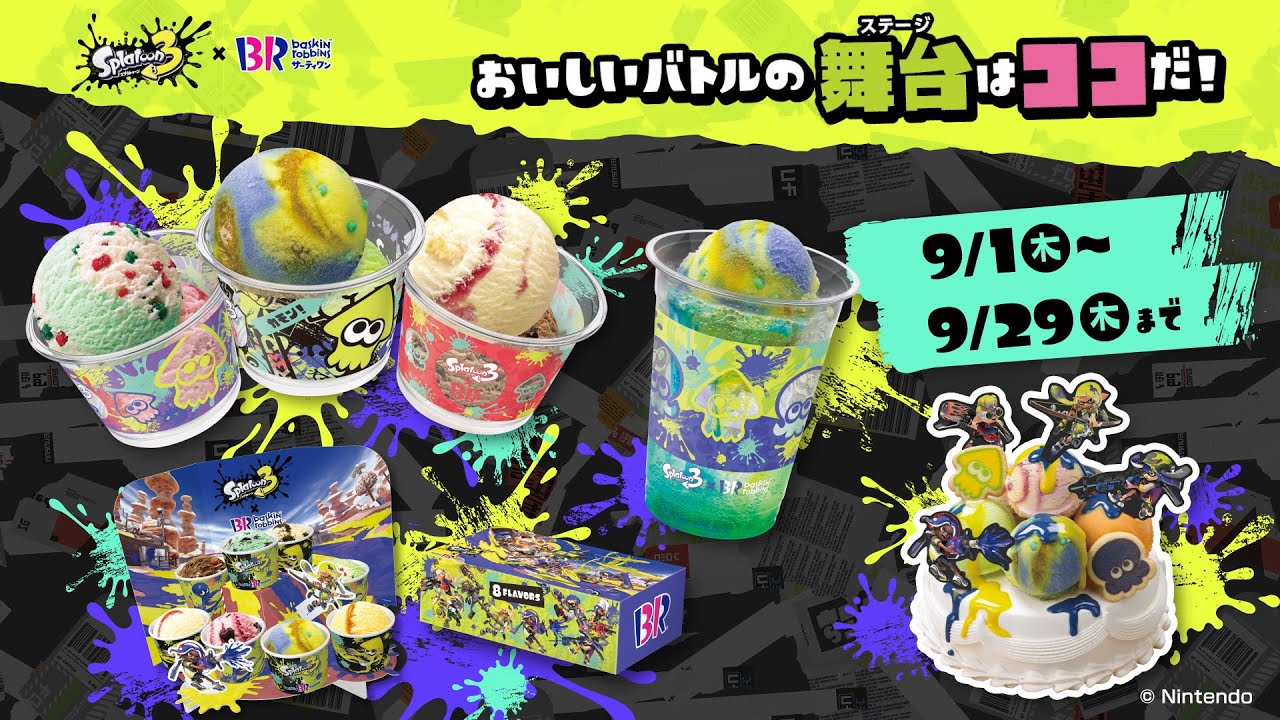
Baskin-Robbins Japan. 2022.
Though its reputation has improved in the West, the Splatoon series is still generally seen as a kids game, either because of its colorful and cartoony aesthetic, Nintendo’s reputation for family-friendly titles, or the continously lackluster advertising.
In Japan however, societal and cultural values mean the game’s design connects with a wider audience, both young kids and adults. Splatoon’s accessiblity in a country where “work-life balance is a foreign concept” means players can simply enjoy the game without much thought. As Lowell Bell of NintendoLife put it:
“They [people’s experiences with the game] highlight a key point that perhaps sets Splatoon apart from both popular team shooters and other huge games: the lower time investment needed to get to the ‘fun’. Yep, Splatoon is a low Time-To-Fun franchise.”14
“Splatoon 3 Live Concert featuring Deep Cut [Nintendo Live 2024 TOKYO].” YouTube, Uploaded by Nintendo of America. 10 Feb. 2024.
Nintendo Japan also throws many more resources into Splatoon’s marketing campaigns. In Japan, brands often collaborate with the game, introducing new products for consumers. This includes Baskin-Robbins’ Splatoon-flavored ice cream, real-world fashion brands players can buy attire from in the shops, and the many themed accessories people can buy like T-shirts, alarm clocks, and backpacks.
This is not to mention the live concerts, where dedicated fans can sing along to the series’s songs live to their favorite idols, complete with lightsticks.
Finally, it seems Nintendo’s online services are more consistent in Japan than in the West. As most Japanese players are in closer proximity than in other regions, many aforementioned issues overseas players have with bad netcode are either absent or not as pronounced in Japan.15
“Splatoon 3.” Nintendo. 2022.
This combined with Japanese players all sharing the same time zone and language means not only is matchmaking much more reliable, but both the general community and the competitive scene in Japan are much larger and more mainstream, to the point Nintendo actively prioritizes it over other regions.16
What Nintendo Can Learn from Its Own Community
What is one of Nintendo’s most unique brands and series is also one littered with missed opportunities and frustratingly confusing decisions. Perhaps Nintendo is fine with limiting “Splatoon’s” main demographic to Japan, and if so, then that should not distract from well built and unique the games are.
But if Nintendo wants to grow one of its most important IPs and let it thrive outside Japan, it needs to lean into the game’s strengths and learn from its mistakes.
“Splatoon 3.” Nintendo. 2022.
There are many ways Nintendo could go about improving the game. Nintendo needs to make its online services more reliable and consistent, instead charging twenty dollars for communication errors. It needs to revamp its update system, making seasons both more frequent and extensive, as well as reevaluating how it approaches kits.
It needs to reframe the game’s marketing, perhaps emphasizing the game’s unique mechanics and lore while translating Japan-exclusive collaborations to international brands people will recognize.
But the most important thing Nintendo could do to work on improving the game is simply listening to its community. The same player base that actively invests time and money into the game are also the same players who speak their minds and call out Nintendo for their mistakes.
They are the same players who want “Splatoon” to be the best it can be, and know how they can improve the game. Nintendo brings many interesting ideas to the table with “Splatoon,” but now its time for the community to contribute.