
Table of Contents Show
Isn’t it strikingly ironic that in an era defined by extraordinary technological progress — where smartphones put the world in our hands, artificial intelligence transforms entire industries, and advances in medicine and communication redefine daily life — today’s generation feels more anxious, uncertain, and disillusioned than any before it?

That irony sharpens when we realize that the very demographic driving much of this innovation — the 18-to-35-year-olds who live, work, and socialize through technology more than any other age group — is also the least happy.1 Recent studies show that Gen Z have disrupted the once-steady “happiness curve2” in record time; across more than twenty countries, they report historic lows in well-being, purpose, and life satisfaction.3
Fierce job competition, fueled by rapid AI development, collides with identity crises and mental health challenges intensified by social media, economic uncertainty, and global inflation — making Gen Z particularly vulnerable.4 Surveys and statistics paint part of this picture, but perhaps even more telling is what people choose to watch.

Unlike in interviews or questionnaires, where self-presentation often clouds the truth, entertainment preferences rarely deceive. In today’s saturated media landscape — where most films and series are quickly forgotten — what endures often reflects what resonates.
And the most-watched releases of 2024 and 2025 reveal a telling pattern: young adults (Gen Z) gravitate toward stories that confront the uneasy realities of modern life — economic pressure, inequality, identity struggles — while also seeking those rare moments of emotional release, where joy, wonder, or catharsis briefly cut through the noise.
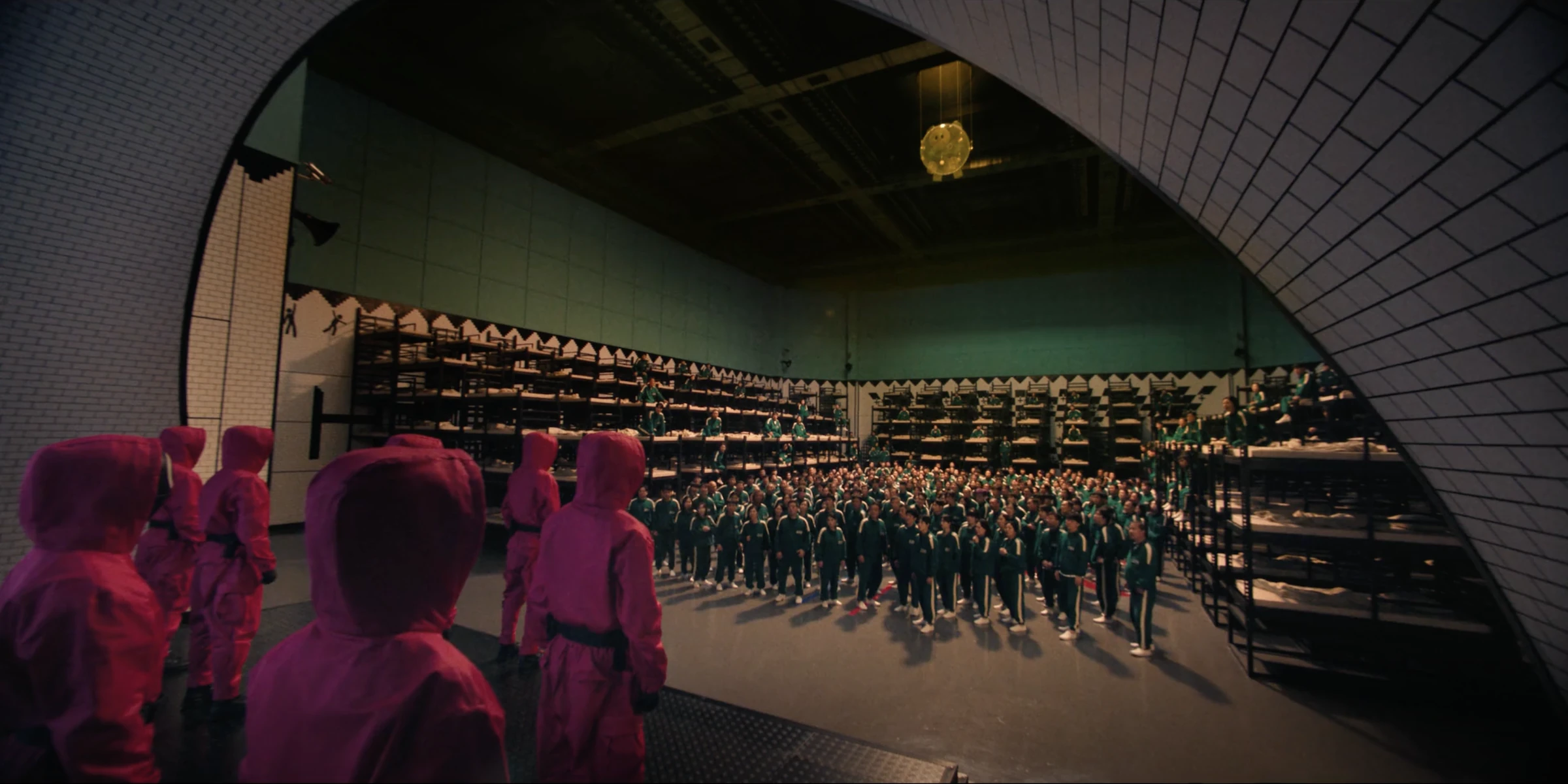
Squid Game (2021–) — Survival, Desperation, & The Price Of Inequality
When Squid Game (2021-) premiered on Netflix in 2021, it wasn’t just a hit — it was a cultural reckoning. The series struck a nerve with young adults (Gen Z) across the globe, resonating far beyond the shock value of its violent, high-stakes premise. Beneath its vivid dystopian spectacle lay a brutal, unflinching critique of class inequality and the dehumanizing machinery of capitalism.

For countless 18-to-35-year-olds, Squid Game mirrored their own anxieties: mounting debt, shrinking opportunities, and the suffocating pressure to survive in a world that measures worth by productivity. Released amid pandemic-era instability, the show’s portrayal of economic despair and desperation felt disturbingly familiar. Its games may have been fictional, but the stakes — financial ruin, moral compromise, systemic exploitation — were all too real.
Industry (2020–) — Ambition, Burnout, & The Myth Of The Dream Job
If Squid Game (2021–, created by Hwang Dong-hyuk) exposed the brutality of economic survival, HBO’s Industry (2020–, created by Mickey Down and Konrad Kay) turns that lens toward professional ambition — and the quiet devastation that follows it. Premiering in 2020, the series offers an unflinching portrait of young professionals navigating the ruthless early stages of their careers. It captures with unnerving precision the chaos, competition, and moral compromises of trying to secure stability in an increasingly unstable job market.

But Industry (2020–, Down & Kay) doesn’t stop at the struggle to get hired — it dissects what comes after. Once the coveted position is secured, the illusion of success begins to unravel. The show peels back the polished façade of elite workplaces, revealing environments defined by exploitation, burnout, and psychological warfare. Far from the glossy heroics of shows like Suits (2011–2019, created by Aaron Korsh), Industry portrays the corporate world as a high-stakes arena where self-worth is constantly negotiated and rarely affirmed.

During its first season, Industry (2020–, Down & Kay) averaged roughly 109,000 live and same-day viewers and a 76% approval rating on Rotten Tomatoes — numbers that underscore its niche but devoted audience. For many young adults (Gen Z), its appeal lies not in escapism but in recognition: this is the reality they live, masked by corporate prestige and ambition. In that sense, Industry functions as an investment-banking counterpart to The Devil Wears Prada (2006, directed by David Frankel) — stylish, cutting, and painfully honest about what it costs to “make it.”
The Substance (2024) — Body Horror, Beauty, & The Violence of Perfection
It wouldn’t be an exaggeration to call The Substance (2024, directed by Coralie Fargeat) a horror counterpart to Barbie (2023, directed by Greta Gerwig). Where Barbie bathes its satire in neon pink and irony, The Substance strips that glamour bare, confronting society’s obsession with youth, beauty, and bodily perfection through grotesque horror allegory.
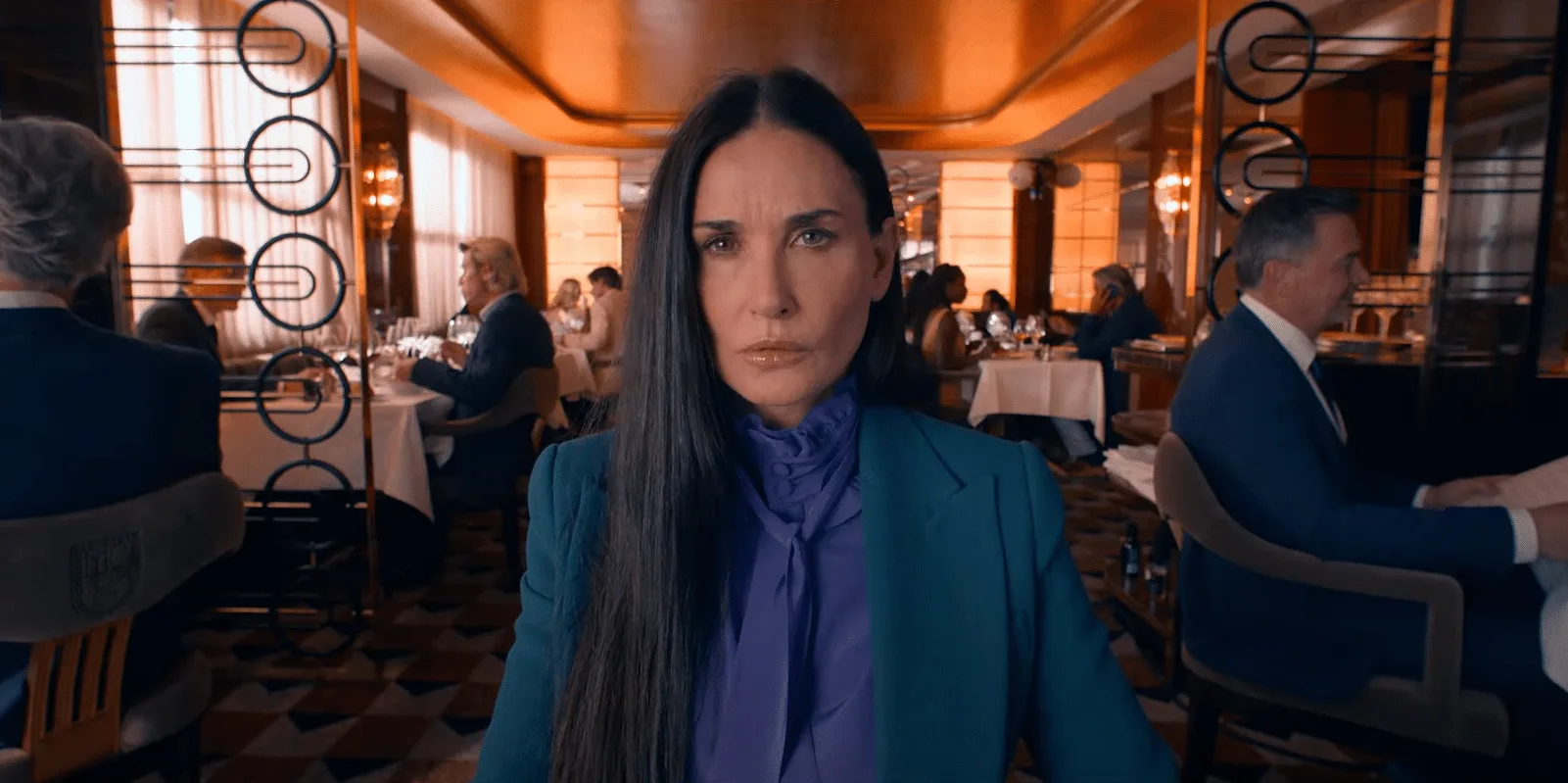
While the film’s mainstream reception was modest compared to Hollywood blockbusters, its critical impact was undeniable. The Substance won Best Screenplay at the Cannes Film Festival, earned five Academy Award nominations — including Best Picture, Best Director, Best Actress, and Best Makeup and Hairstyling — and secured Demi Moore a Golden Globe win for her haunting performance.

At its core, the film resonated deeply with a generation, particularly young women, living under the constant scrutiny of social media’s beauty ideals.56 Through its visceral imagery and biting satire, The Substance exposes how the pursuit of perfection becomes its own kind of body horror — a reflection of a culture that demands self-destruction in exchange for validation.
Baby Reindeer (2024) — Vulnerability, Obsession, & The Shadows Of #MeToo
In contrast, Baby Reindeer (2024, created by Richard Gadd) emerged as one of Netflix’s most unexpected yet powerful successes. Premiering in 2024, the series quickly climbed Netflix’s global charts, amassing over 84.5 million viewers within its first few months7 and even surpassing the debut ratings of The Witcher (2019–, created by Lauren Schmidt Hissrich). A YouGov survey in Australia revealed that 39% of Gen Z had watched the show — a testament to its cross-generational resonance.8

Based on Gadd’s real-life experiences, Baby Reindeer explores trauma, obsession, and the failures of social systems to address abuse and stalking. What makes the series distinct, however, is its subversion of expectation: the victim at the center of this story is not a woman — as is often the case in depictions of stalking — but a man. This reversal struck a chord with young audiences in the post-#MeToo era, expanding the conversation around victimhood, gender, and vulnerability.

Unflinching yet profoundly human, Baby Reindeer forces viewers to confront uncomfortable truths about empathy and silence. Its power lies not in sensationalism but in its emotional honesty — reminding us that abuse and trauma can affect anyone, regardless of gender, and that our systems, both social and digital, remain tragically ill-equipped to protect them.
The Search For Self — Identity, Intimacy, & The Cost Of Becoming — Challengers (2024) & The Idea of You (2024)
It’s no secret that young adults (Gen Z) today are continually wrestling with the questions of identity and connection. For many within the 18–35 age range, the process of self-discovery often sounds like an endless internal dialogue: Who am I becoming? Am I on the right path? What relationships define me — and which ones have I outgrown? Is success worth sacrificing love, stability, or authenticity? These are not just fleeting anxieties but ongoing negotiations of adulthood in a time defined by instability and self-performance.
Challengers (2024)
Luca Guadagnino’s Challengers (2024) dives headfirst into these very questions, disguising them within the tension of a tennis court. Despite its surface as a sports drama, the film is less about athletics than it is about ambition, desire, and the toxicity that festers in love triangles.

Tennis merely serves as the arena through which sex, rivalry, and ego collide. Zendaya’s commanding performance — anchored by her status as a generational icon for both Gen Z and millennials — further cements the film’s resonance.
Upon its release, Challengers debuted at No. 1 at the box office, earning nearly $15 million across about 3,500 theaters in the U.S. and Canada9, with 58% of the audience identifying as women, the majority between ages 18 and 24.
The Idea of You (2024)
In a similar but more romantic register, The Idea of You (2024, directed by Michael Showalter) challenges conventional narratives of love, age, and autonomy. The film — Amazon Prime Video’s most-watched movie worldwide in 202410 — follows a 40-year-old woman’s relationship with a much younger global pop star.

Yet it resists the easy categorization of a “fluffy” rom-com. Instead, it strips away the shame and cynicism that often accompany stories of nontraditional relationships, offering a bittersweet meditation on desire, agency, and self-acceptance. Its trailer alone garnered over 125 million views across social media platforms, signaling its widespread cultural pull.11
Part of what makes The Idea of You so magnetic is its mirror to contemporary life: the allure of celebrity, the blurring of public and private selves, and the yearning to break free from societal judgment. For many young adults (Gen Z) raised in the age of parasocial intimacy, the film feels strikingly familiar — a love story that doubles as a reflection on freedom and the fragile art of self-definition. As Nylon Manila aptly predicted, it became one of the defining films Gen Z would truly obsess over.12
Cinematic Escapism — Spectacle, Stardom, & The Joy Of Forgetting
In a world weighed down by anxiety and uncertainty, the allure of blockbuster escapism remains irresistible. Films like Dune: Part Two (2024, directed by Denis Villeneuve), Mission: Impossible – The Final Reckoning13 (2025, directed by Christopher McQuarrie), and Wicked14 (2025, directed by Jon M. Chu) dominated the global box office, collectively earning hundreds of millions of dollars and reminding audiences why cinema still holds the power to transport.15
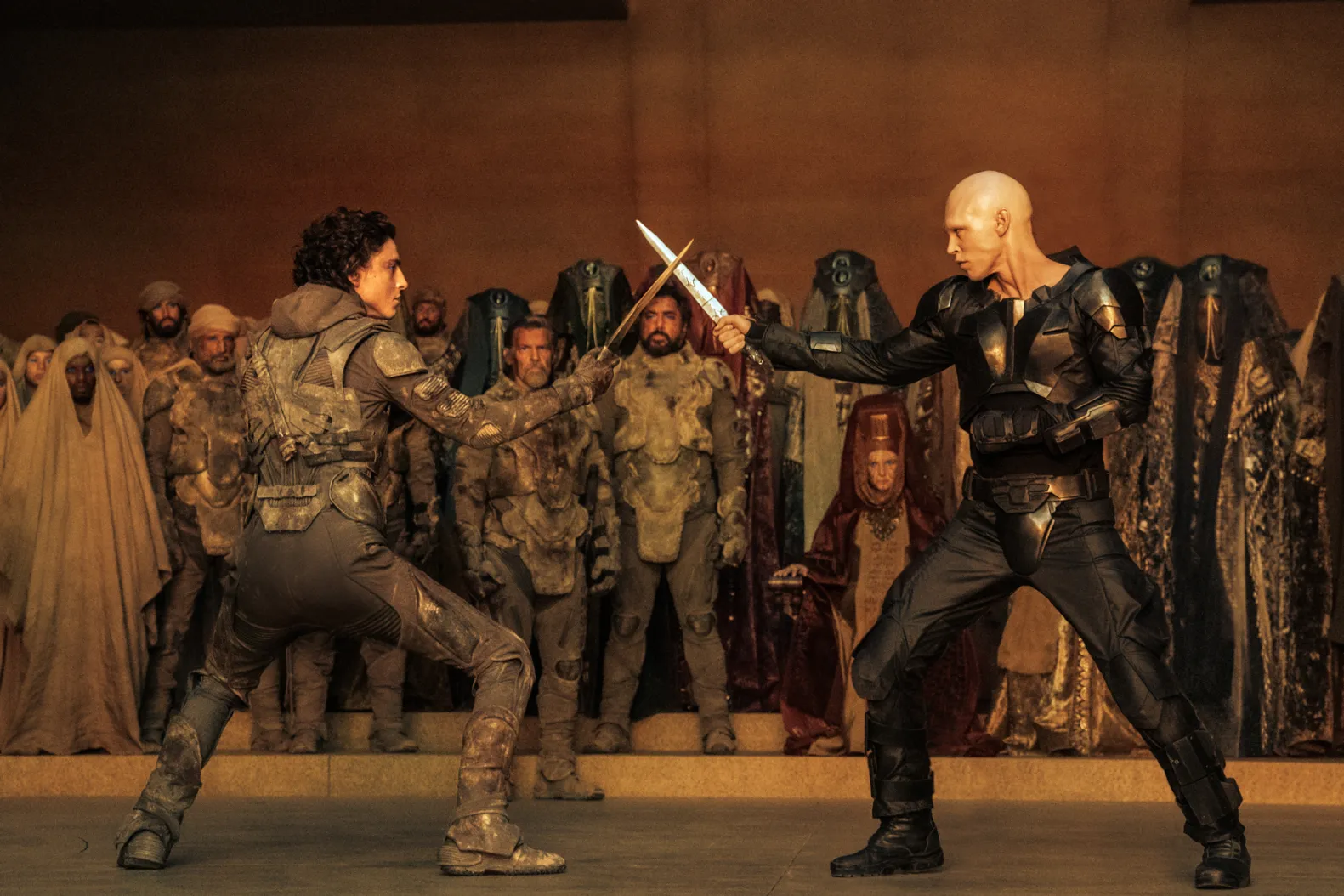
These spectacles deliver exactly what the term escapism promises — communal joy, nostalgia, and a temporary reprieve from reality. Their appeal lies not only in their epic world-building and jaw-dropping stunts but also in the emotional satisfaction of surrendering to grandeur. The stories themselves may be fantastical, but the experience of watching them together — laughing, gasping, and cheering in darkened theaters — feels profoundly human.
Casting, too, is a vital part of that magic. For younger audiences, stars like Timothée Chalamet, Zendaya, and Ariana Grande embody a kind of cinematic glamour that extends beyond the screen; their social media presence, authenticity, and aesthetic sensibility make them cultural touchstones as much as performers.
Meanwhile, veterans like Tom Cruise, who continues to redefine the boundaries of action cinema through his daring stunts, bridge the gap between old-school heroism and modern spectacle.

Ultimately, blockbuster escapism is about more than the films themselves — it’s about the ritual. The act of going to the theater, sharing the anticipation, and seeing familiar faces in larger-than-life stories becomes a collective exhale.
It is a reminder that in an era of constant stress and overexposure, sometimes the greatest luxury is simply to disappear into the glow of the big screen.
Seeking Truth, Relief, & Connection
The viewing habits of today’s 18–35-year-olds reveal a generation caught between longing and restlessness — wanting everything, yet shifting their interests as quickly as the digital world around them.
They delight in the thrill of blockbuster escapism, in cinematic universes that dazzle with scale and spectacle. Yet they do so with a knowing awareness that perfect endings and heroic triumphs rarely mirror their own realities.
The fantasy is pleasurable, but it’s understood as exactly that: fantasy. For many, these films exist in the realm of enjoyment rather than emotional resonance — momentary relief rather than reflection.

What truly endures are the stories that meet them where they are. Films and series that grapple with failure, inequality, heartbreak, and uncertainty strike a deeper chord. These narratives, grounded in vulnerability and imperfection, remind viewers that their struggles are not isolated but shared.
Even the most brutal depictions of modern life — of exhaustion, injustice, or loss — carry within them a quiet reassurance: that empathy still exists, that healing is possible, and that connection, though fleeting, is worth seeking.
In an era defined by disconnection and curated lives, this generation turns to storytelling not just for distraction but for affirmation. They crave truth as much as they crave relief — and in the right film or series, they find both.
Footnotes
- Blanchflower, David G. 2025. “An Expert on Happiness Uncovers a Worrying Trend.” Dartmouth News, January 2025. ↩︎
- Blanchflower, David G., Alex Bryson, and Xiaowei Xu. 2025. “The Declining Mental Health of the Young and the Global Disappearance of the Unhappiness Curve.” PLOS ONE. ↩︎
- Volpe, Allie. 2025. “Gen Z’s Angst Is Dismantling the Long-Established Happiness Curve.” Vox, January 24, 2025. ↩︎
- Twenge, Jean M. 2025. “Declining Life Satisfaction and Happiness Among Young Adults.” National Bureau of Economic Research Working Paper No. 33490. ↩︎
- “List of accolades received by The Substance (2024 film),” Wikipedia, last modified Sept. 2025. ↩︎
- Mankiewicz, Chris. “Demi Moore Wins Golden Globe for The Substance.” Reuters, Jan. 12, 2025. ↩︎
- Todd Spangler, “Netflix’s ‘Baby Reindeer’ Joins All-Time Top 10 English-Language TV List With 84.5 Million Views,” Variety, June 11, 2024. ↩︎
- YouGov, “Baby Reindeer’ most popular with Gen Z viewers in Australia,” YouGov, May 31, 2024. ↩︎
- Lindsey Bahr, “Box Office: ‘Challengers’ Scores with $15 Million After Solid Zendaya Pull,” AP News, April 28, 2024. ↩︎
- Amazon MGM Studios, “The Idea of You Becomes Prime Video’s No. 1 Worldwide Film of 2024,” press release, May 22, 2024. ↩︎
- Anthony D’Alessandro, “’The Idea of You’ Trailer Notches Record 125M Views Across Prime Video & MGM Socials,” Deadline, March 7, 2024. ↩︎
- Rafael Bautista, “Why The Idea of You Is Our Latest Movie Obsession,” Nylon Manila, May 6, 2024. ↩︎
- Box Office Mojo, “Mission: Impossible – The Final Reckoning (2025),” accessed Sept. 11, 2025. ↩︎
- Box Office Mojo, “Wicked (2024),” accessed Sept. 11, 2025. ↩︎
- Box Office Mojo, “Dune: Part Two (2024),” accessed Sept. 11, 2025. Box Office Mojo. ↩︎