
Table of Contents Show
The miniseries Transformers: Last Stand of the Wreckers (LSOTW), written by James Roberts and Nick Roche with art by Nick Roche and Guido Guidi, inks by Nick Roche, John Wycough, Guido Guidi, and Andrew Griffith, with colors by Josh Burcham and Joana Lafuente and letters by Neil Uyetake and Chris Mowry, originally published in 2010 by IDW Publishing and collected in hardcover in 2012, demonstrates that there is more to Transformers than what meets the eye.

The series captures the beating heart of the larger Transformers franchise by focusing on its core: a wartime narrative. With this focus, Last Stand of the Wreckers doesn’t flinch from depicting war’s full weight, forcing readers to confront what these actions mean to those who carry them out.
It examines the cost of war and violence through its characters, while interrogating the ethics of war within the frame of a franchise originally marketed to children.
‘Mission To Garrus-9’ — Setting The Stage for Destruction
Transformers: Last Stand of the Wreckers, like most Transformers stories, is set in the midst of the war between the Autobots and the Decepticons, the respective heroes and villains of the setting, a war which has already damaged their home world of Cybertron. The eponymous Wreckers of the comic are a special unit of Autobot commandos, notorious for suicide missions and an alarmingly high mortality rate.

LSOTW depicts four newcomers to the unit, alongside five hardened veterans, led by the formidable Springer, investigating Garrus-9, an Autobot prison colony that they’ve lost communication with. Their mission brings them up against Overlord, a rogue Decepticon warlord who has twisted the prison into his personal theater of cruelty, while also reuniting the team with Impactor, their disgraced former leader who had been sentenced to Garrus-9.
However, the Wreckers also must find something called Aequitas, also on Garrus-9.
‘Fanboys At War’ — The Shattered Myths Of Ironfist And The Wreckers
Of the four recruits in the story, the most central figure to the themes of LSOTW is Ironfist. Formerly a weapons engineer before being recruited into the Wreckers, Ironfist stands out as a self-fashioned Wreckers fanatic, serving as their unofficial biographer and writing dramatizations of their missions.1 Of all the recruits, despite his fanatic adoration of the team, he’s painfully unfit for the brutal reality of combat.

Following the team’s first encounter with Overlord in Garrus-9 and Rotorstorm’s death, Ironfist breaks down, horrified by how the reality of a Wreckers mission contrasts with the datalogs he wrote.2 Topspin, a veteran Wrecker, snaps at Ironfist and tells him, “People die in stupid, pointless ways. Deal with it.”3 The events of the series effectively shatter Ironfist’s perception of the Wreckers in his head, with the final nail in the coffin being when he learns the truth behind Impactor’s arrest and how the story of the Wreckers’ finest hour was a lie.

Ironfist’s arc within the story exposes the psychological and moral toll of the Wrecker life, framing it from a new recruit’s perspective. Ironfist’s idolatry of the Wreckers is shattered continuously throughout the story, as the constant danger and violence of this world contrasts so greatly with the fantasy he had built around the Wreckers as mythic, untouchable heroes.

His realization of what Impactor had done forever changes how he understands the team, to the point where he’s almost willing to let Impactor die solely for what he did on Pova.4 Ultimately, being a Wrecker costs Ironfist his idolization of the Wreckers and his life, culminating in his quiet death — caused by an accidental bullet wound sustained before the story even began.5
‘The Autobot Who Went Too Far’ — Impactor & the Price Of Violence
Contrasting Ironfist is Impactor, the former leader of the Wreckers, who had been arrested 30 years before the events of the story, held in Garrus-9. The story takes its time in revealing the truth behind Impactor’s arrest and the end of his time with the Wreckers, letting the readers stew in the tension between Impactor and Springer.
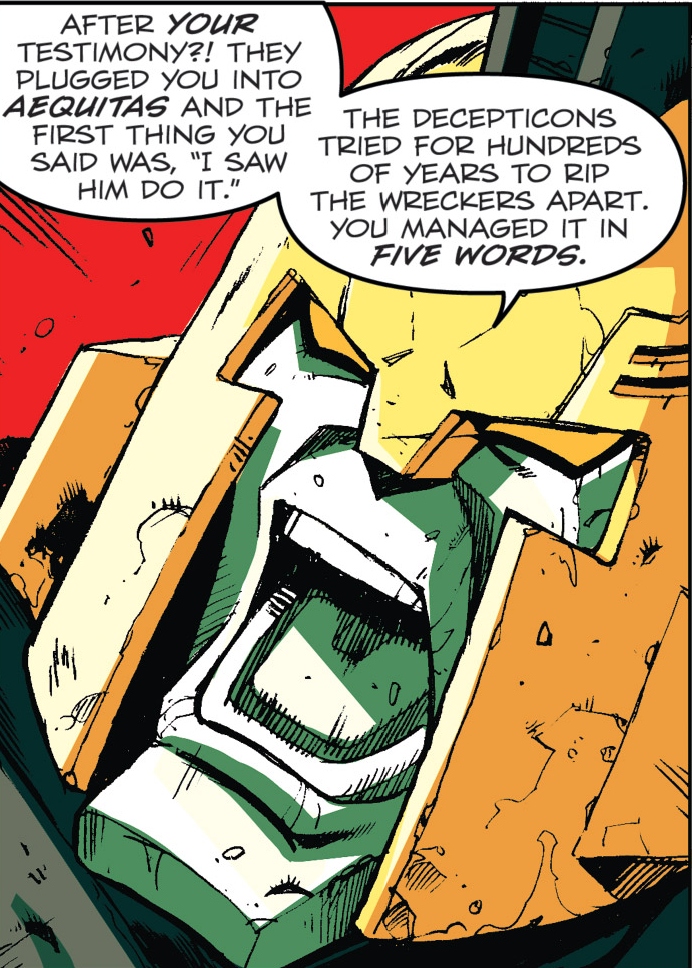
The final issue of the miniseries reveals the truth behind Impactor’s arrest, showing that when the Wreckers battled and captured Squadron X (their Decepticon equivalent) on the planet Pova, the team was ordered to let them go by Prowl, due to a neutrality agreement made with the planet’s inhabitants. Impactor defied orders and executed the defenseless Squadron X in cold blood.6 It’s for this reason that Impactor was arrested, a betrayal cemented by Springer’s courtroom testimony.7
Like with Ironfist, Impactor’s story arc exposes the psychological and moral toll of the Wrecker life, but from the perspective of a veteran member of the team. Impactor had been no stranger to violence within the war, but his demeanor and his actions pose the question of what has become of his moral compass as a result of his life as a Wrecker.
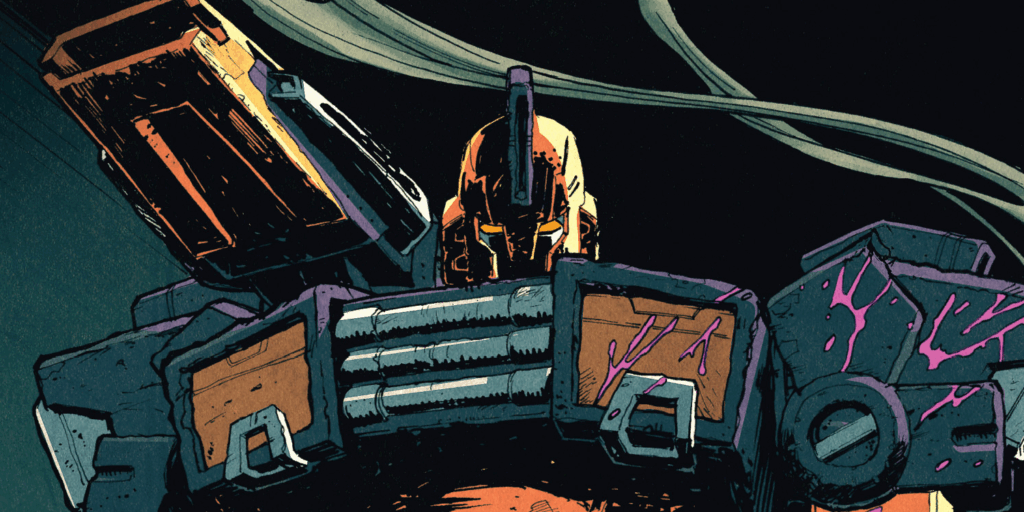
Impactor finds himself consumed by violence. He and the Wreckers spent most of the war tracking Squadron X, obsessed with finding them. When he finds them, he disobeys direct orders and kills them, resulting in his arrest. His actions leave him sentenced to Garrus-9, and throughout his sentence, he still refuses to regret what he did on Pova.
The short story Escape, written and illustrated by Nick Roche with colors by Josh Burcham and letters by HdE, takes place after the events of LSOTW, following Impactor and Guzzle, the only surviving new recruit, on a rescue mission which quickly turns violent.

As Impactor succumbs to violence, he thinks to himself, “Killing them all won’t bring back the dead. But that’s not true. It brings me back.”8 The implications are horrific and tragic for Impactor, signaling that though Impactor escaped Garrus-9, the war never left him. He will never truly be free of the violence that was so prevalent in his time with the Wreckers. He may have survived, but his moral compass may have been the price he had to pay for survival.
‘The Myth Of Heroism’ — When Autobots Commit Atrocities
At the center of Transformers is a wartime narrative. The war between the Autobots and the Decepticons drives the story and characters of Transformers forward, regardless of whether the particular story being told is set before, during, or even after the war. Its presence is an inescapable reality for every character of the franchise.
However, due to the majority of incarnations of the series being intended for children, it seldom comments on the dark morality of war. Though there are some exceptions, for the most part, the series depicts the Autobots as sanitized paragons of justice and the Decepticons as outright evil, with an insatiable urge to dominate all non-organic life.

This makes LSOTW’s willingness to question the morality of its characters, as well as its choices to display the brutality of the war, especially commendable. Though the Wreckers are the series’ protagonists, and they’re on the side of the Autobots, they’re a far cry from the virtuous warriors they’re believed to be.
They engage in extreme acts of violence throughout their missions, no different than the Decepticons they face in Garrus-9. The true nature of their mission is also dubious, as they discover Aequitas on Garrus-9, a supercomputer within the prison which calculates guilt, with the loss of the prison’s command crew meaning the only way to activate it and access its contents is if someone willingly gives up their life.9
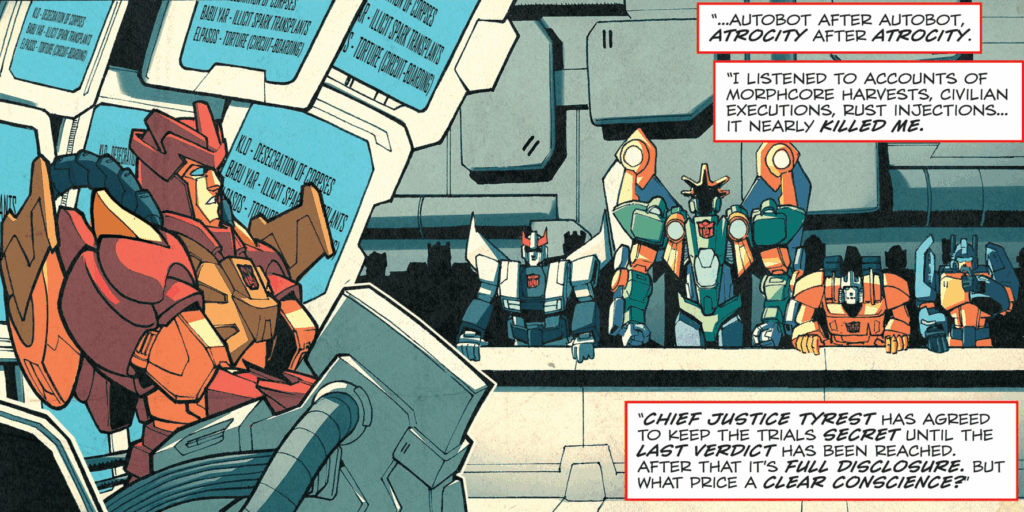
The epilogue of the story, set after the dust settles, reveals both that what the Wreckers were really sent to recover were the trial transcripts from Aequitas, which unearths damning records of Autobot war crimes, buried for the sake of optics and order.10 Additionally, Prowl, the handler of Autobot Intelligence11, reveals that the main reason behind Ironfist’s recruitment was to activate the suicide lock on Aequitas, using Ironfist’s death and manipulating his adoration of the Wreckers, as well as Ironfist’s fear of his own mortality, as the keys for this suicide mission.12
This element of LSOTW recontextualizes both the central mission of the team and what the story says about the morality of the war between the Autobots and Decepticons. By directly calling attention to the fact that trial transcripts reveal Autobot atrocities, the series makes a point of saying that even the “heroes” of the war aren’t so heroic themselves, engaging in war crimes the same as their enemies, or worse in some cases.

It creates a level of nuance in the way Transformers approaches the morality of war, in addition to its presentation of Impactor’s actions as an outright war crime. Whether these characters were so violent before the war, or they learned to embrace it during the war, doesn’t matter. What matters is that even for the heroes, the violence and brutality of the war can make monsters of them.
‘Overlord’s Hollow Crusade’ — Violence Without Reward
The Wreckers are not the only characters who pay a price for their indulgence in violence. Overlord, the main antagonist of the series, also finds himself consumed by violence and getting nothing out of it in return. Overlord is a former Decepticon who deserted during the war over dissatisfaction with being someone else’s weapon.13 He overtakes Garrus-9 and turns it into a twisted combination of an amusement park and a death camp.14
While the purpose behind this is initially unclear, it’s revealed that Overlord has taken over the prison in order to force a confrontation between himself and Megatron, the leader of the Decepticons.15

Ultimately, Overlord’s plan is futile, as Megatron is presumed dead during the events of LSOTW.16 All of the violence Overlord has enacted and partook in on Garrus-9 was simply to get Megatron’s attention, and it ended up being for nothing. Overlord’s realization that he’ll never have the fight with Megatron he dreamed of shatters him, draining him of his will to fight.17
A notable scene occurs earlier in the series, where Overlord frees Shockwave in exchange for correcting a blind spot. As Overlord talks about his plans for Garrus-9, Shockwave interrupts with “You think you’re enjoying this, but you’re not.”18 Additionally, Shockwave calls out Overlord’s machinations as “Hollow theatrics” made just to provoke.19

Similarly to the Wreckers, Overlord pays a price for the violence he partakes in. He commits atrocity after atrocity, all in the name of getting Megatron’s attention, just so he can have the battle he dreamed of. But while he spent years obsessing over this battle, Megatron simply forgot about him and moved on. The obsession he has for this fight consumes him in totality, leaving nothing left. His horrific deeds on Garrus-9, as well as the horrific deeds he encourages others to participate in, are meaningless when the dust settles, because nothing is gained for anyone. His actions on Garrus-9 are entirely hollow, driven by a pathetic hunger for recognition from a warlord who barely remembers him.
‘A War In Color’ — How Art Shapes The Story’s Moral Landscape
Also worthy of praise is the artwork of Nick Roche and Guido Guidi throughout the series, which brings life to James Roberts and Nick Roche’s script. LSOTW is a grim tale, and the artwork complements the narrative’s bleak tone with surgical precision. Each of the characters is given distinctive, clear designs, making it easy to tell each member of the cast apart from one another.
And as this story showcases the horrors of war between the Autobots and the Decepticons, the art makes no attempts to hide how gruesome it can be. The gore and viscera of combat are fully on display, making clear the violence these characters are forced to engage in.

The artwork of the series also accentuates the themes of the writing, specifically the fantasy of war versus the reality of war. When Ironfist is giving a dramatization of what happened on Pova, Josh Burcham’s colors are especially bright, using the color palette of the scene to evoke the image of a Saturday-morning cartoon.20
In the sanitized version of the story, it’s a more traditional narrative about good and evil, with honorable heroes and villainous scoundrels. In that regard, it’s a deliberate echo of the glossy, sanitized heroism typical of Saturday morning cartoons. When the narrative reveals what really happened at Pova, Burcham colors the scene completely differently.

The sun and clear skies of the false story are replaced with dark clouds and rain, giving the truth a much darker image.21 The heroes of the story are much darker, ending with Impactor’s execution of Squadron X.22
The artwork of the series, specifically Burcham’s coloring of these two segments, demonstrates the themes of the series, acting as a microcosm of those themes. War and violence are never as glamorous as stories make them appear, and the reality of them brings out the worst in people.
Transformers: Last Stand Of The Wreckers (2010)– A Children’s Franchise With Adult Consequences
Despite its association with a children’s franchise, Transformers: Last Stand of the Wreckers is a mature, introspective examination of violence and the cost of war. It understands the beating heart of the Transformers franchise as a wartime narrative and explores the consequences of that setting within its characters. Ironfist, Impactor, and Overlord, as well as the remaining cast, are all changed for the worse by the war and the violence they partake in.

Moreover, Last Stand of the Wreckers looks at the black-and-white morality within most Transformers stories and does away with it, not hesitating to illustrate the darker side of the Autobots and how the “heroes” of the war can be driven to do unheroic deeds.
Supporting all of this is the artwork of the series, which unflinchingly makes clear that war is hell, while also making clever use of color to demonstrate the themes of the series. Within the history of Transformers comics, Last Stand of the Wreckers stands as one of the finest entries into this long-running franchise.
Footnotes
- Roberts, James and Roche, Nick. Transformers: Last Stand of the Wreckers. IDW Publishing, 2012. ↩︎
- Roberts, James and Roche, Nick. Transformers: Last Stand of the Wreckers. IDW Publishing, 2012. ↩︎
- Roberts, James and Roche, Nick. Transformers: Last Stand of the Wreckers. IDW Publishing, 2012. ↩︎
- Roberts, James and Roche, Nick. Transformers: Last Stand of the Wreckers. IDW Publishing, 2012. ↩︎
- Roberts, James and Roche, Nick. Transformers: Last Stand of the Wreckers. IDW Publishing, 2012. ↩︎
- Roberts, James and Roche, Nick. Transformers: Last Stand of the Wreckers. IDW Publishing, 2012. ↩︎
- Roberts, James and Roche, Nick. Transformers: Last Stand of the Wreckers. IDW Publishing, 2012. ↩︎
- Roberts, James and Roche, Nick. Transformers: Last Stand of the Wreckers. IDW Publishing, 2012. ↩︎
- Roberts, James and Roche, Nick. Transformers: Last Stand of the Wreckers. IDW Publishing, 2012. ↩︎
- Roberts, James and Roche, Nick. Transformers: Last Stand of the Wreckers. IDW Publishing, 2012. ↩︎
- https://tfwiki.net/wiki/Prowl_(G1)/2005_IDW_continuity ↩︎
- Roberts, James and Roche, Nick. Transformers: Last Stand of the Wreckers. IDW Publishing, 2012. ↩︎
- Roberts, James and Roche, Nick. Transformers: Last Stand of the Wreckers. IDW Publishing, 2012. ↩︎
- Roberts, James and Roche, Nick. Transformers: Last Stand of the Wreckers. IDW Publishing, 2012. ↩︎
- Roberts, James and Roche, Nick. Transformers: Last Stand of the Wreckers. IDW Publishing, 2012. ↩︎
- Roberts, James and Roche, Nick. Transformers: Last Stand of the Wreckers. IDW Publishing, 2012. ↩︎
- Roberts, James and Roche, Nick. Transformers: Last Stand of the Wreckers. IDW Publishing, 2012. ↩︎
- Roberts, James and Roche, Nick. Transformers: Last Stand of the Wreckers. IDW Publishing, 2012. ↩︎
- Roberts, James and Roche, Nick. Transformers: Last Stand of the Wreckers. IDW Publishing, 2012. ↩︎
- Roberts, James and Roche, Nick. Transformers: Last Stand of the Wreckers. IDW Publishing, 2012. ↩︎
- Roberts, James and Roche, Nick. Transformers: Last Stand of the Wreckers. IDW Publishing, 2012. ↩︎
- Roberts, James and Roche, Nick. Transformers: Last Stand of the Wreckers. IDW Publishing, 2012. ↩︎