

Table of Contents Show
It is Monday night — March 13, 2013. You settle on the couch, the weekend still hanging on, the TV already glowing. Teen drama stories tend to build that kind of weekly rhythm — watching, waiting, returning. The room stays dim except for the screen as The Lying Game (2011-2013), right after last week’s chaos: the twins pushed into truth, relationships fracturing, and Theresa found dead in the pool.1 But nothing resolves cleanly. It rarely does.
This episode picks up as if nothing had paused. Characters drift in the aftermath of last week’s collapse, still circling unresolved tensions and shifting allegiances. Rebecca remains threaded through every complication without ever fully coming into focus.1
But the pacing quickly tightens, stacking storylines until they start to buckle. Alec falls through the glass3 — sudden, disorienting — then cuts to black. Credits roll, not as closure, but as a form of interruption: the feeling of a story stopped mid-motion.

You don’t move right away. Then you’re searching for answers — when the next episode airs, whether the story continues. There aren’t any. Forums fill the gap, speculation circulates, but nothing resolves.2 Eventually, it becomes official: cancelled.3 No continuation.
And that’s what it becomes: not an ending, but a cutoff point — something that halts mid-trajectory and never returns to complete itself. A narrative that stops without resolution, leaving behind momentum without closure.
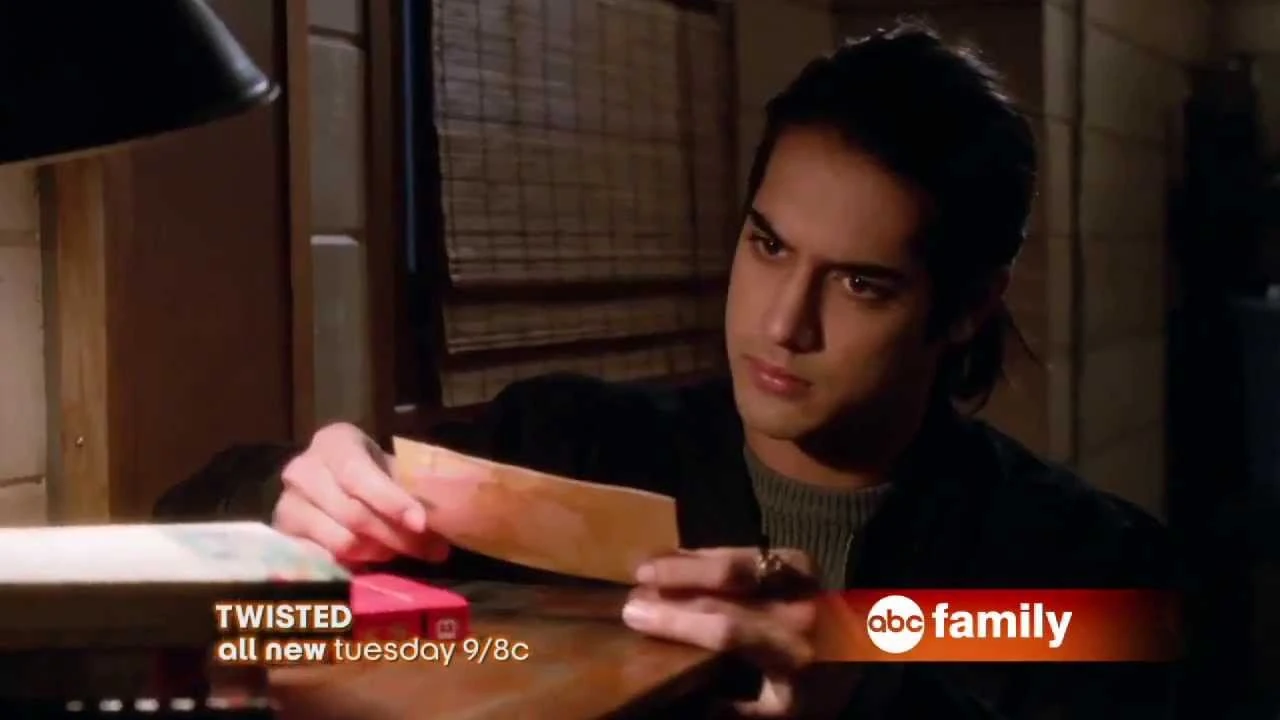
What feels like an isolated moment of disappointment is actually part of a broader pattern in teen drama television, where serialized stories are often interrupted before they can reach completion.4 It isn’t unique to this series; shows such as The Lying Game sit within a larger structure of teen drama stories built on long-form arcs that frequently outlast the support required to finish them.
A Pattern Across Teen Drama Television
The Lying Game isn’t an isolated case — it sits within a broader pattern of teen drama stories built on long-form serialized storytelling that often never reaches completion.6 Teen drama series like these are structured around unfolding mysteries, relationships that develop across seasons, and cliffhangers designed to sustain weekly investment.5 Yet that same structure makes them especially vulnerable to early cancellation, because there is no built-in stopping point — only interruption.
Twisted (2013-2014) moves like a story that never lets the viewer catch their breath. Everything is built around a single, tense mystery (Danny’s murder and the question of who can actually be trusted)6 but every answer shifts the shape of the question itself. Each revelation reorders the relationships around it, turning friends into suspects and familiarity into instability, so that even moments of clarity feel provisional rather than final.

What drives the series isn’t resolution, but deferral. The narrative keeps pushing forward as if the next answer will finally stabilize everything, but instead, it continuously reopens what viewers thought had already been understood. Truth remains in motion — always arriving, but then never fully arriving at all. In that structure, the tension is not only who did it, but the sustained condition of not being allowed to know.
Recovery Road (2016) operates on a different rhythm, but the same interruption of closure remains. Instead of mystery, the show is built around recovery as a process that never settles into permanence. Progress is continually made and undone (relapse and rebuilding folded into the same narrative motion) so that stability is never a final state, only a temporary condition.
The series keeps pushing toward answers, but every revelation only destabilizes things further. Instead of resolving tension, the story continuously reopens it, stretching the mystery forward in a way that depends on continuation to fully pay off.7
Across these shows, the details shift, but the underlying structure remains consistent. Different settings, different tonal registers, different narrative styles within teen drama television — yet the same pattern recurs: stories designed to extend forward are cut off before they arrive anywhere final.7 Always mid-arc. Always just short of resolution. Always leaving viewers suspended in the space where continuation should have been.
How Fans Keep Unfinished Stories Alive
There is a consistent response that follows the cancellation of these types of shows. Viewers do not turn away from the narrative so much as toward each other, constructing spaces where the story can continue in the absence of official continuation.8 Across platforms, this takes different forms, but the underlying behavior remains the same: an attempt to extend, reconstruct, or preserve narratives that have been cut off.
One form this takes is narrative reconstruction. Discussion threads, especially on Reddit, become spaces for unresolved analysis — episode explanations, timeline breakdowns, and theories about what might have happened next. Fan wikis remain active long after cancellation, maintained as if the narrative is still unfolding, preserving continuity that the show itself no longer provides. In these spaces, viewers treat gaps not as closure, but as material to be filled.
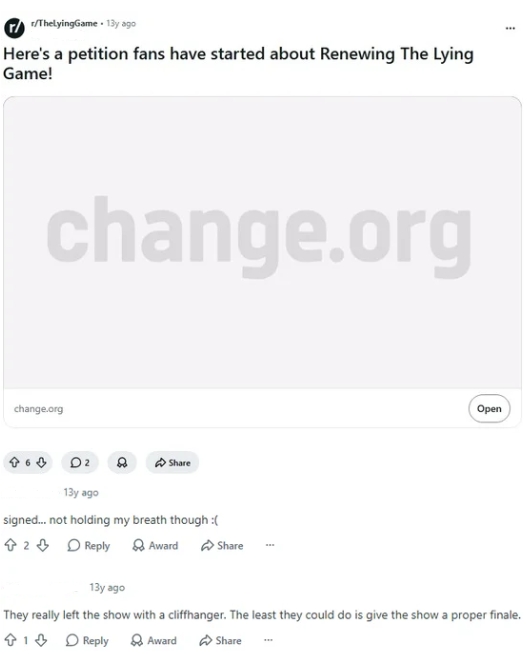
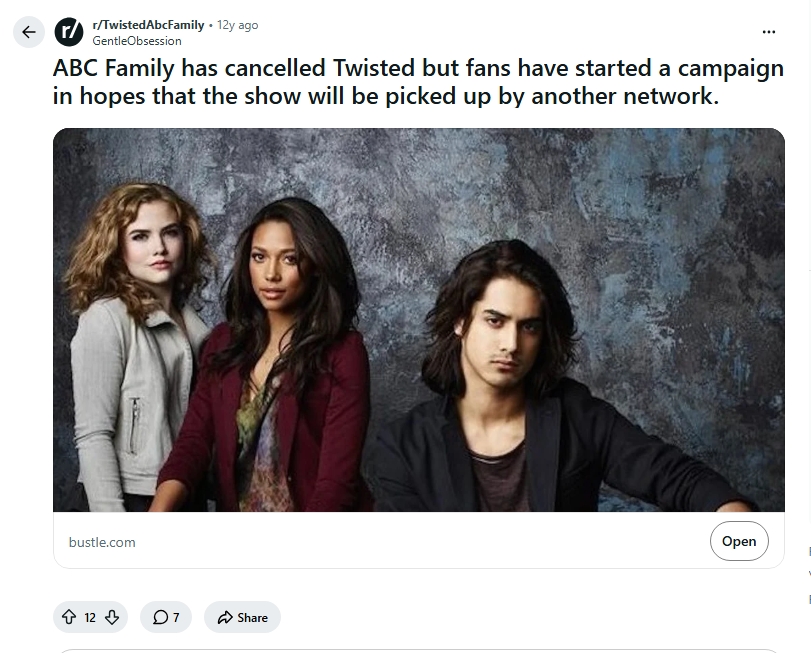
Another form is cyclical reactivation. Petitions and revival campaigns circulate in response to cancellation, attempting to move the show back into production or transfer it to another network.9 In these cases, engagement shifts from interpretation to action, as viewers respond to the narrative interruption with efforts to reverse it. Even when networks announce cancellation framed with resignation, these campaigns reflect a refusal to accept the finality of structural cutoff.
Another part of the cycle is rediscovery. On platforms like X (formerly Twitter), conversations resurface periodically as new viewers encounter the same shows for the first time. The cycle repeats across time: discovery, investment, cancellation, re-engagement. What was once a concluded narrative becomes periodically reactivated through new audiences encountering the same unresolved endings.
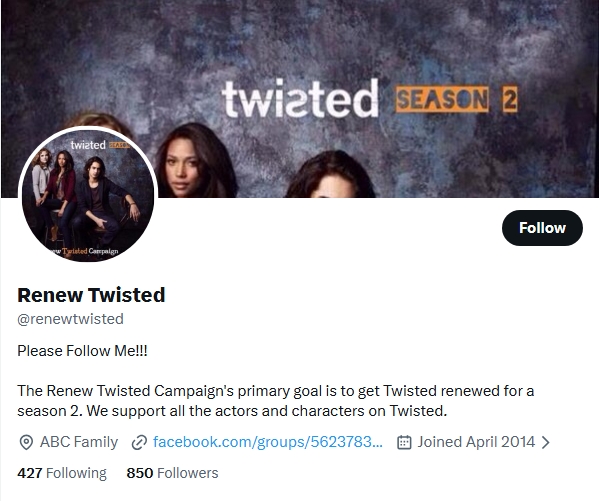
Across these forms, the behavior remains structurally consistent. Whether through reconstruction, intervention, or recurrence, viewers are engaged in the same underlying process: extending narratives beyond their official endpoints. The cancellation does not mark an ending so much as a redistribution of the story into informal, ongoing circulation (Reddit threads, Fanfiction, etc.).
It is not only frustration that drives this response. It is a mode of continuation without permission — a way of sustaining narratives that were structurally interrupted. Across platforms and across time, viewers construct alternative spaces where unfinished stories remain active, even after they have ceased to exist in any official form.
The Business Logic Behind Cancellation
A significant part of this pattern comes down to how these shows are evaluated. Teen dramas like The Lying Game, Twisted, and Recovery Road are built on long-form storytelling — slow narrative accumulation, ongoing mysteries, and relationships designed to develop across multiple seasons.7 But networks make decisions in real time, guided by ratings, viewership trends, production costs, and shifting programming priorities.10 As a result, a series can be structurally mid-arc while already being assessed as something unlikely to continue.7
When performance metrics fall below expectations, the narrative is no longer granted the temporal space it was designed for.15 Instead of a planned conclusion, there is a cutoff point that arrives before the story has resolved. What was constructed as a multi-season arc is compressed, interrupted, or halted entirely, regardless of where the internal structure of the story stands.15

This is compounded by broader shifts in teen drama television throughout the 2010s; teen drama programming rapidly cycled through concepts, responded to short-term trends, and prioritized new programming over sustaining existing series.11 During the 2010s, networks increasingly shifted toward lower-risk programming formats, including reality television and syndicated reruns.
MTV’s programming rotation, becoming heavily dominated by Ridiculousness12 (2011-2026), became one visible example of that broader shift, where inexpensive, repeatable programming often replaced serialized teen drama series that required long-term narrative investment. Within that system, continuation is conditional rather than guaranteed — even when the narrative architecture clearly assumes it.16
The pattern, then, is not incidental. It is structural. These teen dramas are written for long-term continuity, but they exist within an industrial framework that does not consistently support it.
The Legacy Of Unfinished Narratives
Even after the shows disappear, the attachment doesn’t really shut off. The Lying Game, Twisted, and Recovery Road don’t fully become “old shows” in the way completed series do. They become something else: stories that are still mentally active, still being revisited, still being searched for answers they were never allowed to give.13 Viewers don’t just remember them — they keep interacting with them, trying to fill in gaps that were never resolved on screen.14

That lingering feeling is part of what makes these cancellations stick. There’s no final episode to close things out cleanly; no sense of completion that lets the story settle into the past. Instead, the narrative stays open-ended in the viewer’s mind, even when the show itself has stopped existing in any official way.

Over time, that creates a different kind of relationship to television — one where endings feel conditional, and investment always carries the possibility of interruption.7 Over time, that creates a different relationship to teen drama television — one where endings feel conditional, and investment always carries the possibility of interruption. Shows like The Lying Game, Twisted, and Recovery Road were built to keep unfolding. What made their cancellations so frustrating was not simply that they ended, but that they disappeared before the story (and the audience investment within it) was ever allowed to fully resolve.
Footnotes
- “ABC Family Twisted Episode Guide.” Fandom ↩︎
- “Spring Finale Speculation Thread.” Reddit ↩︎
- “The Lying Game: Cancelled by ABC Family; No Season Three.” TV Series Finale ↩︎
- “List of Teen Dramas.” List of Teen Dramas Wiki, Fandom ↩︎
- “Serialized Storytelling for Film & Television.” Fiveable. ↩︎
- “Twisted Episode Guide.” Fandom ↩︎
- “Recovery Road Episode Guide.” Fandom ↩︎
- “I Miss Twisted.” Reddit ↩︎
- “Save The Lying Game Petition.” Change.org ↩︎
- “TV Ratings Explained: Impact, Methods, & Uses.” SparetimeTV. ↩︎
- “How Did We Go from ‘ABC Family’ to ‘Freeform’?” Disney Examiner. ↩︎
- Ridiculousness. IMDb ↩︎
- “What Is Participatory Culture?” Selected Reads ↩︎
- “Fan Theory Discussion.” Reddit. – Reddit ↩︎