

Table of Contents Show
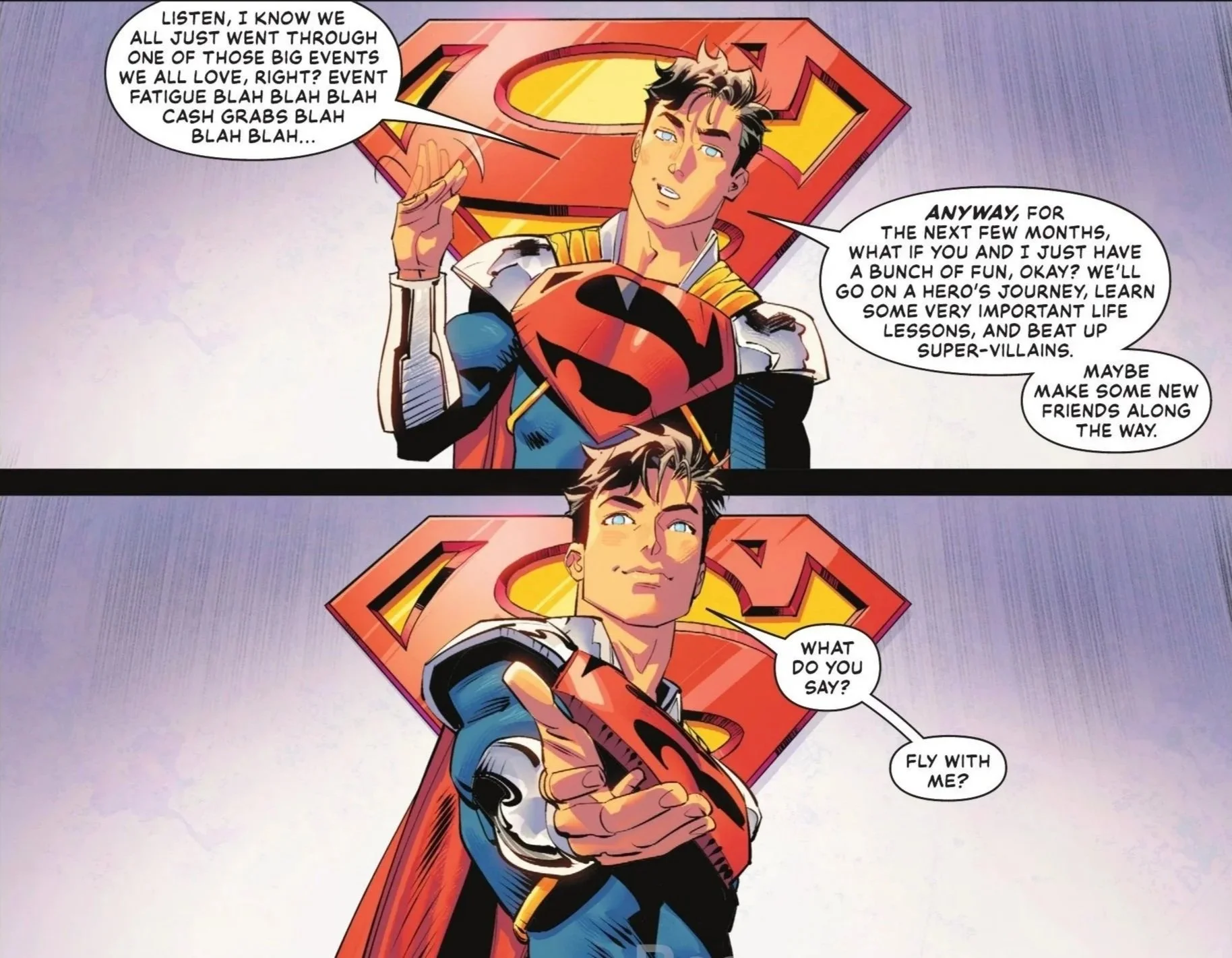
Forty years ago, DC Comics introduced Superboy-Prime, a young hero from a universe that was almost exactly like the real world. On this Earth-Prime, the likes of Superman and Batman were merely comic book characters. After years of villainy, Superboy-Prime has taken Superman’s place as the Man of Metropolis as a part of DC Comics’ Reign of the Superboys event.

Whether it be his debut in Crisis on Infinite Earths (COIE), his villainous turn in Infinite Crisis, or his ongoing redemption arc, Prime’s story has always been a reflection of fandom. As the character faces the challenges of rehabilitation, fans can look at him and see how they can change themselves.
Grant Morrison once said that Superman faces the same issues that we do, but on a “Paul Bunyan scale.”1 Superboy-Prime’s mistakes are certainly on a much larger scale than the average person’s, but his story models how anyone can make serious errors and work to make things better.
Superboy-Prime’s History As A Fan
Prime first appeared in DC Comics Presents #87. Though he didn’t display the same passion for comics that he has in modern stories, Prime demonstrated familiarity with characters ranging from Green Lantern to Lori Lemaris the mermaid. After meeting Superman, his disbelief at the news of Supergirl’s death is rooted in the typical trappings of the superhero genre.

Prime was a fan at heart, and he got to live out every fan’s dream: to be a superhero that fights alongside the rest of the DC pantheon. He felt promised that he would grow up to be Superman. But Prime’s dream turned into a nightmare after the Anti-Monitor destroyed his world along with the rest of the multiverse. After COIE, the five remaining universes were combined into one, and Prime was stuck in a pocket dimension with the Superman and Lois Lane of Earth-2 and Alexander Luthor Junior of Earth-3.
Prime grew bitter in his isolation as he came to view this New Earth as dark and corrupted. His grievances echoed those of fans who were upset at how grim and violent stories had become during the Modern Age of comics. However, Superboy-Prime’s rage at stories like Identity Crisis lacked the substance of a thoughtful critique. Instead, he relied on vague justifications about how this wasn’t what comics were like when he was a kid.

No work of fiction is beyond critique, but Prime embodied a specific type of criticism. His time in the pocket dimension returned him to his pre-COIE position, as a fan watching the stories play out. The shift in tone that he witnessed was exactly the same that real fans saw.
A Toxic Superfan
By the time Infinite Crisis was being written, angry fans could use the internet to wax nostalgic about how everything went downhill after the creation of the New Earth. Superboy-Prime went from being the kid picking up issues of COIE as they came out to the jaded fan who judges every work by how similar it is to that of their youth.
Prime’s lethal rampage in Infinite Crisis was fueled by his desire to reset the universe to a nostalgic, simpler time. The reasoning for his anger was linked to that of upset fans. As such, his villainous turn reflected the darker side of fandom culture; this is the side that sends death threats to creators or harasses people online for not sharing their opinions. When Prime fought the heroes in Infinite Crisis #4, some of his biggest emotional reactions come from being called stupid. His behavior matched someone in a flame war rather than a battle to the death.

It wasn’t until The Sinestro Corps War that Prime first showed his deep childhood love for comics. Flashbacks establish that Prime, like many real fans, felt the need to hide his hobby as he grew older.2 In the present day, he still had the desire to be Superman, but he had completely lost what it meant to be like Superman.
Most of Superboy-Prime’s appearances post-Infinite Crisis concerned his mission to annihilate what he views as untrue to the stories of his youth and find his “perfect world.” It’s in this disturbing trend that Prime makes the first of his now trademark fourth-wall breaks, telling the reader how he plans to brutally murder members of the Legion of Superheroes.
Prime’s mission comes to an end when he is returned to the reconstructed Earth-Prime, only to learn that his loved ones observed all of his atrocities through the very comic books that he appeared in. The final pages of the story depict Prime as a basement-dwelling, vegetable-hating internet troll.3 He had fully become a caricature of a disgruntled DC fan.
Prime’s Second Chance
Though a return to Earth-Prime was his goal for years of publication history, Superboy-Prime’s redemption did not start there. When he first got home, his insecurity and fear led to him using his powers to murder his frightened best friend Laurie and hold his parents captive. It took an encounter with a Black Lantern Alexander Luthor for Prime to begin reflecting on his actions.
“Others find hope and inspiration between these pages. They find a community to belong to. But you’re not like the others. You claim ownership, but you have no control. And you hate what you can’t control. Including the things you love. Things like Laurie.”4
Superboy-Prime defeated the Black Lanterns, but he was unable to accept responsibility for his actions. Instead, he blamed the creatives that “forced” him to hurt people. His self-loathing was unhealthy and avoidant, but it was an acceptance of wrongdoing.

Though Prime would appear as a villain again, he had at least taken this moment to recognize how far he had strayed from the path paved by the heroes he loved.
Prime’s New World
Superboy-Prime had his true change of heart in the pages of Dark Nights Death Metal. The event saw Prime achieve the other half of his old mission: The creation of a world of black and white morality filled with Silver and Bronze Age heroes.5 His choice to abandon this world and join forces with Wonder Woman, Superman, and Batman to fight against the villainous Batman Who Laughs was motivated in part by a desire to be like Superman, but also by a growing apathy toward the stories he used to love.
His years of villainy had brought him nothing but ruin. When he finally got the worlds he wanted, they were disappointments. Prime’s fatigue at the ever-shifting nature of DC continuity left him feeling that everything was meaningless. He had no reason to be a villain anymore because he couldn’t see the reason to do anything.

As scores of heroes and villains waited for the final battle, Prime was isolated from both. The only one to approach him was Krypto the Superdog. Even as Prime played the part that the others expected from him, Krypto stayed. Prime softened, and reached out to pet the dog.
“I remember the first story I read about you…”6
This moment between a boy and a dog gave the pathos to Prime’s arc in the issue. Twice before, Krypto and Superboy-Prime had met and fought; first so Krypto could protect Conner Kent, and again to avenge his death. This small bit of forgiveness, especially from a character that was in publication before Prime’s debut, allowed Superboy-Prime to temporarily drop the facade of the angry, violent young man. Someone he had hurt believed he was able to change.
His redemption didn’t truly begin until he got the opportunity to destroy the world and rebuild Earth-Prime again or become a beloved hero. Instead, Prime chose to sacrifice himself in order to give the others a fighting chance. He had seen that he couldn’t force people to love him. With Krypto at his side, Superboy-Prime chose to give up his life, at last understanding that he could never get back the childhood he yearned for.

However, Prime woke up in his childhood bedroom rather than the afterlife. Earth-Prime was reborn once more, and Superboy-Prime was once again the only person with superpowers. With this blank slate, Prime could finally begin taking steps toward true redemption.
Superboy-Prime reappeared in Superman #28 fully committed to rehabilitation. He played a crucial role in rescuing Booster Gold and defeating Darkseid, albeit temporarily. Ultimately, Prime’s redemption arc was strengthened by the lessons he still had to learn.
“Prime Time” — Superboy-Prime Takes Over As The Man Of Steel
In the aftermath of DC K.O., Superman went missing, and Superboy-Prime adopted the task of protecting Metropolis and Earth. Joshua Williamson’s run on Superman has been very interested in themes surrounding redemption. Villains like Silver Banshee, Parasite, Doomsday, and even Lex Luthor himself were all given the opportunity to change their ways, to varying degrees of success.
What’s crucial about Prime’s ongoing arc is that it demonstrates how making amends can be difficult. The presence of Power Girl underscores how not everything can be forgiven, but that doesn’t mean one shouldn’t still try to be the best version of themselves that they can be. Prime can never make up for murdering Power Girl’s cousin,7 but he can still try to be more like Superman.
Mr. Terrific stressed to Lois Lane that people still remember all the things that Prime did, meaning he isn’t welcome on the Justice League’s Watchtower.8 The ethos of “forgive and forget” can’t be applied in every situation. Prime can attempt to better himself while accepting that he cannot earn everyone’s trust back. None of his crimes have been forgotten, but his efforts to change are still framed as meaningful.
Further complicating the matter is Prime’s own troubled instincts. In his ongoing arc, Prime has seen flashes of the brutal ways he could murder the villains he faces. It’s unclear whether this is his imagination or the work of the telepathic villain Manchester Black who appeared at the end of Superman #36. Regardless, these moments of inner conflict reinforce the idea that redemption is a continual active choice, one easy to slide back on.
Superboy-Prime’s team-up with Damian Wayne, AKA Robin, in Superman #37 supported this aspect of redemption. Damian outright explained the importance of trying to be better every day after Prime asked him for advice about how to improve his reputation.

Much of Robin’s checkered past can be more easily forgiven than Prime’s because of his age and upbringing, but neither has had a straightforward road to redemption. Damian has stumbled at times, yet he still aspires to Batman’s example. Prime may stumble in the future, and he has a long path ahead of him. The important thing is that when he makes those mistakes, he keeps trying.
The little choices that Prime made serve this narrative as well. He chose to go by CK, allowing his name to tether him to his humanity. This comes in stark contrast to his previous rage at being called Clark when Superman tried to get through to him.9 Prime’s dedication to his responsibilities as a genuine hero and his newfound civilian life are the marks of a character that is explicitly trying to be more like Superman. But this character is more than just that; he’s a fan.
Redemption Is Possible
People can hurt the things they love. Everyone has done or said something they wish they could take back, and sometimes those things can be incredibly serious. Humans are imperfect and make mistakes, but they don’t have to be defined by them.
Superboy-Prime’s redemption arc is exactly that kind of human story, just on the same cosmic scale as Superman’s problems. Prime at his worst reflected the darkest side of comic book fandom, but his actions were exaggerated far beyond what any fan is capable of. Now, Superboy-Prime can represent a different aspect of comic book fans: the part that’s trying to be like Superman.

This may be unsatisfying to people who want Prime to face accountability for his actions. Accountability is important, but things get muddy when someone is making a genuine effort to change and do good. The world of the DC Universe is a better place because Prime has been allowed to act as a superhero again, but that can be cold comfort for all of his victims and their loved ones.
Prime has not been absolved of the dozens of murders he has committed. Rather, he offers readers a chance to look to a figure who has not been forgiven but still tries to improve. People’s mileage may vary on the legitimacy of Superboy-Prime’s rehabilitation, but the story opens the door for that conversation.
No one can change the past, but they can work toward a better tomorrow. CK still must face the reality and consequences of his actions while he strives for improvement. Superman stories have always been about kindness, compassion, and championing the oppressed. At times, it may seem like living up to Superman’s standard is impossible. In Superboy-Prime, readers can find a mirror to gaze into. He’s a fan who has made horrible mistakes, but he can try to be better. He can keep trying every day, even when he fails. His story connects to audiences, not just as fans, but as people.

Atonement isn’t easy. Prime’s arc can remind readers to not only see themselves in CK, but others as well. Just as Prime has received grace from the Justice League and given grace to villains like the Absolute Lightning Lad and the Royal Flush Gang, fans must be willing to give grace to those that make the effort to be better.
Forty years ago, Superboy-Prime let fans see themselves join the fight against evil. Twenty years ago, he became a twisted reflection of those same people. Now, Prime can show them that the promise made to him was true. Everyone can be Superman.
Footnotes
- “The Super Psyche.” Playboy Magazine, May 2012. ↩︎
- Johns, Geoff. “Tales of the Sinestro Corps: Superman-Prime #1.” Into the Sun. DC Comics. 24 Oct. 2007. ↩︎
- Johns, Geoff. “Final Crisis: Legion of 3 worlds #5.” Legion of 3 worlds. DC Comics. 22 July 2009. ↩︎
- Johns, Geoff. “Adventure Comics #5.” He Primed Me Part Two: Flame War. DC Comics. 9 Dec. 2009. ↩︎
- Snyder, Scott. “Dark Nights: Death Metal #4.” Death Metal An Anti-Crisis Part IV Shot in the Dark. DC Comics. 13 Oct. 2020. ↩︎
- Johns, Geoff and Scott Snyder. “Dark Nights: Death Metal The Secret Origin #1.” Secret Origin. DC Comics. 22 Dec. 2020. ↩︎
- Johns, Geoff. “Infinite Crisis #7.” Infinite Crisis Finale. DC Comics. 3 May 2006. ↩︎
- Williamson, Joshua. “Superman #36.” Prime Time Part One. DC Comics. 25 Mar. 2026. ↩︎
- Johns, Geoff. “Final Crisis: Legion of 3 worlds #3.” Legion of 3 worlds. DC Comics. 4 Feb. 2009. ↩︎